Global financial markets faced mixed yet broadly downward momentum this week, driven by a toxic mix of escalating geopolitical tensions in the Middle East, growing investor skepticism over overinflated artificial intelligence (AI) sector investments, and fresh uncertainty around U.S. monetary policy.
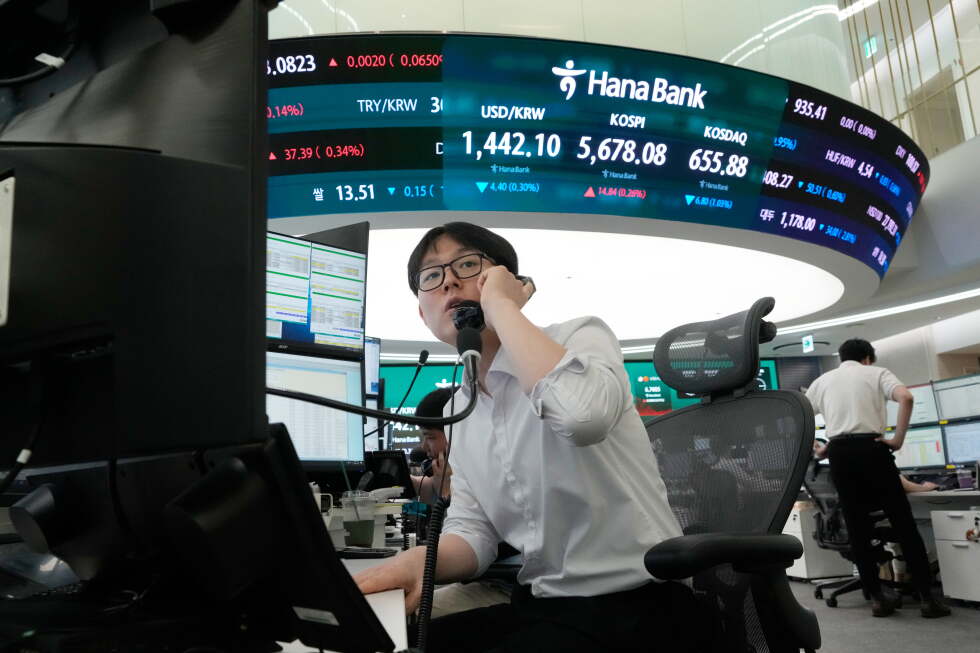
The most dramatic movement has unfolded in South Korea, where the benchmark Kospi index has plunged into a steep correction after months of double-digit gains fueled by the global AI boom. By Thursday morning trading, the index dropped 1.3% to 5,587.82, extending steep losses from the prior two sessions that saw it fall 10.8% on Tuesday and nearly 6% on Wednesday. From its all-time high above 9,000 hit in June, the Kospi has corrected more than 35%, though it still holds a roughly 30% gain for the year to date. The sharp pullback has been widely interpreted by market analysts as a reflection of broadening doubts over the massive capacity expansion investments being poured into AI by the world’s largest technology firms.
Individual South Korean tech stocks delivered mixed results despite strong earnings reports. Samsung Electronics climbed 2.4% after posting a record quarterly operating profit that matched consensus analyst estimates. However, top memory chipmaker SK Hynix dropped 4% on Thursday, after plummeting more than 9% a day earlier. Even though SK Hynix reported a sixfold jump in quarterly operating profit to a new record, the results fell short of market expectations, triggering a wave of profit-taking from disappointed investors.
Elsewhere across Asian markets, performance was uneven. Japan’s Nikkei 225 bucked the downward trend to gain 0.6% to 61,778.02, even as SoftBank Group — a major investor in OpenAI — fell 2.7%. Chip sector stocks led gains in Tokyo: chip equipment manufacturer Tokyo Electron rose 4.4%, while memory chip producer Kioxia Holdings added 7.5%. Taiwan’s Taiex index, another market that has surged on the back of the AI boom, also advanced 0.8%, with leading contract chipmaker Taiwan Semiconductor Manufacturing Company (TSMC) climbing 1.8% in intraday trading.
Major East Asian indexes mostly closed lower. Hong Kong’s Hang Seng Index slipped less than 0.1% to 25,779.70, while mainland China’s Shanghai Composite Index dropped 1.2% to 3,784.55. Australia’s S&P/ASX 200 fell 0.9% to 8,959.90, and India’s Sensex posted a marginal gain of less than 0.1%.
Oil prices retreated on Thursday despite renewed hostilities between the U.S. and Iran that have threatened global energy supply chains. The pullback came after the U.S. launched a “heavy wave” of airstrikes on Iranian targets this week, in response to an earlier Iranian attack on a U.S. military base in Jordan that killed three American service members. Maritime traffic through the Strait of Hormuz — a critical chokepoint that carries roughly a fifth of global daily oil consumption — remains constrained, which has put ongoing upward pressure on supply. Brent crude, the global benchmark for oil prices, fell 1% to $87.18 per barrel on Thursday, after spiking sharply in the prior session. U.S. benchmark West Texas Intermediate crude declined 0.9% to $83.74 per barrel. For context, both benchmarks traded around $72 per barrel in late February before the latest escalation of regional conflict.
On Wednesday, U.S. equities extended the global pullback, with all three major indexes closing in negative territory. The broad S&P 500 dropped 1.5% to 7,316.15, the Dow Jones Industrial Average fell 2.2% to 51,594.14, and the technology-heavy Nasdaq Composite declined 1.7% to 24,442.94. Top AI and chip stocks led the losses: Nvidia shed 3.6%, Advanced Micro Devices (AMD) fell 5.5%, and Broadcom dropped 2.8%. U.S. futures ticked higher in early Thursday trading following Wednesday’s sell-off.
The sell-off on Wall Street came shortly after the Federal Reserve announced it would hold interest rates steady at its latest monetary policy meeting, though the decision carried unexpected hawkish undertones. Several voting members of the Federal Open Market Committee pushed for a rate hike at the meeting, a shift that surprised investors who had widely anticipated rate cuts would begin in the first half of 2025. Fed Chair Kevin Warsh reaffirmed the central bank’s commitment to bringing annual inflation back down to its 2% target, after years of above-target price increases. He also confirmed the Fed would continue its current approach of providing less forward guidance to markets about upcoming rate moves, a policy that has increased uncertainty for investors. “Did the Fed take an explicit change in its policy rate today? No, but I think that’s the beginning of the story,” Warsh told reporters during a post-meeting news conference.
In the U.S. bond market, the yield on 10-year Treasury notes rose to 4.70% on Wednesday, up from 4.61% the prior session, reflecting shifting rate expectations. In currency markets early Thursday, the U.S. dollar edged higher against the Japanese yen, rising to 163.49 yen from 163.41 yen. The euro slipped slightly to $1.1454, down from $1.1467 against the greenback.