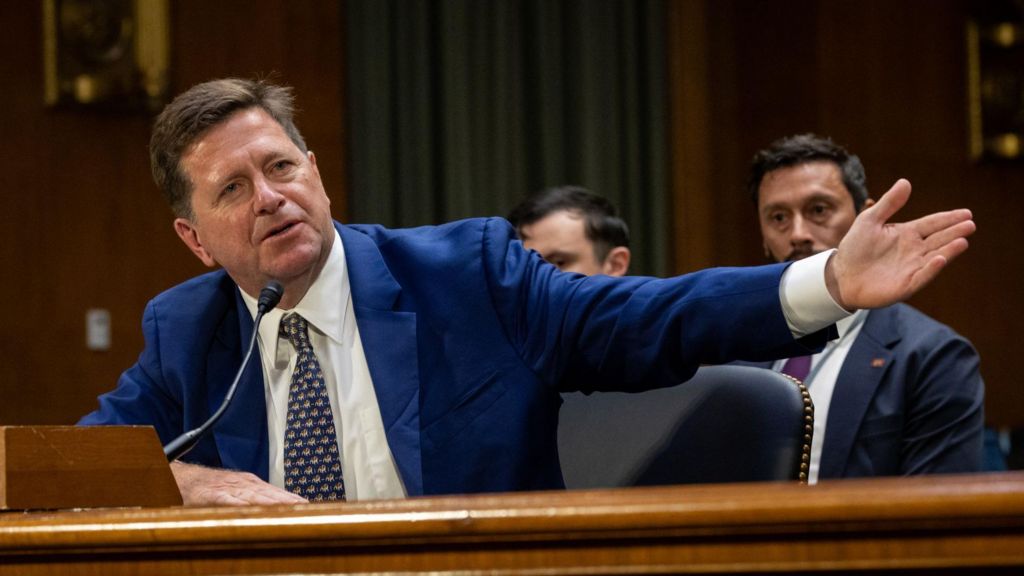
In a move that resolves weeks of political uncertainty over the top U.S. intelligence leadership post, the United States Senate has formally confirmed Jay Clayton as the nation’s next Director of National Intelligence, advancing President Donald Trump’s second pick for the role after his original nominee was rejected by bipartisan lawmakers.
The final vote on Tuesday concluded with a narrow 51-49 margin in favor of Clayton, who will step into the role previously held on an acting basis by Bill Pulte. Pulte, a Trump loyalist who first took the interim post when former DNI Tulsi Gabbard departed the agency last month, drew fierce cross-partisan backlash shortly after his June appointment. Critics quickly raised red flags over Pulte’s total lack of national intelligence experience—his prior role was a federal housing regulator—and his controversial actions in that position, where he referred multiple of Trump’s political opponents for potential criminal prosecution and oversaw sweeping agency staffing cuts. Just hours before Clayton’s confirmation vote passed, Pulte took to social media platform X to announce he was implementing a fifth and near-final round of layoffs, bringing total staff reductions to roughly 30% from just a few weeks prior.
Following the widespread bipartisan alarm over Pulte’s appointment, Trump quickly pivoted and nominated Clayton, a veteran federal law enforcement official with deep experience in high-profile national security and regulatory cases. Before being tapped for DNI, Clayton served as the U.S. Attorney for the Southern District of New York, where he led a number of high-stakes investigations, including a major drug trafficking prosecution against former Venezuelan President Nicholas Maduro. A former federal prosecutor and U.S. securities regulator, Clayton brings a decades-long record of public service in law enforcement to the intelligence role.
President Trump voiced his full support for Clayton immediately after the confirmation vote, writing on his social media platform Truth Social that “Jay is outstanding in every way, and will do a spectacular job as Director!” The path to confirmation was not entirely smooth, however: Trump originally called off Clayton’s first scheduled confirmation hearing before the Senate Intelligence Committee on June 17, blaming lawmakers for allowing the broader Foreign Intelligence Surveillance Act (Fisa) to lapse temporarily.
While initial reaction from congressional Democrats positioned Clayton as a far more conventional, mainstream pick than Pulte, shifting dynamics during his confirmation hearing earlier this month eroded much of that early optimism. During the hearing, Clayton faced repeated questioning from Democrats over the validity of the 2020 U.S. presidential election. In response, Clayton stated that Joe Biden had been formally certified as the 2020 election winner, adding that “I’m not an election denier.” Even so, Senate Intelligence Committee Vice Chair Mark Warner, a top Democrat, said he left the hearing with significant concerns about Clayton’s willingness to push back against political pressure from the White House. “I sincerely hope he proves those concerns unfounded, because the Intelligence Community deserves steadier leadership than it has received in recent months,” Warner said in a post-hearing statement.
Beyond reshaping the leadership of the U.S. intelligence community, Clayton’s confirmation is widely expected to reopen stalled congressional negotiations over the reauthorization of Section 702 of FISA, a critical surveillance provision that allows U.S. intelligence agencies to collect communications of foreign targets located overseas without requiring individual warrants. Trump has been a vocal advocate for a long-term renewal of the controversial authority, and Senate Majority Leader John Thune, a Republican, noted Monday that he expects Clayton’s confirmation will break the current logjam on the legislation. “I hope [Clayton’s appointment] will encourage my colleagues to stop blocking reauthorisation of the Foreign Intelligence Surveillance Act,” Thune said.