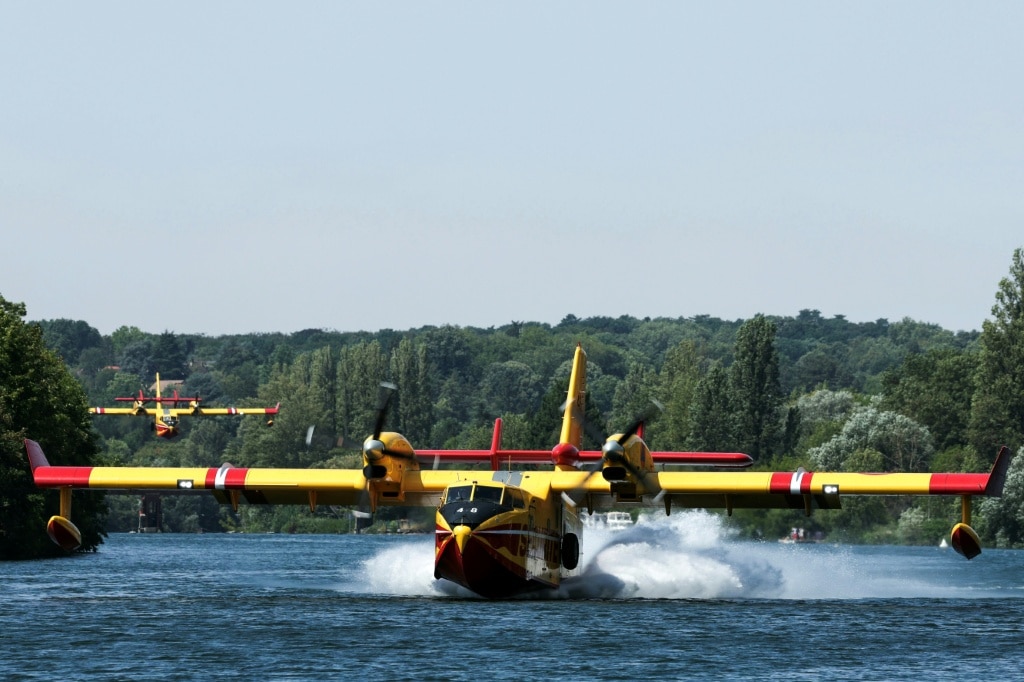
As French firefighters battle the most devastating wildfires in modern history, they are constrained by a critical shortage of the aerial fire-fighting tools most effective against large blazes: just 12 Canadair water bombers remain in France’s active fleet, and new aircraft will not arrive for years due to slow, painstaking production thousands of kilometers away in a Canadian manufacturing facility. Canadair water bombers are widely recognized as one of the most powerful weapons for containing wildfires spreading across rugged, hard-to-access terrain, capable of skimming along the surface of lakes to scoop up nearly 6,000 liters of water in just 12 seconds before dumping it on advancing blazes. But building these specialized aircraft is an extraordinarily slow process, complicated by a nine-year gap in production that shattered the global supply chain for custom parts needed for assembly.
Current manufacturer De Havilland Aircraft of Canada only restarted Canadair production in 2024, after the program was halted by previous owner Bombardier in 2015. Even with production now back online, the first two next-generation DHC-515 water bombers bound for France will not be delivered until at least 2028, with two additional aircraft ordered by France in June 2025 not scheduled for handover until 2032 or 2033.
During an on-site visit to De Havilland’s Calgary assembly plant by Agence France-Presse, the labor-intensive nature of the production process was on clear display. Unlike modern commercial aircraft manufacturing that relies heavily on automated assembly lines, almost all work on the Canadair fuselage is done by hand: every hole is drilled individually, and every rivet is set manually by skilled technicians. This low level of automation caps the facility’s annual output at just 10 aircraft total, even as demand for the specialized fire-fighting planes surges across fire-prone Europe.
“On the fuselage, everything is done manually, so every hole, every rivet you see on the fuselage is being done manually,” Victor Ocadiz, the plant’s Operations Director, told AFP.
The crippling shortage of aircraft and years-long wait for new reinforcements has sparked intense political controversy in France, where opposition parties have blamed national government budget cuts for slowing efforts to expand the fire-fighting fleet ahead of record-breaking wildfire seasons driven by climate change. But De Havilland leaders say the core of the delay traces back to the decade-long production pause that gutted the program’s supply base.
Production only restarted this year after the European Union and six member states — France, Spain, Italy, Greece, Portugal and Croatia — placed an initial collective order for 22 planes. That order book has since expanded to 40 aircraft globally, as southern European nations scramble to boost their wildfire response capacity amid rising temperatures and longer fire seasons.
Jean-Philippe Cote, De Havilland’s Head of Strategy, explained that the nine-year gap between production halts and restart left the company forced to rebuild the entire supply chain from scratch. “We have had to put more than 50,000 different parts back into production and select new suppliers because the previous suppliers no longer existed,” Cote said.
The first modernized DHC-515 water bomber off the line will actually go to Greece, with delivery scheduled for early 2028, Cote confirmed. French Interior Minister Laurent Nunez has said the first two French aircraft are scheduled for delivery in April and November 2028, and has stressed that the manufacturer must stick to this timeline. De Havilland has declined to confirm specific delivery dates beyond saying the timeline remains aligned with official forecasts.
While the supply chain rebuild has delayed new deliveries, it comes with a hidden benefit for the more than 160 older-generation Canadair water bombers already in service around the world — half of which are operated in Europe, and many of which are more than 30 years old. With production restarted and parts manufacturing back online, Cote noted that repair and maintenance has become far faster for existing fleets. “If an aircraft is damaged, we can quickly take a part from the production line and send it to France. It is becoming increasingly easy for us to meet repair needs,” he said.