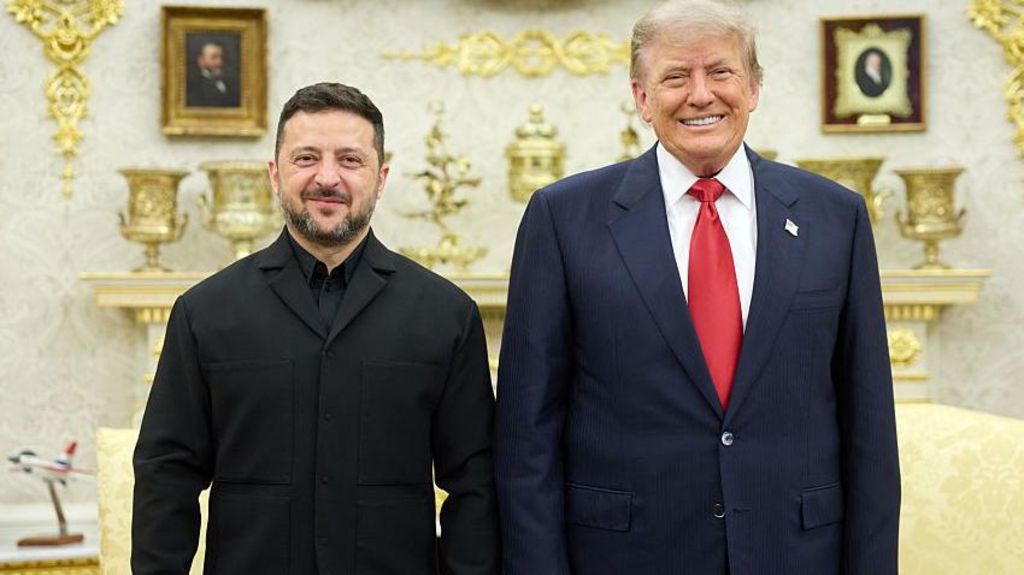
Two key Middle Eastern and European leaders traveled to Washington D.C. in late July 2026 for back-to-back closed-door meetings with U.S. President Donald Trump, held on the sidelines of the funeral of longtime Republican Senator Lindsey Graham, a prominent cross-partisan advocate for both Israeli security and U.S. military assistance to Ukraine who passed away earlier that month.
Ukrainian President Volodymyr Zelensky used his high-profile White House meeting to press the Trump administration for progress on a longstanding Ukrainian defense priority: securing U.S. approval to domestically produce American-made Patriot air defense interceptors, a capability Kyiv says is critical to countering intensifying Russian aerial assaults on Ukrainian civilian and infrastructure targets. Zelensky noted ahead of the meeting that Trump had previously raised the possibility of granting production licensing at the recent NATO summit, and Ukrainian officials have repeatedly emphasized that expanding domestic access to the advanced interceptor systems would drastically improve Ukraine’s ability to shield its population from Russian drone, cruise missile, and ballistic missile attacks that have ramped up in recent months.
Following the closed-door discussion, no formal binding commitment on the Patriot license or new U.S. military assistance packages was announced by either side. Still, Zelensky struck a constructive tone in a public post on the social platform X, thanking Trump for ongoing U.S. support and confirming that the pair had addressed the Patriot licensing request alongside other bilateral defense and diplomatic priorities. He added that the two leaders agreed on the need to reinvigorate diplomatic efforts to end the full-scale Russian invasion of Ukraine.
Beyond his talks with Trump, Zelensky also held a separate meeting with executives from Lockheed Martin, the U.S. defense prime contractor that manufactures the Patriot system, to outline a path forward for deepening bilateral defense industrial cooperation. In a follow-up post, Zelensky noted that discussions covered joint production capabilities for Patriots and other air defense systems, with working-level teams already advancing concrete proposals to speed up the launch of co-production and expand Ukraine’s air defense capacity.
The Ukrainian leader also planned to meet with a bipartisan group of U.S. Senators advancing new legislation that would impose harsh secondary sanctions on buyers of Russian oil and natural gas, a measure designed to increase economic pressure on Moscow for its ongoing invasion.
Shortly after Zelensky concluded his White House visit, Israeli Prime Minister Benjamin Netanyahu arrived for his own one-on-one meeting with Trump, at a moment when U.S.-Israel relations have been strained by growing disagreements over policy toward Iran and ongoing cross-border conflict between Israel and Lebanese militant group Hezbollah. In recent months, Trump has publicly criticized Netanyahu for refusing to pursue a ceasefire in Lebanon and for expanding Israeli strikes that risk triggering a broader regional conflict.
After their closed-door discussion, Netanyahu told Israeli reporters that the meeting produced aligned outcomes on core shared priorities, most notably preventing Iran from acquiring a nuclear weapons capability. He described the conversation as one of the most productive he has ever held with President Trump, and an official photograph released from the meeting showed the two leaders smiling together in the Oval Office, signaling at least a public reset of their previously tense relationship. The White House characterized both back-to-back meetings with Zelensky and Netanyahu as “positive and productive” in an official readout released after the sessions concluded.