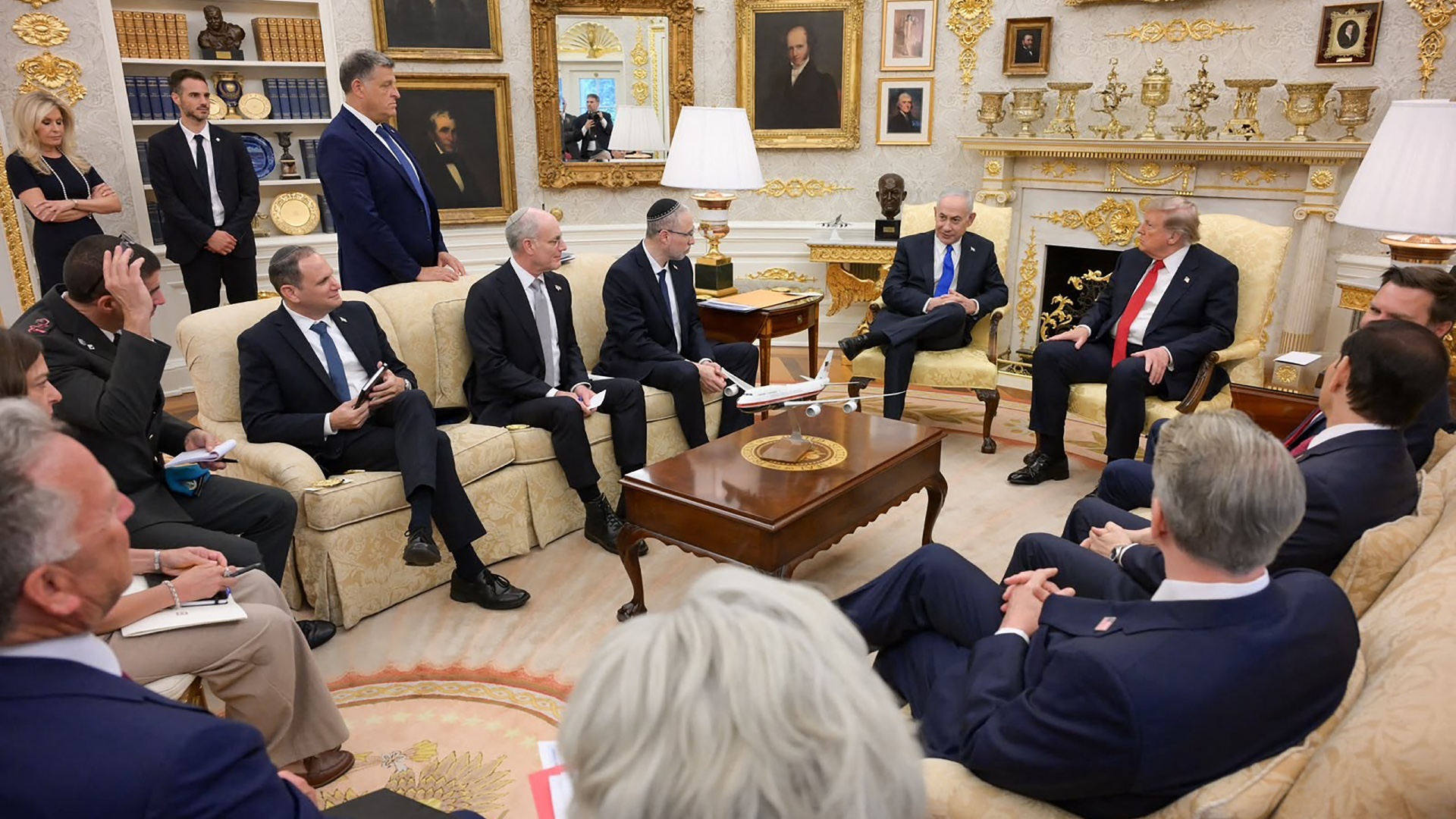
With just three months remaining until Israel’s most consequential election of his decades-long political career, Israeli Prime Minister Benjamin Netanyahu traveled to Washington D.C. for a urgent closed-door meeting with U.S. President Donald Trump — a trip analysts say was only made possible by a sudden, unexpected death that opened a rare window for the Israeli leader to court Trump’s endorsement ahead of the vote.
The core of Netanyahu’s re-election strategy hinges on cementing his reputation as the only Israeli politician who can command unwavering backing from the U.S. president, and safeguard the critical strategic and security alliance that forms a lifeline for Israeli leadership. The opportunity for this White House meeting arose after prominent pro-Israel advocate and Trump confidant Lindsey Graham passed away suddenly earlier this month, according to Aaron David Miller, a former U.S. State Department senior advisor on Palestinian-Israeli negotiations and current senior fellow at the Carnegie Endowment for International Peace. “The visit would not be taking place, had Lindsey Graham not passed,” Miller told Middle East Eye.
Since Trump’s return to the presidency in January 2025, no other foreign leader has secured more one-on-one time with the U.S. commander-in-chief than Netanyahu. But this 90-minute closed-door meeting carried far greater urgency than previous encounters: it came on the heels of a series of high-profile meetings Trump held with other regional leaders, including Turkish President Recep Tayyip Erdogan, Syrian President Ahmed al-Sharaa, Iraqi Prime Minister Ali al-Zaidi and Lebanese President Joseph Aoun.
Disagreements between the two leaders have bubbled into public view in recent weeks, centered on Netanyahu’s push for continued U.S. military involvement targeting Iranian nuclear-linked facilities, a position Trump has openly pushed back against. When asked by Fox News about Netanyahu’s public warnings about activity at Iran’s Pickaxe Mountain nuclear-related site, Trump made his frustration clear. “I don’t need Bibi to tell me that. Bibi is telling me that because he wants me to stay involved. I mean, I don’t necessarily [want to],” Trump said in a Tuesday phone interview. He added, “I heard Bibi announce that [and] I said, ‘Why don’t you just tell it to me? Why do you have to announce it to the world?’ I know exactly what’s going on at Pickaxe. It’s not a big problem. We took out their nuclear sites, and we’ll have to take out Pickaxe if we don’t make a deal.”
Nizar Farzakh, a former advisor to Palestinian leadership in Ramallah and current lecturer at George Washington University, argues Netanyahu’s renewed focus on the Iranian threat stems from a lack of tangible progress on Israel’s campaigns in Gaza and Lebanon. “Only Netanyahu wants the war [in Iran]. Everybody – literally everybody else – does not want escalation. So I guess he’s coming to fix what all the others have ruined,” Farzakh explained to Middle East Eye.
Tensions also emerged over Trump’s open consideration of resuming F-35 fighter jet sales to Turkey, a move Netanyahu has publicly opposed. When asked about Netanyahu’s disapproval aboard Air Force One, Trump reaffirmed his close ties to Erdogan and pushed back on any Israeli interference in U.S. foreign policy. “Nobody tells me what we should be selling. And now Turkey has been a tremendous ally for me… Turkey’s not a big fan of Israel. You know that, right?” Trump said.
While both the White House and Netanyahu attempted to frame the meeting as positive and productive — with Netanyahu calling it “one of the best conversations I’ve ever had with a president of the United States, our friend Donald Trump” — analysts say the closed-door format signals far more underlying disagreement than public statements acknowledge. Miller noted that Trump has broken with decades of U.S. presidential precedent by openly criticizing and challenging Netanyahu, leaving him with unprecedented leverage over the Israeli leader just as he faces a make-or-break election that could determine not just his political future, but his personal freedom.
“[Trump] has said things about an Israeli prime minister that no American – none of his predecessors – has ever said… He has mocked the prime minister. He has allowed his profanity-laced phone conversations to be leaked. He opened a dialogue with Hamas without Israel’s knowledge. He did a deal with the Houthis over and above the objections of the government of Israel,” Miller recounted. “And right now, 90 days before the most consequential election in Benjamin Netanyahu’s political life, which could involve his personal freedom, [Trump] has more leverage over this Israeli prime minister than any of his predecessors have ever had at any given moment.”
Netanyahu has faced ongoing corruption investigations in Israel since 2019, and could face up to 10 years in prison if convicted on current charges, which he denies. Compounding his vulnerability is the fact that the U.S. remains one of the only major world powers where he can travel without risk of arrest, after the International Criminal Court issued an arrest warrant for him on war crimes and crimes against humanity charges linked to Israel’s military campaign in Gaza nearly two years ago.
Netanyahu’s motorcade through Washington D.C. was met by large crowds of anti-Israel protesters, who waved Palestinian flags and chanted calls labeling the prime minister a war criminal. New polling released this week underscores deep public division in the U.S. over Netanyahu’s visit: a joint Economist/YouGov poll of 1,559 U.S. adults released Tuesday found 49% of respondents believe Netanyahu should be arrested if he stays on U.S. soil, compared to just 27% who oppose arrest and 23% who are undecided. Support for arrest is strongest among respondents under 50 and non-white Americans.
Separate polling from YouGov and CBS News, released last week, further highlights broad public opposition to continued conflict. The poll found 67% of Americans want the U.S.-Israeli military campaign against Iran to end immediately, with overwhelming support for a ceasefire among adults under 30. Broken down by party affiliation, 92% of Democratic voters, 73% of independent voters, and 30% of Republican voters support an immediate end to the war.
Farzakh argues Trump is actively seeking an exit strategy from the Iran conflict, a goal that directly clashes with Netanyahu’s domestic political calculus. “Nothing is working with Iran. Iran keeps getting stronger,” Farzakh said. “[Trump is] way in over his head with this, and he’s trying to find an exit strategy.” That exit strategy, he added, is impossible if Netanyahu’s re-election depends on branding himself as Israel’s “Mister Security” by pushing for ongoing escalation. Netanyahu is next scheduled to return to the U.S. for the United Nations General Assembly in September.