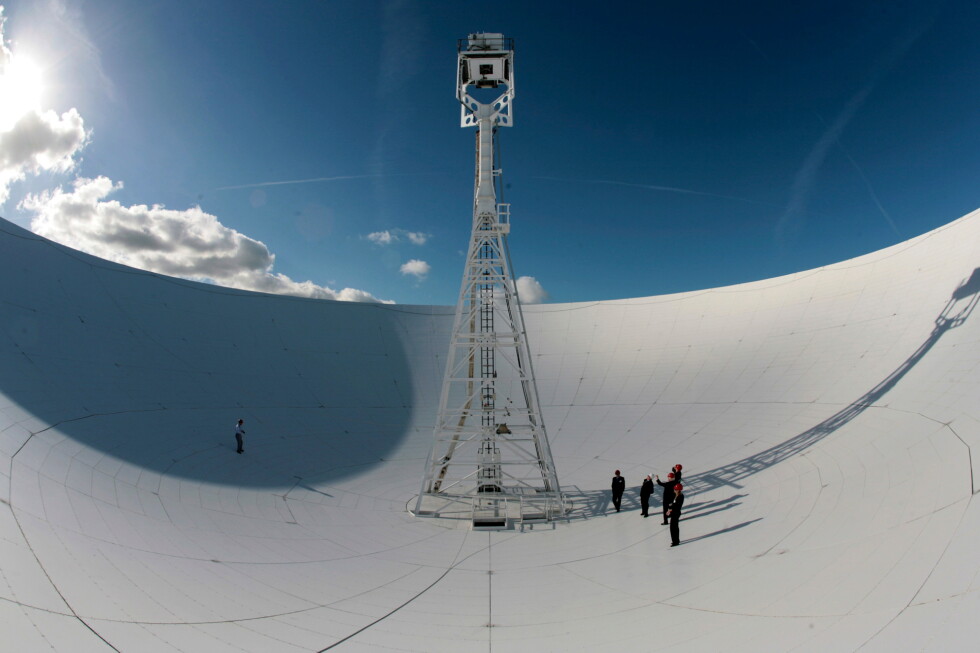
LONDON – A landmark decision to end public funding for one of the world’s most historic and celebrated radio telescopes has triggered widespread outrage and deep concern across the global scientific community. The Lovell Telescope, the centerpiece of the Jodrell Bank Observatory – a UNESCO World Heritage Site located in northwest England that has pushed forward the boundaries of cosmic exploration for nearly seven decades – will lose all government backing after 2028, according to an official announcement.
U.K. Research and Innovation (UKRI), the government’s public funding body for research and innovation, revealed the funding change Monday. The 76-meter-wide Lovell Telescope, a recognizable regional landmark that has stood since the 1950s, is a core component of e-Merlin, a national network of seven interconnected radio telescopes managed by the University of Manchester’s Jodrell Bank Centre for Astrophysics, south of Manchester.
In its statement, UKRI justified the cut by saying the decision came out of “a rigorous prioritization process to focus investment on the areas that will deliver the greatest long-term scientific capability, impact and value for the U.K.” Public funding for the entire e-Merlin array will cease at the end of March 2028.
Leading figures from the British and international scientific community have quickly pushed back against the decision, warning that the cuts will cause irreversible damage to the U.K.’s standing in global astronomy research. Renowned particle physicist and broadcaster Brian Cox, based at the University of Manchester, described the funding cut as “devastating and irreversible.”
Paul Howarth, president of the U.K.’s Institute of Physics, called the latest cuts to physics funding that include Jodrell Bank “a terrible blow to the scientific community.” He has called on newly appointed Prime Minister Andy Burnham to reverse the decision, warning that the choice undermines Britain’s global reputation as a leading destination for scientific research, discovery and innovation.
“For the sake of U.K. physics and our national reputation as a place to do science, conduct research and innovate, we would urge the new government to review this ruinous set of decisions,” Howarth said.
The University of Manchester, which oversees operations of the e-Merlin network and the Lovell Telescope, has confirmed it is currently pursuing alternative funding from private businesses, philanthropic organizations, and potential new government grants to save the facility. However, university leaders have made clear that without securing alternative backing, the telescope will cease to operate as an active scientific research instrument after 2028.
Sarah Sharples, the university’s dean of science and engineering, told reporters: “But, if we don’t find those alternative sources of funding, then there is a risk that as of the end of March 2028, the Lovell Telescope will not be an actively functioning scientific facility for radio astronomy.”
Completed in 1957, the same year the Soviet Union launched Sputnik, the first artificial satellite to orbit Earth, the Lovell Telescope has cemented its place as a trailblazer in global radio astronomy, a field that studies distant cosmic objects through the radio waves they emit. The telescope made history within months of opening by tracking the path of Sputnik as it orbited the planet, a feat that put Jodrell Bank on the global map. In the decades that followed, it received the first transmitted images from the lunar surface in 1966 during the early era of space exploration, and has enabled groundbreaking discoveries of distant galaxies, while advancing scientific understanding of black holes, quasars, pulsars and gravitational lenses.
During the Cold War, the telescope also served a critical national security role, operating as an early-warning system to detect incoming Soviet intercontinental ballistic missiles. The site’s public engagement center, which welcomes thousands of visitors and school groups annually to learn about astronomy and space science, will not be impacted by the funding cuts.