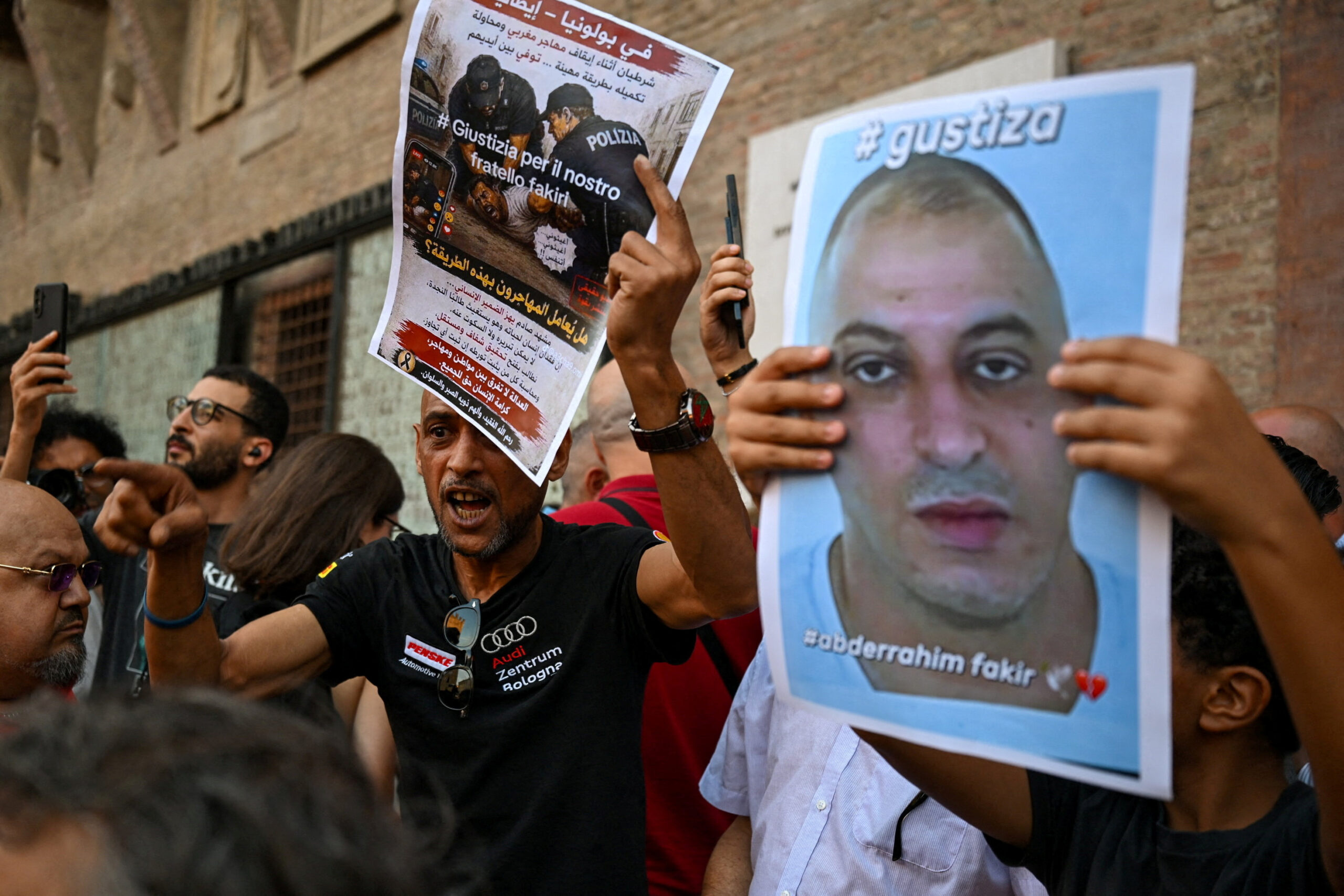
Two recent fatal incidents involving men of North African descent have reignited deep-seated, long-standing concerns within Italy’s Middle Eastern and North African (MENA) communities over systemic police excessive force, institutional discrimination, and political neglect, sending a wave of anxiety through marginalized migrant and racialized neighborhoods across the country.
The first tragedy unfolded on July 19 in Bologna, where 42-year-old Moroccan-born Abderrahim Fakir died after being restrained by two police officers and a civilian. Local authorities had been called to the scene after Fakir, experiencing an acute episode of psychological distress, claimed he faced imminent danger and damaged nearby residential garage doors.
Amateur footage captured from a neighboring apartment contradicted initial police accounts, showing Fakir handcuffed, struck with tear gas, and pinned face-down to the ground by officers for multiple minutes as he repeatedly screamed for help. Strikingly, Italian Red Cross volunteers already on site stood idle throughout the nearly seven-minute incident, offering no medical intervention. The graphic footage spread virally across social media platforms within hours, sparking widespread public outrage and triggering two separate official inquiries: one into the officers’ use of force, and a second into the Red Cross’s failure to intervene. Bologna’s public prosecutor’s office has since opened a formal manslaughter investigation into Fakir’s death.
Just four days later, a second death amplified public anger in the southern city of Cosenza. Twenty-five-year-old Mohamed Amin Bessioud, who was born in Italy to Tunisian parents, died after jumping from a third-floor balcony while Carabinieri military police conducted a residential search. Bessioud’s mother told local media her son had long struggled with clinical depression and had grown increasingly tormented by repeated police harassment, saying he lived in constant fear of officer check-ins. Local prosecutors have launched an investigation into the circumstances of his death, while community activists frame the incident as another preventable fatality rooted in systemic police targeting of MENA communities.
These two deaths are not isolated incidents, community leaders and analysts emphasize: they are the latest in a growing string of fatal encounters stretching back years that have left a deep mark on Italy’s Arab communities. Previous high-profile cases include the 2021 shooting death of Youns El Boussettaoui by a former police officer in Voghera, the 2024 death of 19-year-old Ramy Elgaml following a high-speed police chase in Milan that sparked weeks of mass protests, and the January 2025 shooting death of Abderrahim Mansouri by police during a drug operation in Milan’s Corvetto district.
In the wake of Fakir’s killing, thousands of demonstrators marched through central Bologna to demand accountability and justice for his death. Protests quickly spread to more than a dozen other Italian cities, and isolated clashes between small groups of demonstrators and riot police pushed the issue to the top of Italy’s national political agenda. Bologna’s center-left Democratic Party mayor Matteo Lepore has found himself caught between competing pressures: police unions and right-wing politicians have accused him of tacitly endorsing violence against law enforcement, while grassroots community groups argue his administration has responded to decades of social neglect in the working-class Pilastro neighborhood—where Fakir was killed—with expanded aggressive policing rather than targeted investment in housing, education and social services. The far-left communist party Power to the People has gone further, accusing both Lepore’s municipal government and Prime Minister Giorgia Meloni’s national government of accelerating the militarization of low-income, majority-migrant neighborhoods. The party argues that current security policies pursued by both levels of government frame working-class, majority-migrant districts as public security threats rather than addressing the deep structural inequalities that have shaped these communities for generations.
For MENA communities in Italy, the two deaths cannot be separated from a broader shift toward restrictive security policies that disproportionately target racialized groups under the current far-right government. Since taking office in 2022, Meloni’s administration has introduced a series of harsh decrees targeting street protest and petty crime, a policy framework that consistently frames MENA and Muslim communities as inherent public security risks. A controversial February 2025 law that grants law enforcement greater flexibility to bypass standard investigative procedures is now being applied for the first time to the two officers charged in Fakir’s death, a move that has reinforced community claims of institutional favoritism for police.
Emmanuele Jonathan Pilia, editor at independent Italian publisher D Editore, says the current crisis is the outcome of decades of systemic practice. “Italian policing has long been used to control populations considered marginal,” Pilia explained in an interview. “Today that same logic is increasingly directed towards neighbourhoods where many Arab, Muslim and migrant families live.” Pilia notes that years of political rhetoric linking migration, Islam and public insecurity have normalized aggressive policing and legitimized anti-Muslim hostility in mainstream public life, pointing to high-profile incidents such as far-right Lega Party MEP Silvia Silvia Sardone’s public harassment of a woman wearing a niqab in Turin, where Sardone filmed the encounter and told the woman to “move to Islamabad.”
Decolonial psychotherapist Camilla Ponti, whose work centers on migration, racialization and mass incarceration, argues that systemic police violence is rooted in cultural dehumanization that predates any law enforcement interaction. “Before violence becomes institutional, it becomes cultural,” Ponti said. “When non-white people are consistently portrayed as dangerous, their dehumanisation becomes normalised.” Ponti adds that this same framing has shaped Italy’s response to pro-Palestine activism since the start of Israel’s military campaign in Gaza: dozens of Arab pro-Palestine organizers have been arrested and detained on unsubstantiated terrorism charges, framed as security threats under the same national security framework that targets racialized communities.
Italian-Pakistani journalist Sara Tanveer argues that mainstream Italian media plays a central role in reinforcing these harmful stereotypes. “Italian journalism still struggles to recognise its own biases,” Tanveer said. “Too often, Arabs and Muslims become visible only through stories about crime, terrorism or security.” She notes that coverage of cases like Fakir’s typically prioritizes unproven accusations about the victim’s past over contextual details of his death or the concerns raised by his family, reinforcing public suspicion rather than empathy. The same pattern, she says, shapes coverage of detained pro-Palestine activists, where reports rarely scrutinize investigations that rely heavily on Israeli intelligence, reinforcing the harmful link between Muslim identity and terrorism in public discourse.
For many activists, the latest deaths have not opened a new national conversation—they have revived one that has festered in Italian politics for decades, recalling earlier high-profile cases of police impunity such as the 2001 killing of left-wing activist Carlo Giuliani during the G8 summit protests in Genoa, and the 2009 death of Stefano Cucchi, who was beaten to death by Carabinieri after being arrested for minor drug possession. Strikingly, Fakir’s death came exactly as thousands of demonstrators were gathering in Genoa to commemorate the 24th anniversary of Giuliani’s killing, drawing a direct line between decades of police impunity and the current crisis facing MENA communities.
Many community members now report a growing, pervasive sense of insecurity, saying they are increasingly identified by their Arab identity first, and their Italian citizenship second. “After Youns El Boussettaoui was killed, something broke,” said Rajaa Ibnou, an Italian-Moroccan activist at Milan’s Lambretta social centre. “Many of us realised we were no longer seen first as citizens, but as Arabs. The Arab community in Italy is under growing pressure. Not only because of increasingly restrictive security policies, but also because of the silence of much of the political opposition.”