For years, Iraqi leaders in Baghdad have walked a precarious diplomatic tightrope, enacting incremental concessions to Washington’s demands to curtail Tehran’s informal influence across the country while preserving deep, long-standing bilateral ties with its neighboring Iran. This delicate balancing act has severely limited Baghdad’s capacity to advance urgent domestic economic and security reforms, and has blocked the nation from forging a truly independent, self-determined foreign policy aligned with its own national interests.
Today, however, a confluence of shifting regional dynamics – a renewed push to strengthen central Iraqi state institutions, the impending full withdrawal of US-led coalition forces from federal Iraq, and the growing prospect of a diplomatic settlement between Washington and Tehran – has opened a rare window of opportunity for Baghdad to fundamentally redefine its relationships with both global and regional powers.
Iraq’s new Prime Minister Ali Falih Kadhim al-Zaidi, a former veteran banker who assumed office in April, has made building up the authority of the Iraqi state through sweeping institutional reform the top policy priority of his administration. His reform agenda encompasses three core pillars: expanding Iraq’s full integration into the global international banking system, modernizing and strengthening the country’s critical energy sector, and enforcing a long-delayed state monopoly on all legal arms possession across the nation.
Many of these reforms, while framed as domestic priorities, inherently will limit the scope of Iran’s informal influence within Iraq. For example, banking sector reforms first initiated under the previous Iraqi administration were designed to cut systemic corruption and streamline access to global financial networks. According to Hayder al-Shakeri, a research fellow at the London-based Chatham House think tank, while opening the banking sector is not framed as an anti-Iran measure, it will inevitably restrict the informal financial channels that Iran and Iran-aligned political and armed networks rely on to exercise influence inside Iraq.
Baghdad has also leveraged its deepening diplomatic engagement with Washington to expand its energy partnerships and cut its long-standing reliance on Iranian gas imports. During al-Zaidi’s recent high-profile visit to Washington, the prime minister signed dozens of new commercial partnerships and investment agreements with US energy firms, including major deals for associated natural gas capture projects that will allow Iraq to recover gas that is currently flared as waste during oil production. Once completed, these projects are projected to significantly reduce Iraq’s dependence on Iranian gas imports, which for years have met roughly 40 percent of the country’s total gas and electricity needs.
Reforming Iraq’s fragmented security sector presents a far more daunting political challenge, however. Al-Zaidi has set a firm September 30 deadline for the full disarmament of all unauthorized militias operating in Iraq, and has called for the voluntary reintegration of former militia fighters into official Iraqi state security institutions. Yet even if all militias comply fully with the disarmament order, analysts warn these groups will almost certainly retain significant informal political power in Baghdad. As al-Shakeri explained to Middle East Eye, the political networks tied to these armed groups are deeply entrenched in Iraq’s parliament, cabinet, and core state institutions, meaning their influence will not disappear overnight.
Even so, analysts note that even partial progress toward centralizing political and security authority within the Iraqi state – a goal that successive Iraqi administrations have pursued since 2003 – would allow Baghdad to advance long-stalled domestic reforms and pursue a foreign policy with far greater autonomy from outside influence. Beyond this domestic agenda, Baghdad is also seeking to reorient its relationship with the United States on more equal footing. The US-led international coalition against the Islamic State is on track to complete its full withdrawal from federal Iraq by September 30, a timeline that aligns deliberately with the militia disarmament deadline. This coordinated timeline reflects Baghdad’s deliberate push to rewrite the framework of US-Iraq relations, with a new vision focused on expanding bilateral economic ties rather than the long-standing security partnership that has defined the relationship for decades. During his Washington visit, al-Zaidi signed 48 distinct economic agreements and commercial partnerships with US companies, and has publicly stated he expects a growing American economic footprint in Iraq in the coming years.
Still, significant progress on expanding economic ties between Baghdad and Washington remains unlikely as long as the threat of militia attacks on US commercial interests persists. A number of powerful Iraqi militias, including Kataib Hezbollah and Harakat Hezbollah al-Nujaba, have joined the ongoing Iran-US-Israel conflict in support of Tehran, viewing any potential weakening or collapse of the Islamic Republic of Iran as an existential threat to their own power and influence in Iraq. According to a senior anonymous US State Department official, Tehran and its affiliated Iraqi armed groups launched roughly 600 separate attacks on US interests across Iraq during the recent conflict, targeting diplomatic facilities, military bases, and critical energy infrastructure. While a formal end to the Iran-US conflict would not automatically force militias to disarm, a lasting ceasefire would greatly ease the disarmament process. Al-Shakeri notes that Iranian government approval of the process would remove a major barrier to successful disarmament, even if it does not resolve all challenges.
US security concerns in the region now extend beyond Iraqi militia activity, however. In recent months, Iran has demonstrated its willingness and capability to launch cross-border attacks across Iraq, Jordan, and the Gulf Cooperation Council countries. As a result, the expanded economic partnerships that both Baghdad and Washington have expressed interest in will almost certainly require a lasting diplomatic settlement between the US and Iran that ends the current open conflict first.
A potential end to the conflict under the framework of the Memorandum of Understanding signed between the two parties in June – which would lift primary and secondary US sanctions on Iran – would create a unique opening for Baghdad to manage its deep cultural, economic, and political ties with Tehran through formal, transparent state channels. Annual bilateral trade between Iran and Iraq already stands at roughly $12 billion, making it one of the most robust trading relationships in the region, and the two countries already collaborate extensively on religious tourism, healthcare, and financial cooperation. For years, US sanctions have blocked broader economic collaboration between the two neighbors. Iraqi economist Zahraa Albachachy told Middle East Eye that sanctions relief would have far-reaching benefits beyond just energy and bilateral trade: restoring Iran’s access to international contractors, insurance providers, and global financing would allow many long-stalled cross-border infrastructure projects to move forward. Albachachy pointed to the Shalamcheh-Basra railway project as a key example: despite five separate memorandums of understanding signed since 2011, the project has never moved past the planning stage, a delay Albachachy attributes to structural barriers created by US sanctions rather than a lack of political will from both governments.
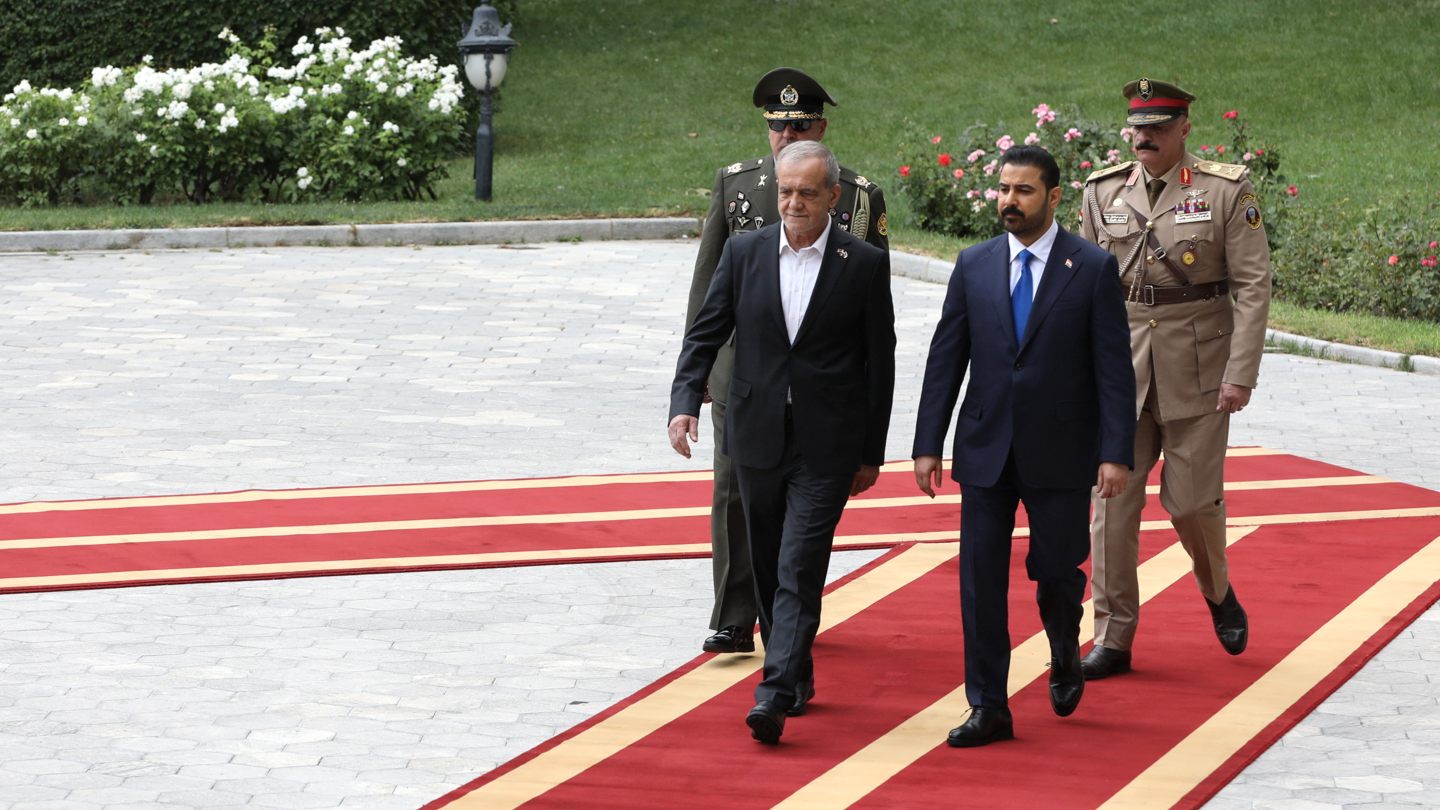
Notably, al-Zaidi’s diplomatic agenda goes far beyond simply reframing Baghdad’s balancing act between Washington and Tehran. Citing anonymous Iranian and Iraqi political sources, regional media reported last week that during al-Zaidi’s recent visit to Tehran, he pitched the idea of developing trilateral commercial opportunities between Iran, Iraq, and the United States to Iranian officials. If this vision moves forward, it could allow Iraq to emerge as “Iran’s door to the West,” as an advisor to the Iraqi prime minister described it publicly last week.
Ultimately, however, all of these ambitious initiatives – from militia disarmament to deeper economic ties with both Washington and Tehran, to the strengthening of Iraq’s domestic energy sector – depend on the successful negotiation of a durable, long-term diplomatic agreement between the United States and Iran that brings the ongoing conflict to a lasting end.