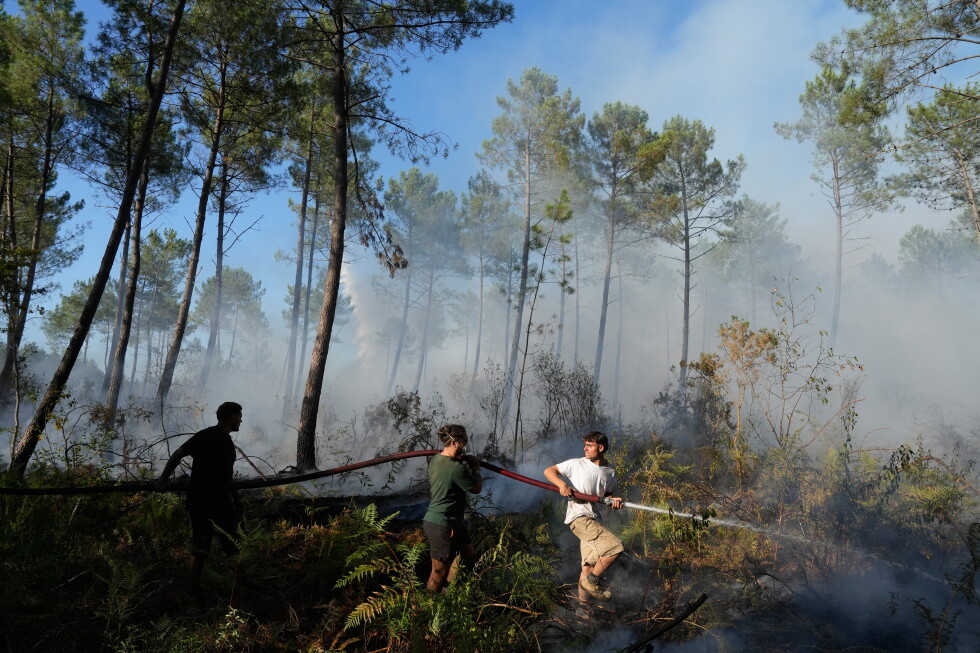
LEGE-CAP FERRET, France — As soaring temperatures return to southwestern Europe, French emergency officials have ordered the evacuation of nearly 4,000 people from coastal Atlantic tourist sites, raising the stakes for an unprecedented regional wildfire crisis that has already displaced hundreds of thousands across France and Spain.
The sprawling Gironde wildfire west of Bordeaux, which has already burned through 420 square kilometers of land — an area four times the size of Paris — has been held at a standstill overnight by firefighting crews, who managed to douse flare-ups near coastal dunes and halt the fire’s advance. While regional authorities have categorized the blaze as stabilized, they warn this status does not mean the fire is fully contained: with thermometers climbing and humidity levels dropping, the inferno could easily resume its spread across drought-parched vegetation.
The precautionary evacuation order issued Tuesday covers all tourist infrastructure in the Lacanau resort region, including popular campsites, holiday villages, seasonal residences and leisure parks stretching across Lacanau Ocean and both shorelines of Lacanau Lake. “We are currently in a highly fragile position,” Eric Brocardi, spokesperson for France’s national firefighters federation, told broadcaster BFMTV Tuesday. “Even with the predicted temperature rise, we will continue our offensive against this fire.”
Since igniting last week, the Gironde blaze has proven wildly unpredictable, at times escalating into a self-sustaining firestorm that forced 220,000 people to flee their homes and vacation getaways. Even after 24 hours without expansion, officials warn that smoldering undergrowth along the fire’s 103-kilometer completed firebreak line could spark new outbreaks as conditions worsen. To date, 93 firefighters have been injured battling the blaze, key transport routes including the A63 highway remain partially closed, and most rail traffic south of Bordeaux is suspended.
The tense standoff in Gironde stands in contrast to promising progress in neighboring Landes, where a separate destructive wildfire has officially been declared contained, allowing 15,000 of the more than 30,000 displaced residents and tourists to return to their properties starting Monday night. “The fire is fixed, that is good news for Landes,” French President Emmanuel Macron confirmed Monday evening, noting that containment means the fire’s advance has been fully halted with no new active outbreaks spreading. The reprieve comes as a major relief for summer vacation communities that were emptied when flames swept through regional forests and tourist hubs. Still, authorities stress the Landes fire is not fully extinguished: residual hot spots, combined with persistent drought and shifting winds, could reignite the blaze, and surveillance and damping operations will continue for days, if not weeks.
All hard-won progress across both French fire zones faced an immediate test Tuesday as heat began building back up across the region. France’s national weather service placed Gironde under a yellow heat warning starting midday, forecasting inland temperatures between 33 and 35 degrees Celsius, with southeastern winds expected across the department.
So far this year, more than 116,000 hectares of land have burned across France, part of a broader trend of extreme wildfire activity amplified by climate change. The European Union’s Copernicus Climate Change Service confirmed Western Europe saw its hottest June on record this year, with extreme heat and widespread drought creating ideal conditions for fires to spread and intensify across both France and Spain.
Across the border in Spain, the situation remains even more severe, with hundreds of firefighters, military emergency brigades and water-dropping aircraft continuing to battle multiple major blazes, including the largest wildfire recorded in the country’s history. Spain entered its fourth major heat wave of the summer on Tuesday, with forecasts calling for temperatures exceeding 40 degrees Celsius in many inland regions. To date, the ongoing wildfire crisis — which prompted the Spanish government to declare a first-ever national wildfire emergency — has forced roughly 79,000 people to evacuate and ordered another 30,000 to remain sheltered in their homes.
The highest level of concern centers on two large blazes west of Madrid that have at times neared merging into a single mega-wildfire in the region’s wooded hills, while a separate blaze in the eastern province of Castellón has also triggered mass evacuations. The record-breaking wildfire in Ávila, west of Madrid, has already scorched more than 500 square kilometers of hilly rural terrain — an area five times the size of Barcelona. “Look at how the entire valley is burned. Look at the houses, look at what people have lost,” said David Gonzalez, a 48-year-old gardener who has used his personal van to deliver supplies to firefighting crews in Ávila. “We feel so much anger and helplessness. This is something inhuman.”
This year alone, wildfires have burned more than 1,530 square kilometers across Spain — six times the total area scorched by wildfires in the same period of 2025, according to Spanish Ecology Minister Sara Aagesen. Spanish Prime Minister Pedro Sánchez has called for a unified national pact to address the growing wildfire risk, which scientists and policymakers agree has been significantly worsened by human-caused climate change.
Across the two countries, the ongoing crisis has forced more than 330,000 people to flee their homes and tourist accommodations, marking one of the largest and most destructive wildfire outbreaks in recent European history.