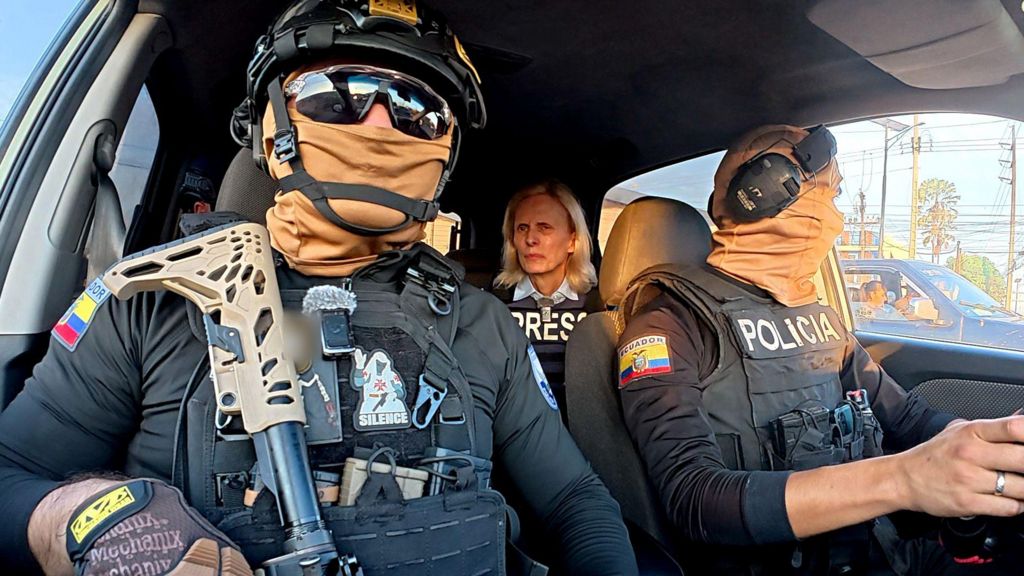
Deep in the violence-plagued coastal city of Durán, Ecuador, police captain Jean Carlos Bustamante confronts an enemy on two fronts: ruthless drug-trafficking gangs that terrorize local communities, and widespread corruption embedded within the very institutions meant to stop them. At 34, a former special forces operator and the oldest member of his hand-picked, trusted team, Bustamante knows the cost of this fight all too well — he has already lost three close colleagues to gang violence, and lost his own fear years ago, even as his parents live in constant dread for his safety.
On a recent operation at dusk, Bustamante led his unit into the core of Los Aguilas (The Eagles) gang territory, a gritty neighborhood where homes are secured with iron bars and residents stay silent out of deadly fear. Acting on a tip that illegal weapons were stashed in an abandoned property, the team lined up against an exterior wall, breached the door with a battering ram, and seized two handguns and assault rifle ammunition — a small but critical win, as Bustamante notes, that removes two deadly weapons from criminal circulation. Still, he acknowledges it is a minor victory in a grinding war of attrition: gangs hold far more firepower and financial resources than the underfunded state security apparatus can match.
Ecuador, once a peaceful South American tourist haven, has transformed into a global hub of cocaine trafficking in less than a decade. According to President Daniel Noboa, roughly 70% of all cocaine bound for Europe and North America now transits through the country. Colombian and Peruvian producers, the world’s top two cocaine suppliers, ship product into Ecuador, where local gangs with ties to Mexican cartels and Albanian organized crime syndicates coordinate onward smuggling. These criminal networks exploit the country’s poorly patrolled long Pacific coastline, weak border management, and under-resourced security services to move millions of dollars worth of narcotics every year. Last year alone, Ecuador recorded more than 9,200 homicides, one of the highest murder rates globally, despite a harsh two-year government crackdown on organized crime.
Critics argue the hardline crackdown has backfired. While top crime leaders have been taken into custody, the fragmented gang landscape has only spawned more small, violent factions competing for territory and smuggling routes. Many Ecuadorians have grown convinced that the war on gangs can never be won — but Bustamante refuses to stop fighting. In a second operation, he used a surveillance drone to spot three suspected micro-traffickers selling small quantities of drugs on the edge of a local playground. The team quickly tracked the suspects to a residential address, breached the door, and detained all three, discovering tiny $1 packets of an addictive heroin mix stashed in a flowerpot. Though one suspect was formally charged, the other two were released — a common outcome, according to senior police, who blame systemic corruption in the judiciary and prosecutor’s office for undermining their work.
Durán police deputy commander Colonel Santiago Gavilanes sums up the frustration: “We imprison them, and they release them. We know because when we carry out raids, we recapture them. Some of those who are released kill people and leave orphans behind.” Gavilanes says gangs have the capital to “buy laws, judges, and politicians,” a claim verified by an anonymous officer who told the BBC he had twice been offered a life-changing bribe to cooperate with criminal networks. After turning the offer down, he learned gangs had detailed information on his work and location, leaked by a corrupt colleague. “You never know who is watching,” he said — a sentiment repeated by almost every officer interviewed in Durán.
Local police claim incremental progress: the city’s murder rate has fallen by half in the first six months of the year, streets are no longer completely deserted after 7 p.m., and public dismemberments of rival gang members, once common, have become far rarer. Colonel Gavilanes says the force has managed to contain gang activity, but full control will be a slow, medium-term process. That progress, however, is constantly undermined by institutional corruption. In an interview arranged through a contact on gang-held territory an hour outside Durán, a mid-level gang leader who goes by the pseudonym Jonathan openly admitted he pays four local police officers between $1,500 and $2,000 per month for advance warning of upcoming raids. “Whenever they’re going to do an operation, they call me,” he said. “They tell me to hide things, and to get out of here. When they arrive, they find nothing.”
Now 37, Jonathan joined a gang at 18 to earn enough money to feed himself. He walks openly through neighborhood streets in daylight, armed alongside his crew, which includes teenagers as young as 17. He admitted to killing eight people, saying he only targets rival gang members who try to seize his territory, and has no regrets about recruiting underage members or selling drugs in the community. Human rights workers confirm that gangs in Ecuador often recruit boys as young as 12, training them to work as hitmen by the time they turn 15. Jonathan is blunt about the persistence of the drug trade: “If they shut us down, another gang will come along, and if they shut that one down, there will be another.” He expects to die violently, like most gang leaders: “Death is paid by death. But if they come to kill me, I won’t make it easy for them.”
Back in Durán, just two nights later, the cycle of violence played out as usual. Under flashing police lights, the body of a young man lay next to a motorbike, killed in a revenge killing by a rival gang. A witness, who spoke only on condition of anonymity, described how two attackers on a motorbike shot the man six times, finishing him with a bullet to the head after he fell. “We are used to this now because it happens every day,” the witness said. “You might just step outside and catch a stray bullet. You can’t even go out or talk to friends or family because someone could shoot you.” He echoed the widespread doubt that the government’s campaign will ever change things: “Criminals are like ghosts. They pop up wherever they please.” As the forensic team loaded the body into a refrigerated van, another corpse was already waiting inside — another chapter in Ecuador’s endless, bloody war on drug-fueled organized crime.