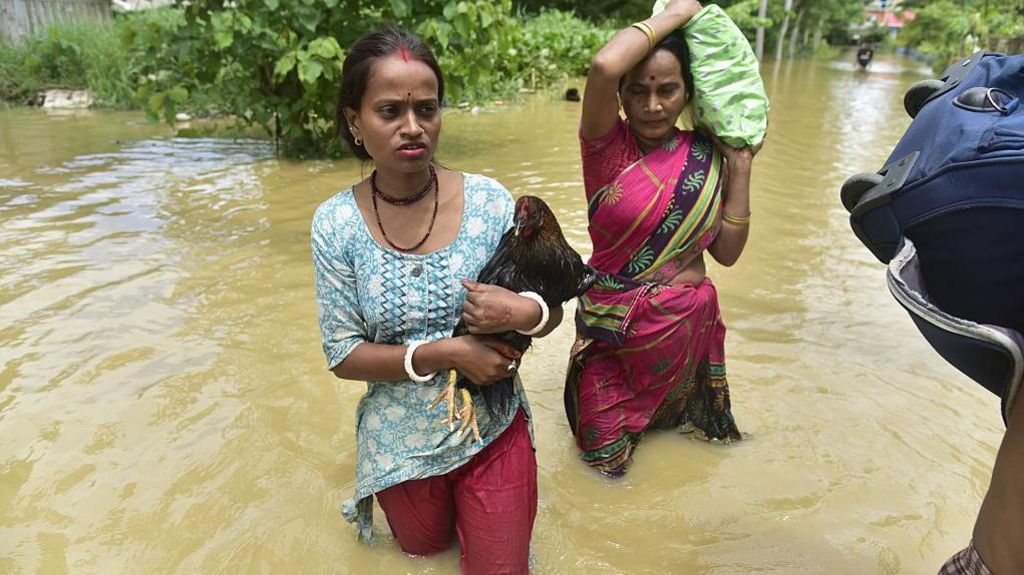
For millions of residents in India’s northeastern state of Assam, annual monsoon flooding is a grim, recurring reality. But the 2026 deluge is unlike anything living memory has recorded. What began as steady rainfall on July 19 rapidly escalated into a catastrophic disaster that has reshaped the lives of hundreds of thousands, leaving a trail of death, destruction, and uncertainty across the state’s floodplains.
Eighteen-year-old Shalini Patra, a resident of Jorhat’s Seleng Sumoni Pathar village along the banks of the Jhanji River – a major tributary of the Brahmaputra – describes how the disaster unfolded in minutes. As she watched the morning rain from her family home, Patra had no hint of what was to come. By mid-afternoon, the roar of rushing water and panicked shouts of neighbors cut through the quiet. Within minutes, knee-deep water surged into her family’s residence.
Patra quickly guided her elderly parents and younger brother to higher ground, then turned back to salvage what belongings she could. By the time she fought her way back through the churning current, the entire structure had been swept away. Every possession the family had spent decades building – a television, a wooden cupboard, a sofa, even basic kitchenware – was gone. “The floods took everything from us,” Patra told BBC Hindi from a government relief camp, where she now resides with her family.
Flooding is embedded into the geography of Assam: India’s National Flood Commission estimates that nearly 40 percent of the state’s total land area is classified as flood-prone. Stretching across the vast Brahmaputra floodplain, where the Himalayan river and its more than 50 tributaries carry glacial melt and monsoon runoff across flat terrain, the state has adapted to annual seasonal inundation for generations. When monsoon rains raise river volumes, silt and sand deposits build up on the riverbed over time, shrinking the channel’s water capacity and making overbank flooding inevitable. But in recent decades, experts confirm that flooding has grown increasingly severe, driven by a toxic mix of human activity and climate change: upstream deforestation that increases erosion and silt runoff, crumbling, century-old embankment systems that have not been upgraded, and more intense extreme rainfall events linked to rising global temperatures.
This year’s disaster was triggered by unprecedented rainfall across Assam and neighboring Nagaland that began in mid-July. State minister Pijush Hazarika has called the event the worst flooding Assam has seen in 60 years. As of late July, official data confirms at least 68 people have lost their lives over the past four weeks, with 58 of those deaths recorded in just the final week of the deluge. Nearly 40 people remain unaccounted for, and more than 600,000 people across the state have had their lives upended by the disaster. Tens of thousands have been displaced from their homes, with around 25,000 now sheltering in government-run relief camps, and thousands more staying with friends or relatives in unaffected areas.
On July 21 alone, 21 people lost their lives in a 24-hour period – most swept away by rushing floodwaters or drowned, while others died in rain-triggered landslides or when collapsing flood-damaged homes fell on residents. Assam Chief Minister Himanta Biswa Sarma confirmed that parts of the two states saw rainfall between 435 percent and 490 percent above the seasonal average during that extreme weather event, causing rivers to swell at a rate no warning system could adequately prepare for. Upper Assam, where dozens of tributaries from the surrounding Naga and Meghalaya hills feed into the Brahmaputra, bore the full force of the disaster. Districts including Sivasagar, Charaideo, and Jorhat were the hardest hit, with floodwaters cutting off road access to entire villages, leaving rescue teams struggling to reach stranded families trapped by rising water.
Stories of harrowing survival have emerged from the hardest-hit regions, echoing the tenacity of residents facing the disaster. In Sivasagar’s Holang Katoni village, 32-year-old Rekhamoni Gogoi and her seven-year-old son spent 12 hours stranded in the branches of a large mango tree after floodwaters swallowed their entire neighborhood. On the afternoon of July 19, Gogoi told local reporters, water rose to chest level in just 60 minutes after overnight rains swelled local rivers. She first took shelter in a two-story neighbor’s home, but when water continued to climb past the first floor, she was forced to flee again. By 8 p.m. local time, the pair climbed into the tree’s upper branches, after other local women helped Gogoi, carrying her son, climb to safety first.
“There was darkness all around us. There seemed to be no hope of survival, but I refused to lose courage,” Gogoi recounted. Stranded overnight without food, water, or warm clothing, Gogoi’s son comforted his mother, telling her they could survive by eating tree leaves if they had to. “My son’s life is more precious to me than my own, so I was determined to protect him at any cost,” she said. A rescue team reached the pair at dawn the next day, and they are now staying in a relief camp waiting for floodwaters to recede.
State officials have mobilized emergency response teams to address the crisis. Assam Chief Secretary Ravi Kotta said that senior administrative officials have been deployed to the worst-hit districts to accelerate relief and restoration work, with priority given to distributing food, clean water, and emergency shelter supplies, and restoring damaged power and communication lines. Chief Minister Sarma added that the government’s focus is now shifting to long-term rehabilitation, with cabinet ministers deployed across every affected district to coordinate recovery efforts.
Even with emergency response underway, for survivors like Patra, the future remains deeply uncertain. Her parents work as daily wage laborers, and spent more than a decade saving to build their small family home. With all their possessions gone and no property left to rebuild on in the immediate term, Patra says her family has no clear path forward. “My parents spent years building that house. I don’t know what we will do now. It will take us years to build another one,” she said.