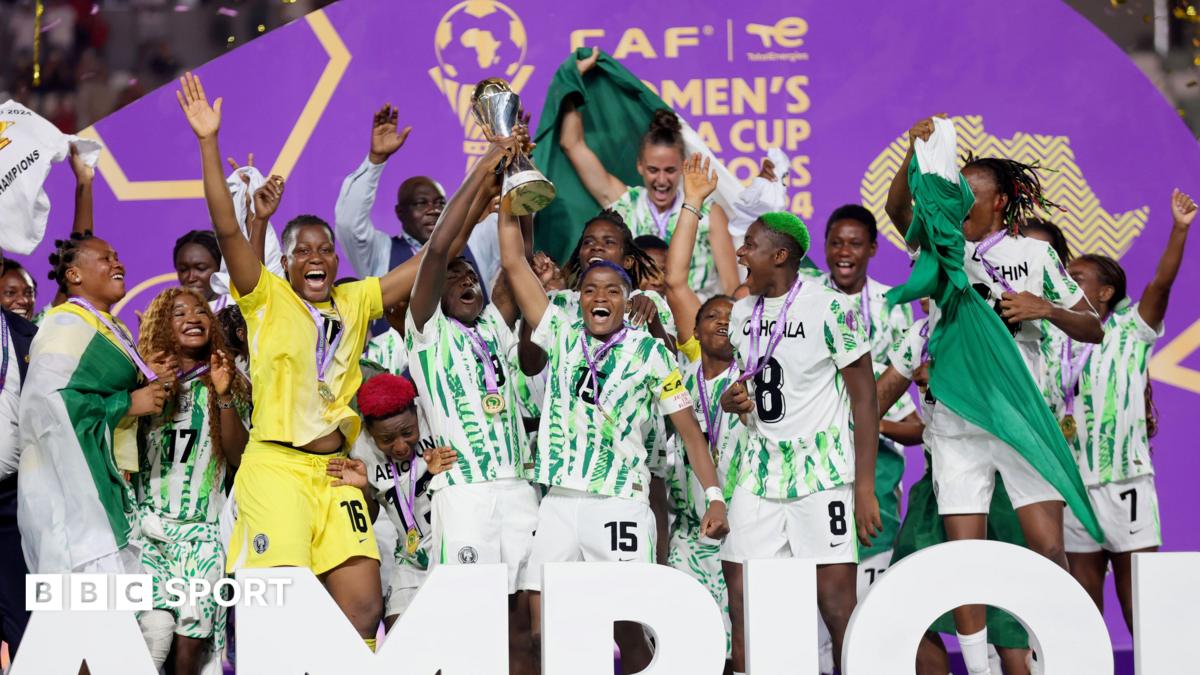
As the 2026 Women’s Africa Cup of Nations (Wafcon) kicks off in Morocco, Nigeria’s Super Falcons, the undisputed powerhouse of African women’s football, have touched down in the host nation carrying the heavy weight of widespread expectation that has followed their decades of unprecedented success. Since the tournament’s inaugural edition in 1998, Nigeria has lifted the trophy 10 times out of 13 total stagings — a record of dominance matched by no other women’s national side on the continent, with only Equatorial Guinea (2008, 2012) and South Africa (2022) ever managing to break their stranglehold on the title. The 2025 edition, also held in Morocco, ended with a dramatic 3-2 win over the host nation that secured their 10th crown, codenamed “Mission X” by the squad. Now, the team is chasing an elusive repeat: their last successful title defense came in 2018, when they capped a three-tournament winning streak.
Head coach Justin Madugu, who masterminded last year’s title run, acknowledged the steep challenge his side faces entering this year’s competition. “Now that we are champions, every other team will want to draw you down,” he told BBC Sport Africa on the eve of Nigeria’s opening Group C fixture against debutant nation Malawi. “It’s not going to be easy. We are quite aware of that and we are going to be fully ready.” Assistant coach Ann Chiejine, who won four Wafcon titles as a player for Nigeria, echoed that cautious approach. “Every country wants to beat Nigeria. That is why we must up our game by making sure we train harder.”
Nigeria’s roster blends veteran leadership and proven elite talent with exciting young prospects, a deliberate mix crafted by Madugu to balance experience and hunger. Star names returning to the squad include captain Rasheedat Ajibade, who earned the tournament’s best player honors in 2025; Chiamaka Nnadozie, the reigning African Goalkeeper of the Year; and Asisat Oshoala, a six-time African Women’s Player of the Year who is chasing her fifth Wafcon title. Alongside these household names of African football, Madugu has called up a cohort of emerging young players, including Sweden-based striker Joy Omewa, who watched last year’s triumph from the sidelines and is making her first Wafcon appearance. Omewa said she expects the 2026 tournament to surpass even the excitement of last year’s campaign, crediting veteran stars like Oshoala for acting as invaluable mentors to the younger generation. “She’s a really remarkable person. She’s a person who you can talk to, share experiences with and she tells you things she has gone through. I think she’s a really good mentor,” Omewa said.
One of the most notable new additions to the squad is 21-year-old backup goalkeeper Comfort Erhabor, who was born in the Netherlands and raised in England and made her international debut earlier this year against Cameroon. Erhabor, who plays in England’s third tier for Portsmouth, said the opportunity to represent Nigeria, her family’s homeland, is an unmatched honor. “It’s in my blood, so I felt like there is no greater honor than to represent my roots, make my parents proud as well,” she said, describing starter Nnadozie as a supportive “big sister” to the younger keeper. Madugu’s preparations for this tournament have also been far more robust than in previous years, with a full slate of friendly matches against Cameroon, Senegal and Tanzania allowing the coaching staff to test squad combinations and build cohesion ahead of Wafcon.
Group C pits Nigeria against Malawi, Zambia and Egypt, and the Super Falcons are under no illusions about the threat their opponents pose. Malawi, ranked 153rd in the world compared to Nigeria’s 40th spot, is making its Wafcon debut this year, led by star attacking duo Tabitha and Temwa Chawinga — both proven goal scorers at the highest club level. Tabitha Chawinga fired Olympique Lyonnais to a fifth consecutive French league title last season, while younger sister Temwa has won the National Women’s Soccer League Golden Boot and MVP in both of her two full seasons with the Kansas City Current. Zambia, another strong contender, boasts an experienced strike partnership of Barbra Banda and Racheal Kundananji, both of whom ply their trade in the NWSL as well. Ajibade emphasized that the team will not underestimate any opponent, noting that Malawi’s qualification itself is proof of the rapid progress smaller African nations are making in the women’s game.
The 2026 Wafcon brings several key changes that raise the stakes for all participants. The tournament has expanded from 12 to 16 teams, bringing more nations into the fold and increasing the depth of competition. It also serves as the qualification tournament for the 2027 FIFA Women’s World Cup in Brazil, with the four semi-finalists automatically earning a spot at the global tournament. Nigerian winger Francisca Ordega clarified the team’s priorities: “Our first target is to qualify for the World Cup. After that we can think of defending our title. We are not under any kind of pressure. We can hold our own against any team across Africa.” Nigeria has qualified for every iteration of the Women’s World Cup since the tournament launched in 1991, maintaining their status as Africa’s most consistent contender on the global stage.
Chiejine noted that the narrowing of gaps between top and lower-ranked African teams is a positive sign for the growth of the women’s game across the continent. “If we are now being beaten by penalty shootout, or 1-0, 2-0, it means that the graph is rising,” she said. This growth is also reflected in the tournament’s prize pool, which has been doubled for 2026, with the champions set to take home $2 million — a tangible indicator of rising investment and interest in African women’s football. The Super Falcons do face minor setbacks heading into the tournament: key center-back Ashleigh Plumptre, a standout from last year’s title run, is sidelined with a foot injury, and multiple players reported thefts of cash and personal belongings shortly after arriving in Morocco, including 2025 final player of the match Esther Okoronkwo, who lost hundreds of dollars. Still, Nigeria enters the tournament as the clear team to beat, aiming to extend their historic reign as Africa’s queens of women’s football.