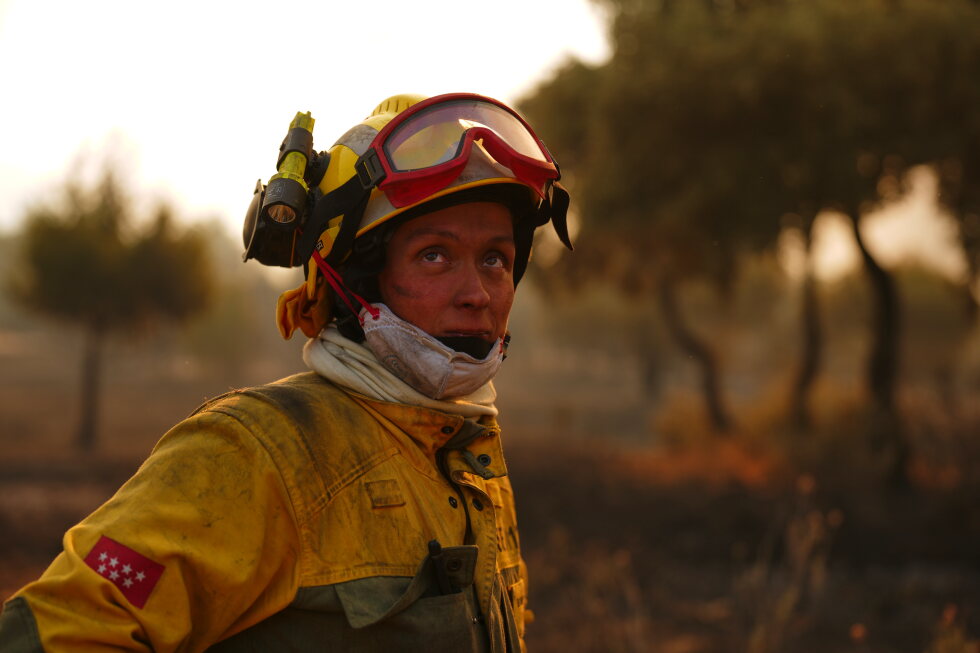
PARIS — Unrelenting heat waves and months of deficient rainfall across Western Europe have sparked catastrophic, historic wildfires that have driven hundreds of thousands of people from their homes, marking one of the largest mass evacuation efforts on the continent since World War II. Forecasts of even higher temperatures later this week threaten to hinder containment efforts, as blazes have already scorched an area four times the size of Paris across southwestern France and continue to burn dangerously close to Spain’s capital, Madrid.
Decades of climate data confirm that Europe is warming faster than most other regions on the planet, and 2025 has already seen multiple extreme heat events that have primed the landscape for uncontrollable wildfire. While Spanish firefighters have described the current blazes as too intense for direct frontal attacks, officials in France reported a small but hopeful development on Monday: the rapid spread of the massive Gironde region fire appears to be slowing for the first time.
A core driver of this disaster is the rising heat and dryness amplified by human-caused climate change. Prolonged above-average temperatures starting with a record-breaking June heat wave created widespread drought conditions across the region. Extreme heat saps moisture from vegetation, turning even normally damp brush and trees into perfectly flammable fuel that allows flames to spread much faster and burn with far greater intensity than historic wildfires. This summer’s extreme heat was effectively impossible without the influence of climate change, according to a June analysis from the international research collective World Weather Attribution.
French national meteorological service Météo-France confirmed that June 2025 was the hottest ever recorded in the country, with average temperatures 3.8 degrees Celsius (6.8 degrees Fahrenheit) higher than long-term norms, while total rainfall dropped to nearly half the average for the month. Spain, which already faces regular summer wildfire season, has seen conditions grow far more dangerous as climate change pushes summer temperatures higher and extends dry periods. Compounding this risk is the decades-long decline of traditional farming and forest industries that once cleared overgrown vegetation, leaving large swathes of unmanaged wilderness primed to ignite like a tinderbox.
This year’s wildfire season has already shattered all previous European records. Data from the European Union’s European Forest Fire Information System shows more than 300,000 hectares (3,000 square kilometers, or 1,160 square miles) have burned across France and Spain alone to date. France’s Interior Ministry reports that 115,000 hectares (1,150 square kilometers, 444 square miles) have burned in the country since January – the highest annual total recorded in France’s modern history, surpassing all previous full-year wildfire damage.
In Spain, the total burned area so far this year has reached 153,000 hectares (1,530 square kilometers, 591 square miles), six times the total area burned in the first half of 2024, according to Ecological Transition Minister Sara Aagesen. Just over a week ago, the country saw its second largest and third largest wildfires on record burn simultaneously. One blaze in rural Avila, located west of Madrid, alone consumed more than 50,000 hectares of land. Earlier this month, 13 people died in a wildfire in southeastern Almeria, marking Spain’s deadliest wildfire event in recent memory.
To date, more than 300,000 people have been displaced from their homes across the two countries, an event the European Union described Monday as one of the largest evacuation operations in modern European history. In France alone, more than 250,000 people have been evacuated, 220,000 of them from the southwestern Gironde region. As France prepares to enter its peak August tourist season, Gironde officials have implemented strict emergency measures, closing popular holiday destinations and banning holiday camps for children and people with disabilities to avoid putting more lives at risk. In Spain, the government confirmed 76,000 people have been evacuated, while an additional 30,000 remain confined to their homes as fires advance near their communities.
European countries have rallied to support the affected nations through cross-border emergency aid. European Commissioner for crisis management Hadja Lahbib announced Monday that the EU has coordinated the deployment of seven firefighting aircraft and four helicopters from Czechia, Croatia, Germany, Portugal, Slovakia, Sweden and Turkey to France, while an additional six planes from Greece, Italy and Turkey have been sent to Spain. “No country should ever have to face a disaster of this scale alone,” Lahbib said in a statement. “To the people of France and Spain: Europe will stand with you until the fires are out.” The EU’s Copernicus satellite program is also providing emergency responders with real-time, updated maps of fire risk to support containment efforts.
Reporting contributions from Gabor Szalai in Budapest, Hungary, Joseph Wilson in Barcelona, Spain, and Sam McNeil in Brussels.