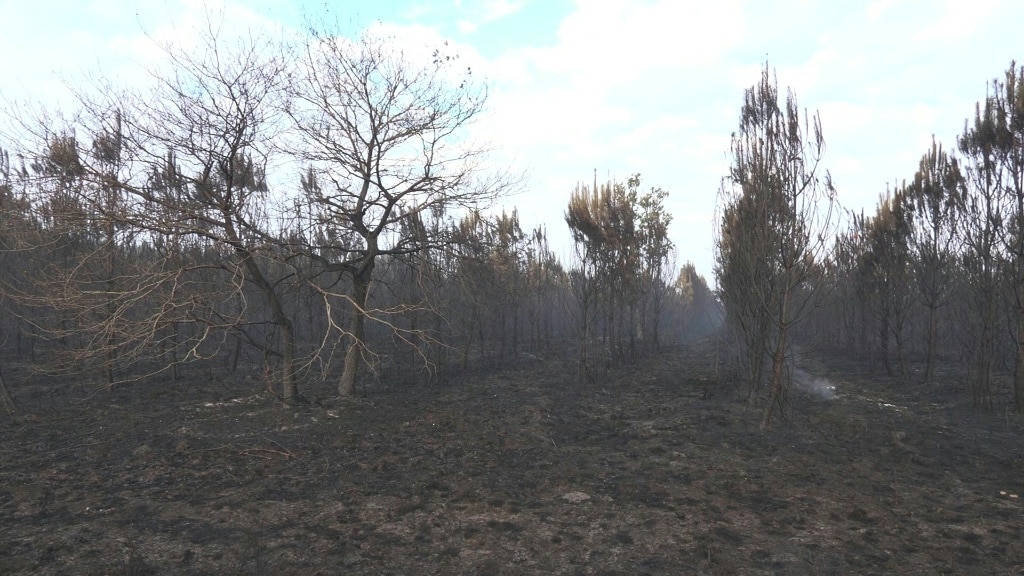
As emergency shelters across France and Spain hit overflow capacity on Monday, thousands of exhausted local residents and summer tourists face displacement from some of the most devastating wildfires the region has seen in decades — blazes so extreme they are generating their own weather patterns, with a new record-breaking heatwave already forecast to arrive in the coming days.
The infernos are tearing through parched forest landscapes: one in southwest France surrounding Bordeaux’s world-famous wine-growing region, and a second cluster burning across central Spain near the capital Madrid. The outbreak has struck at the peak of the Northern Hemisphere summer travel season, upending hundreds of thousands of lives and devastating vast swathes of protected woodland.
To date, more than 325,000 people have been forced to evacuate their homes and vacation accommodations. The fires spread rapidly fueled by vegetation left tinder-dry by back-to-back heatwaves and near-total lack of rainfall across the region since May.
Speaking from a closed highway in the Madrid region, 50-year-old Olga Congacha, a resident of the locked-down village of Robledo de Chavela, described the chaotic evacuation. “Everyone had to get out of the village quickly — it was a critical situation and people were scared. My husband and I left with all that we could grab: our important documents and some clothes,” she told Agence France-Presse.
In France, the scale of the blazes has spawned an unprecedented meteorological phenomenon for the country: pyrocumulonimbus clouds, giant fire-generated storm clouds that produce their own powerful winds, lightning strikes, and in some cases tornadoes, all of which can spark new secondary blazes. Eric Brocardi, spokesperson for France’s National Firefighters Federation, called the battle a classic “David-versus-Goliath” scenario, adding that crews were working to identify a vulnerable weak point in the fire’s perimeter to launch a coordinated counterattack.
Thousands of frontline firefighters, supported by a fleet of specialized water-bombing aircraft, have been working around the clock to contain the flames and clear toxic smoke that has blanketed residential and tourist areas. French President Emmanuel Macron convened an emergency crisis cabinet meeting on Monday to coordinate the national response, while Spanish Prime Minister Pedro Sánchez traveled to a newly burned area in eastern Spain’s Valencia region, where crews are battling a fresh outbreak.
Spain’s civil protection chief, Virginia Barcones, described the massive wildfire burning near Avila as a “monster” in comments Sunday to state broadcaster TVE. “We are dealing with a perimeter of 280 kilometres encompassing 77,000 hectares (190,000 acres),” she said.
Climate scientists have long warned that human-caused climate change is increasing both the frequency and intensity of extreme heat events and wildfire risk across southern Europe. In France’s Gironde department, the epicenter of the country’s blazes, regional prefects have urged all non-resident tourists to avoid the area entirely and seek alternate summer destinations. “The wind is changing so much, it’s really the fire calling the shots,” one frontline firefighter told reporters.
Since Wednesday alone, the Gironde fire has ravaged more than 42,000 hectares of land — an area seven times larger than the island of Manhattan. Around 220,000 people have been evacuated from the region, 45 seasonal campsites have been forced to close, and an estimated 40,000 summer tourists have had their vacation plans ruined. An additional 30,000 people have been displaced by blazes in other French regions. As of early Monday, local Gironde authorities reported the fire remained “broadly stable” after overnight containment efforts.
In Saint-Jean-d’Illac, one of the villages at the edge of the fire zone, Georges Clivaz refused to evacuate despite an official evacuation order issued Friday. Holding a garden hose to spray down the perimeter of his property a few kilometers from the active blaze, Clivaz said he and his family were staying to protect their home. “We’re doing this to slow down the fire’s advance; we want to save our homes,” he told AFP. “But the firefighters are telling us that in two or three hours the fire will be here.”
Weather forecasters have confirmed a new heatwave will descend on parts of France starting Tuesday, with temperatures forecast to hit 40 degrees Celsius (104 degrees Fahrenheit) in some affected areas. Across Spain, a total of 75,000 residents have been evacuated across the Madrid region, Avila, Toledo, and Castellon in eastern Valencia. On Monday, authorities reported the main fire was still “not yet under control,” but noted enough progress had been made to reopen one evacuated campsite that held 4,500 people and allow elderly residents to return to their homes in another low-risk area, should conditions hold.
Officials added that shifting winds were currently pushing wildfires near Madrid southward, away from the capital, but the blaze’s path has forced additional evacuations of small villages in its trajectory. To date, the blazes have claimed three lives: one civilian fatality near Valencia on Saturday, and two French firefighters killed near Bordeaux earlier this week.