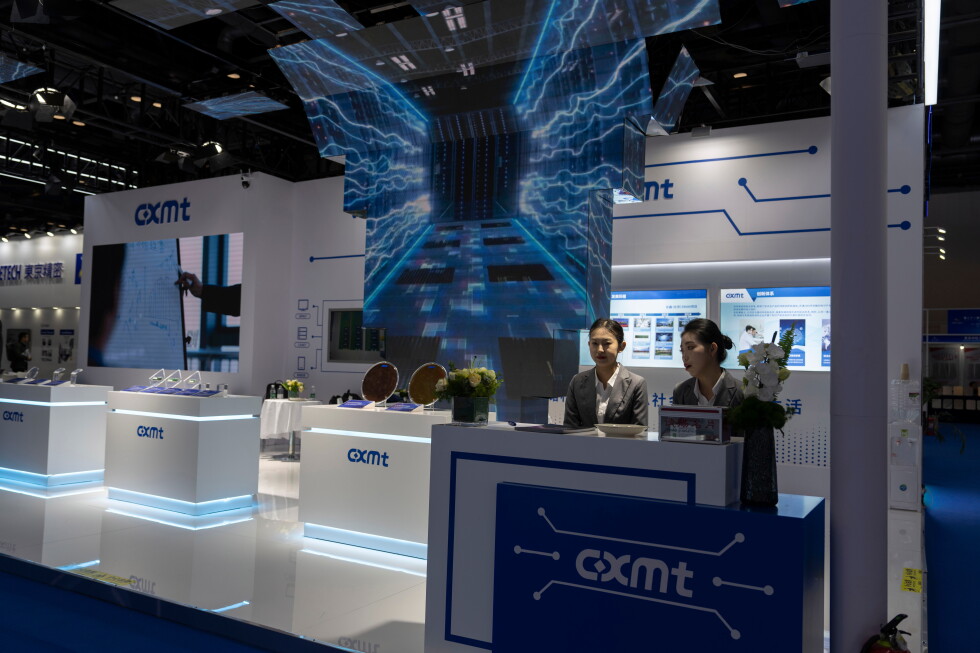
On Monday, ChangXin Memory Technologies (CXMT), China’s leading domestic memory chip manufacturer, made a historic trading debut on Shanghai’s Science and Technology Innovation Board (STAR Market), triggering a dramatic surge in share prices that cemented its status as one of the world’s most valuable semiconductor companies. The landmark initial public offering (IPO) raised at least $8.6 billion, making it the second-largest mainland Chinese share sale in history, surpassed only by Agricultural Bank of China’s $22.1 billion dual offering in Shanghai and Hong Kong back in 2010.
Priced at 8.66 yuan ($0.13) per share, CXMT’s stock opened to overwhelming investor demand, climbing as much as 472% in morning trading and holding onto a 462% gain by early afternoon. The explosive rally pushed the chipmaker’s total market capitalization to roughly 3.3 trillion yuan, equal to more than $487 billion. While that valuation makes CXMT the most valuable listed firm on mainland China’s exchanges, it still lags behind global industry giants including South Korea’s Samsung Electronics and SK Hynix, as well as U.S.-based Micron Technology.
Founded in 2016 in Hefei, a major technology hub in eastern China, CXMT specializes in manufacturing dynamic random access memory (DRAM) chips — semiconductors that form a critical component for everything from AI data center servers and electric vehicles to consumer smartphones and personal computers. As of the first quarter of 2026, CXMT holds roughly 9% of global DRAM shipment market share, up slightly from 8% for the full year 2025, per data from Counterpoint Research. That ranking places it fourth globally, behind Samsung (36%), SK Hynix (29%), and Micron (24%). Counterpoint forecasts CXMT’s global share will climb to 11% by 2028, but the firm notes the company will need to reach at least 15% market share to maintain long-term global competitiveness.
CXMT’s explosive growth has been fueled largely by the global artificial intelligence boom, which has sent demand for high-performance memory chips soaring and created a widespread global shortage that has pushed up prices for electronics ranging from laptops to smartphones. In the first three months of 2026 alone, CXMT’s revenue skyrocketed 700% year-over-year to 50.8 billion yuan ($7.5 billion), driven by unmet demand from AI developers and server builders.
For China, CXMT carries strategic importance beyond its commercial success: it is the country’s leading candidate to develop domestic high-bandwidth memory (HBM) chips, a cutting-edge DRAM variant critical for powering large AI models. U.S. export restrictions already block Chinese firms from importing HBM from foreign suppliers, as part of broader American-led limits on access to advanced semiconductor technology designed to slow China’s technological advancement. Washington has also restricted exports of the most advanced chipmaking manufacturing equipment to Chinese firms, forcing CXMT to rely on domestic equipment suppliers to scale production.
“CXMT plays a critical role in China’s AI push, particularly in the face of U.S. export controls,” explained Kyle Chan, a Brookings Institution fellow and expert on China’s technology policy. Chan added that a key open question is whether CXMT can expand production fast enough to help ease the ongoing global memory chip shortage. MS Hwang, Counterpoint Research’s memory semiconductor research director, noted that trade restrictions on advanced manufacturing tools remain the single biggest barrier to CXMT’s long-term growth. In recent months, some U.S. lawmakers have even called on the current U.S. administration to block American companies from purchasing CXMT chips over purported national and economic security concerns. The U.S. Pentagon has already added CXMT to its list of Chinese companies designated as having alleged links to the Chinese military, a designation Beijing has repeatedly rejected as unfounded.
The CXMT IPO comes just weeks after South Korean peer SK Hynix raised $26.5 billion through its own Nasdaq listing, highlighting the intense investor appetite for memory chip makers amid the ongoing AI boom.