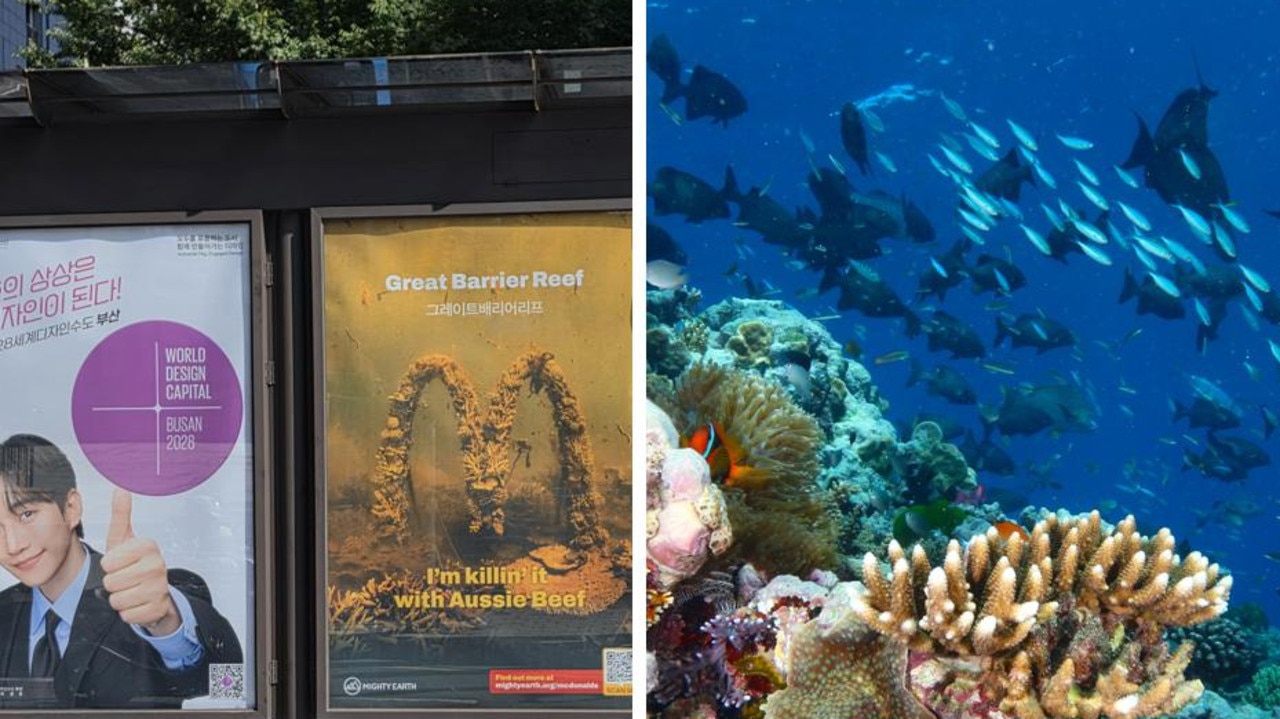
As the UNESCO World Heritage Committee convenes this week in Busan, South Korea, to deliberate on the long-term future of Australia’s Great Barrier Reef, environmental campaigners have launched a high-profile public campaign across the coastal city to pressure global and local fast-food chains over their links to deforestation that threatens the natural World Heritage site.
Last week, UNESCO’s cultural branch upheld a draft ruling that opted against adding the 2,300-kilometer reef to the organization’s “in danger” list, a decision that Australian federal authorities framed as a validation of years of investment and policy reform to protect the ecosystem. Last year, the Australian government passed sweeping legislative changes that introduced federal oversight of land clearing in the reef’s river catchment areas and established the country’s first-ever National Environmental Protection Agency, capping off years of back-and-forth negotiations between Canberra and UNESCO.
But environmental organizations have pushed back against claims of sufficient progress, arguing that the Australian government must speed up and expand conservation reforms, while also holding major food corporations accountable for their role in accelerating ecosystem decline. Campaigners argue that beef suppliers for major fast-food brands are directly tied to large-scale land clearing in the reef’s catchment zones, where deforestation for cattle grazing drives sediment pollution that damages fragile coral habitats.
To amplify their message during the week-long committee meeting, campaigners from Australian and global environmental groups have blanketed Busan – a city of more than 3 million residents – with attention-grabbing advertisements, including subway signs, bus shelter billboards, and even a flying blimp. The most viral of these ads parodies McDonald’s iconic golden “M” logo and famous slogan “I’m lovin’ it”, reworking it to read “I’m killin’ it with Aussie Beef” alongside a graphic of bleached coral. The modified slogan, printed in both English and Korean, appears across all campaign materials deployed across the city.
Kristin Urquiza, senior adviser for global environmental organization Mighty Earth, explained that the campaign targets McDonald’s alongside other major chains including Burger King and South Korea’s homegrown leading burger brand Lotteria, noting that 70% of McDonald’s locations worldwide – including those in South Korea – source Australian beef. South Korea is the third-largest market for Australian beef by value, trailing only the United States and China, with roughly one-third of all beef consumed in the country coming from Australian farms.
“Land clearing for grazing is the single biggest driver of sediment pollution that harms the Great Barrier Reef, and companies buying beef from cleared reef catchments are part of that harmful supply chain,” Urquiza said. “Australia has never met its own domestic targets for cutting sediment pollution flowing onto the reef, so corporate action is critical to driving change.”
Environmental experts confirm that deforestation in catchment areas that drain into the Great Barrier Reef releases large volumes of sediment into the marine ecosystem, which smothers coral and degrades critical inshore reef habitats. Data collected by the Australian Conservation Foundation shows that between 2018 and 2023, more than 856,700 hectares of forest and woodland were cleared in the reef’s catchment zones, 84% of which was cleared to make space for cattle grazing. The Burdekin and Fitzroy catchments alone – with the Fitzroy ranking as Australia’s second-largest sea-draining basin – dump more than 4.9 million tonnes of sediment into the reef’s waters every year.
Nathaniel Pelle, deforestation expert at the Australian Conservation Foundation, added that while a majority of Australian cattle producers prioritize responsible land stewardship to protect threatened ecosystems, a small minority continue clearing native forests that undermines the collective effort to protect the reef. “Every burger, sausage and steak sold by major retailers and chains should come from Australian producers that have committed to zero deforestation,” Pelle said.
McDonald’s has previously framed Australia as a high-priority market for its deforestation-free beef procurement policy, alongside other major beef producing nations including Brazil, Argentina, and Uruguay. In its official policy, the company states that it has collaborated with producer groups for years to “better understand and address the links and drivers between beef production, deforestation and conversion”.
For its part, the Australian government has welcomed UNESCO’s recent decision not to list the reef as in danger, with Environment Minister Murray Watt saying the ruling recognizes “Australia’s strong collaboration and ongoing efforts to protect the reef”. “While challenges like climate change remain significant, today’s recognition demonstrates that Australia’s long-term investments, strong management and governance frameworks and collaborative approach are delivering tangible results,” Watt said. “We will continue to build on our comprehensive suite of actions, leverage strong partnerships, and utilise our world‑leading reef management to support the Great Barrier Reef’s resilience into the future.”
Since 2014, the Australian federal government and the Queensland state government – which jointly manage the reef – have invested more than $5.3 billion in conservation initiatives. The Great Barrier Reef is one of Australia’s most important economic assets, supporting hundreds of thousands of jobs and contributing roughly $9 billion annually to the national economy. Alongside the Great Barrier Reef assessment, the World Heritage Committee is also set to discuss this week the Statement of Outstanding Universal Value for Australia’s recently inscribed Murujuga Cultural Landscape, a sacred Indigenous site in Western Australia home to tens of thousands of ancient rock engravings.