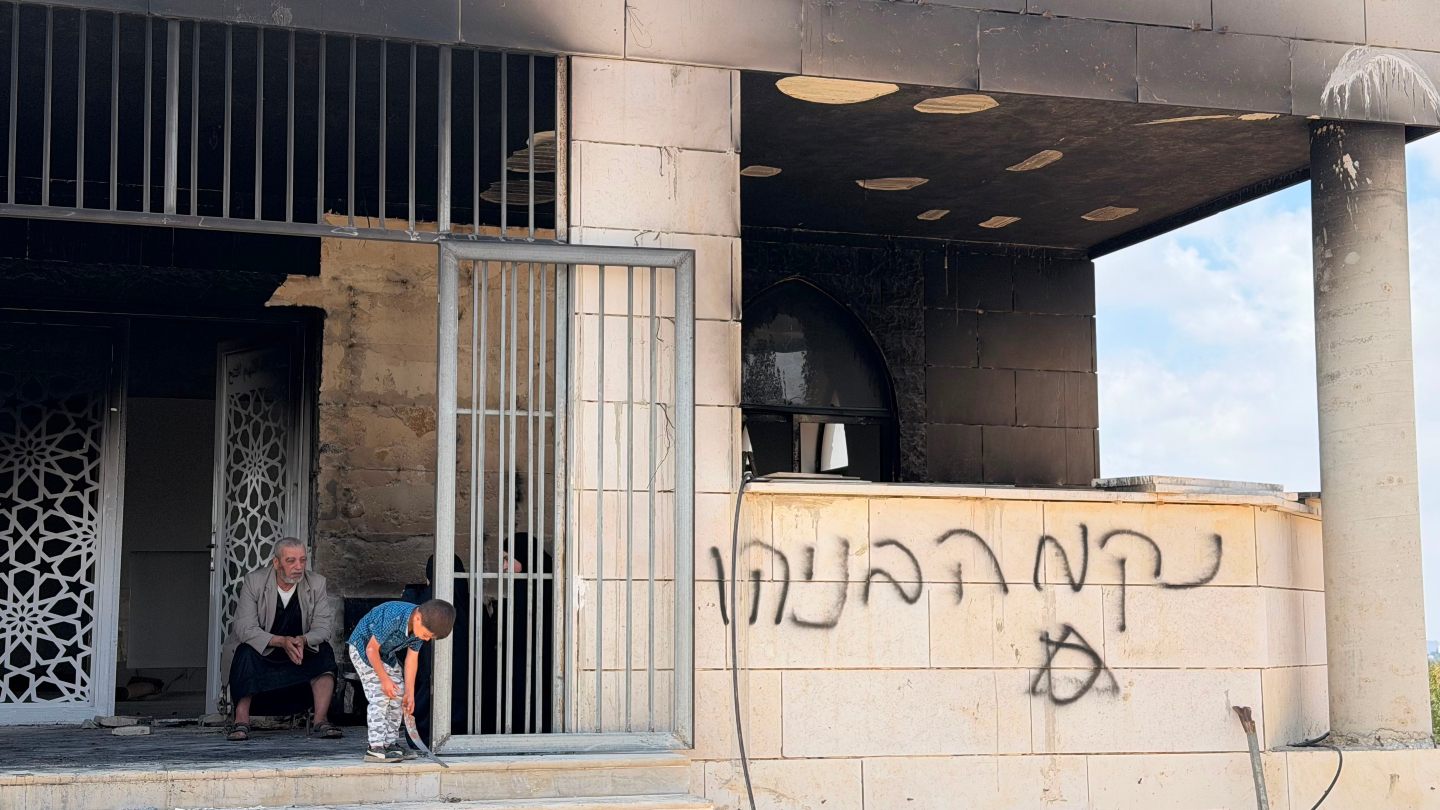
On a Sunday in late July 2026, Israeli settlers carried out a coordinated wave of violent attacks spanning multiple districts across the occupied West Bank, leaving two mosques destroyed, infrastructure damaged, and dozens of Palestinian residents terrorized. Palestinian officials confirm the assaults were conducted under the direct protection of Israeli military forces, marking one of the broadest single-day settler offensives targeting Palestinian communities in recent months.
The most destructive attacks targeted places of worship, in what Palestinian religious leaders call a deliberate attempt to inflame religious tensions. In the village of Qusra, located south of Nablus, settlers set large portions of the newly completed al-Rahma Mosque ablaze. Local activist Abdul-Azim Wadi told Middle East Eye that he was alerted to the arson at 2:30 a.m., when residents rushed to the scene to battle the fire before fire crews could gain access. Just one day prior, villagers had finished renovating and recarpeting the mosque in preparation for its official opening in the coming days. The blaze left extensive damage, including partial collapse of several interior walls. Investigating the site after the attack, residents found racist Hebrew-language slogans spray-painted across the mosque’s outer walls, including phrases reading “Israel will be established with blood” and “Mosques will not frighten us.” The graffiti made clear the arson was carried out as revenge for the recent killing of settlers in the nearby Tell area. Wadi added that Qusra has been a repeated target of settler aggression: in 2011, settlers burned another village mosque, in 2023 they killed six Palestinian residents in a single day of violence, and in 2024 they set fire to 47 residential and agricultural structures across the village.
A second mosque was attacked in the village of Kur, south of Tulkarm, where settlers also set the building on fire and left revenge-themed racist graffiti on its walls.
Beyond religious sites, settlers targeted Palestinian economic infrastructure and private property across eight additional West Bank governorates: Ramallah, Hebron, Salfit, Qalqilya, Jericho, and Jerusalem. In the Ain Samia region, northeast of Ramallah, assailants raided a privately owned Palestinian stone quarry, setting more than 10 pieces of heavy industrial equipment including excavators, bulldozers, and transport trucks on fire. Quarry owner Abdel Samad Abdel Aziz estimates total damages at 2 million Israeli shekels, equal to roughly $666,000. The assault left three security guards injured after settlers beat them and attacked them with pepper spray. Abdel Aziz noted that while his quarry has been targeted by vandalism in the past, this was the first large-scale arson attack. He added that the Israeli military delayed entry for Palestinian fire crews, allowing the fires to burn uncontrolled for hours and significantly worsen the total damage.
Across other West Bank communities, the violence extended to civilian infrastructure and residents: in Beitillu, northwest of Ramallah, multiple Palestinian-owned vehicles were set ablaze. In Beit Furik, east of Nablus, settlers attempted to burn down a private home after spray-painting inciting slogans on its exterior, but were forced to flee by alerted local residents. Near the Karnei Shomron settlement, built on expropriated Palestinian land east of Qalqilya, settlers blocked and attacked an ambulance transporting a critically ill patient, forcing the vehicle to turn back to its point of origin. Near Mitzpe Yericho, southwest of Jericho, settlers stoned passing Palestinian civilian cars. In Bani Na’im, east of Hebron, assailants blocked a key access road to the desert region east of Yatta with piles of excavated soil. East of Jerusalem, armed settlers opened live fire on residents of a Bedouin community near the village of Jaba’, before setting a residential home and a civilian vehicle on fire. Along the Wadi Qana highway connecting Salfit and Qalqilya, settlers stoned passing Palestinian vehicles, while simultaneously establishing a new unauthorized settlement outpost on privately owned Palestinian land belonging to the village of Deir Istiya, according to Palestinian officials.
Palestinian authorities have issued widespread condemnation of the attacks. The Palestinian Higher Fatwa Council called the assaults part of a deliberate, systematic campaign targeting Palestinian religious sites. “The burning of al-Rahma Mosque in Qusra and the mosque in Kur represents a new crime that falls within the systematic and dangerous policy of the Israeli occupation targeting holy sites and places of worship,” the council said in an official statement. The body also warned that repeated attacks on holy sites, including repeated incursions into the Al-Aqsa Mosque compound in East Jerusalem, carry a severe risk of escalating regional tensions across the entire Middle East.
The Palestinian Ministry of Foreign Affairs echoed the condemnation, framing the violence as organized state-backed settler terrorism. “Targeting mosques and other places of worship, and writing racist and inciting slogans on their walls, reflects the true face of the racist, settler-colonial occupation and its ongoing attempts to transform the political conflict into a religious one, in order to fuel hatred and justify its crimes against the Palestinian people,” the ministry said. The statement emphasized that the attacks are the direct result of a long-standing policy of impunity for settler violence, where Israeli forces provide protection for assaults and do not hold perpetrators accountable. The ministry called on the international community, the United Nations, and all relevant global bodies to implement binding practical measures to halt the violence, designate armed settler groups operating in the West Bank as terrorist organizations, and impose harsh deterrent sanctions on settler perpetrators and their backers to ensure accountability for crimes against Palestinian civilians.
Data collected by Palestinian advocacy groups shows that this recent wave of violence is part of a rapidly escalating trend of settler aggression in 2026. The Wall and Settlement Resistance Commission reports that Israeli forces and settlers carried out roughly 11,074 separate attacks against Palestinian communities in the West Bank during the first half of 2026 alone. The Palestinian Information Center documented 6,856 separate violations of Palestinian rights just in the month of June. Currently, approximately 750,000 Israeli settlers reside in the occupied West Bank, distributed across 141 officially recognized Israeli settlements and 224 unauthorized outposts, built on expropriated Palestinian land. Roughly 250,000 of these settlers live in settlements east of Jerusalem, amid daily attacks targeting Palestinian residents, their agricultural land, and their private property.