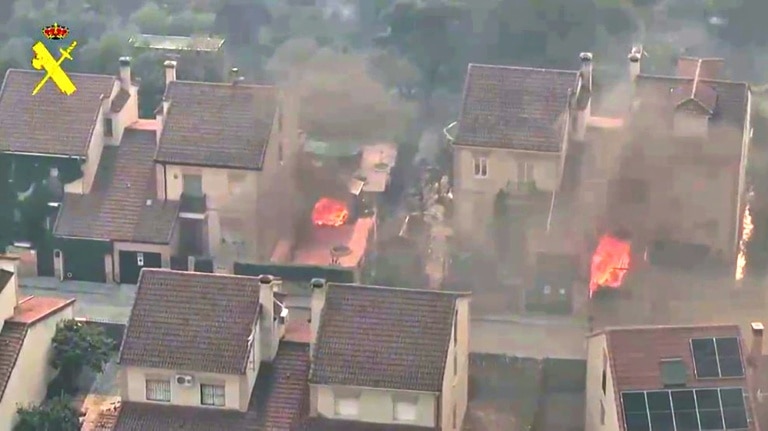
Across southwestern France and central Spain, out-of-control wildfires have carved a path of destruction, forcing hundreds of thousands of residents to flee their homes, shutting down key transport links and prompting a major military deployment to combat the blazes. The rapid spread of the infernos, fueled by unseasonably high temperatures and strong gusty winds, has created one of the most severe wildfire crises Europe has faced in decades, with new developments unfolding hourly over the weekend.
In France’s Gironde region, the massive wildfire burning outside the major city of Bordeaux has already consumed 42,000 hectares of forest and inhabited land, marking it as one of the largest single wildfire events recorded in the country since the end of World War II. For context, the largest wildfire in modern French history, recorded in 1949, scorched roughly 50,000 hectares. By Sunday, the scale of evacuations from Gironde and surrounding at-risk areas had surpassed 220,000 people, with an additional 55,000 villagers ordered to leave their homes overnight Saturday as the fire line advanced toward populated areas. Further south in the Landes region, another 30,000 residents have already been relocated to emergency shelters away from the advancing flames.
To bolster firefighting efforts, the French government announced it would deploy an extra 500 soldiers to the southwestern fire zone, bringing the total number of military personnel supporting response operations to 1,500. Defense officials confirmed the troops will support local emergency teams with evacuation logistics and help secure abandoned properties to prevent looting and further damage.
Strong winds pushed the Gironde fire across containment lines over the weekend, forcing authorities to close 60 kilometers of the A63 motorway, the primary highway connecting Bordeaux to the Spanish border. National rail operator SNCF also suspended passenger and freight service along a 100-kilometer stretch of track south of Bordeaux, cutting off a key north-south transport link for the region.
French officials have warned residents that the battle against the blazes will be a prolonged one. Following a downward revision of weather forecasts, Prime Minister Sebastien Lecornu cautioned late Saturday that “the coming hours could be difficult” for crews working to contain the fire near Bordeaux. Interior Minister Laurent Nunez added that evacuated residents would not be permitted to return to their properties until the blaze is fully contained and the area is deemed safe.
In a surprising development, three local men were taken into custody Saturday in Gironde on charges of endangering public life. Prosecutors confirmed two of the three are accused of setting off unauthorized fireworks in a dry, wooded area, an act investigators believe may have sparked one of the regional blazes that has now scorched more than 32,000 hectares.
The wildfire crisis is not isolated to southwestern France. In southeastern Var, the Ponteves wildfire remained “very active” on Sunday after five days of burning, having already destroyed 4,000 hectares of land and leaving roughly 2,000 displaced residents unable to return to their homes. On the island of Corsica, firefighters continued to battle an out-of-control blaze near the town of Corte that has spread across more than 800 hectares of vegetation.
The cross-border crisis has hit Spain just as hard. As of Sunday, at least 60,000 people have been forced to evacuate wildfire zones surrounding the capital city of Madrid. On Saturday evening, Spanish authorities ordered the evacuation of eight additional municipalities near Toledo, located west of Madrid. All residents of Buenaventura, Navamorcuende, Real de San Vicente, Hinojosa de San Vicente, Castillo de Bayuela, Garciotum, Nuno Gomez and Pelahustan were instructed to leave their homes immediately as the fire advanced. In eastern Spain’s Valencia region, one person has already been confirmed dead in a wildfire that was only contained by firefighters after it spread through populated areas.
The widespread destruction has even disrupted major international events. Organizers of the Tour de France announced Sunday that they would shorten the race’s final stage in a show of solidarity with affected communities. The original route, which was set to run from Thoiry to Paris, will be adjusted to avoid passing through fire-impacted regions of southwestern France.
As fire crews from across the continent work to contain the blazes, officials warn that ongoing heat and dry conditions are likely to keep wildfire risk elevated across much of Southern Europe through the coming weeks.