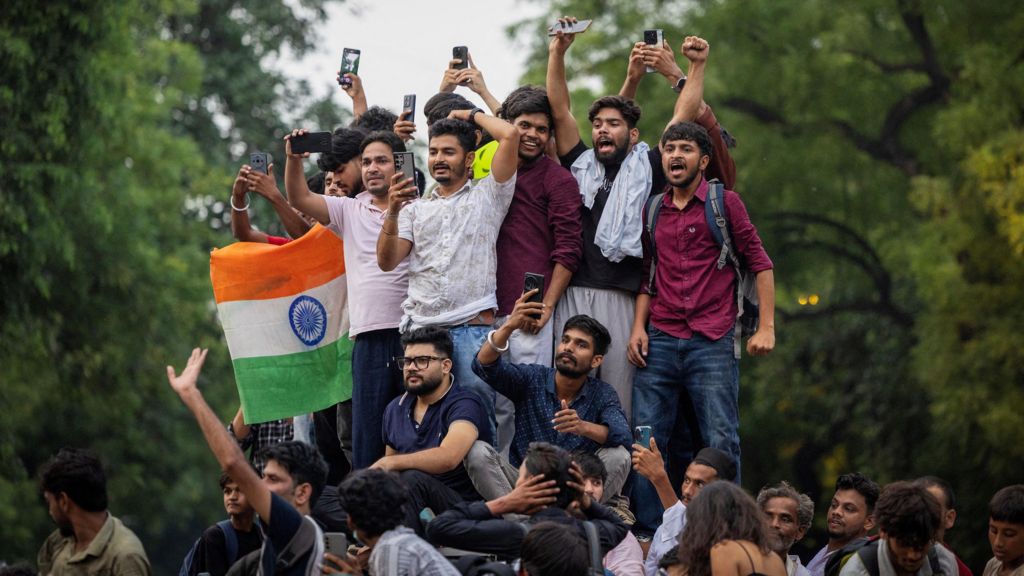
In a landmark victory for grassroots youth dissent in India, embattled Education Minister Dharmendra Pradhan has stepped down from his post, prompting jubilant celebrations among protesters and leading the movement that forced his ouster to end its five-week campaign. The unexpected outcome marks one of the most significant blows to Prime Minister Narendra Modi’s ruling administration in recent years, born from a viral satirical movement that evolved from an online joke into a powerful vehicle for widespread public discontent.
The movement behind the protest, known as the Cockroach Janta Party (CJP), is not a registered political party. It traces its origins to a controversial comment from India’s Chief Justice, who labeled unemployed young people entering activism and independent journalism as “cockroaches.” Though the justice later clarified he was only referring to individuals holding fake academic credentials, the term was reclaimed by young activists, who transformed the once-insulting label into a symbol of resilience and defiance against systemic failure. Led by 30-year-old political communications strategist and former Boston University student Abhijeet Dipke, the movement quickly amassed a massive online following, now boasting 26 million followers on Instagram, and channeled widespread youth anxiety over broken education systems, high unemployment, and repeated exam paper leak scandals into tangible street action.
The CJP’s core demands centered on comprehensive education reform, accountability for recurring exam paper leaks, and Pradhan’s resignation. The protest gained global momentum when prominent Indian activist and educationist Sonam Wangchuk joined the movement on June 28 and launched an indefinite hunger strike to back the group’s demands. As Wangchuk’s health declined, police forcibly removed him from the main protest site at Delhi’s Jantar Mantar last Saturday and transferred him to a hospital, where he continued his fast. He only ended his strike early Friday after receiving official assurances from the government that his demands would be reviewed.
Tensions escalated dramatically this week, when a peaceful march by protesters to India’s Parliament was met with a violent police crackdown that left dozens injured, hundreds hospitalized, and around 70 protesters arrested (most of whom have since been released on bail). Images and footage of the crackdown spread rapidly across social media, amplifying public anger and putting unprecedented pressure on Modi’s administration. For nearly five weeks, the government had ignored the protest, but the fallout from the police violence forced a rapid shift in strategy: on Thursday, Modi broke his silence, announcing plans to establish fast-track courts for anyone involved in exam paper leaks, and releasing a video message stating that a strict new law targeting paper leaks was already in draft form and would soon be introduced to parliament. The announcement failed to defuse tension, with social media flooded with memes and mocking posts turning the prime minister’s attempt to quell anger into viral jokes.
Hours before the CJP called off its protest, Pradhan announced his resignation in a Hindi-language post on the social platform X. In his statement, Pradhan wrote that he “respected the aspirations, dreams, and expectations of the youth” and was “pained by the events” of the preceding days. He framed his resignation as a step to “prevent anti-national forces from exploiting” the unrest, preserve national unity, and ensure that no Indian student’s future becomes “entangled in legal complexities,” allowing young people to return to their studies and career building.
As news of the resignation broke, celebrations erupted immediately at Jantar Mantar. From the protest’s makeshift stage, an emotional Dipke shouted to the crowd, “We have done it,” sparking deafening cheers. Protesters sang, danced, chanted slogans, and distributed sweets to mark the win. Even after CJP leadership announced the end of the protest and left the site hours later, thousands of jubilant supporters remained gathered at the venue deep into the night. Many told reporters they had waited weeks for the outcome and were not ready to leave without full celebration. Large numbers of police were deployed around the protest site, but officers confirmed they would only intervene if laws were broken.
Dipke called Pradhan’s resignation a clear win for democracy, but emphasized that the movement’s work is far from finished. In a post-resignation statement on X, he said the CJP would continue advocating for compensation for the families of students who died by suicide after a key medical exam was canceled over leak concerns. He also renewed calls for accountability against police officers accused of using excessive force during the July 20 crackdown on the parliamentary march, ending his statement with a defiant warning: “Remember, do not mess with [the] cockroach.”
Political analysts note that while the protest only explicitly demanded Pradhan’s resignation, it has already dealt a severe blow to Modi’s political brand and his long-held aura of invincibility. Since taking power in 2014, Modi’s government has rarely tolerated public dissent and has typically cracked down heavily on large-scale protests, making this climbdown all the more notable. This is not the first time the administration has backed down in the face of widespread public action: in 2021, the government repealed controversial agricultural laws after a year-long mass protest by Indian farmers.
The youth-led movement has resonated across broad swathes of India’s middle class, cutting across divisions of religion, caste, and industry to unify people around shared anger over limited educational opportunities and stagnant job growth. Many protesters who spoke to reporters revealed they had once supported Modi but had since abandoned the prime minister, accusing his government of dividing communities along religious lines instead of addressing pressing economic and social issues. On Saturday, opposition leaders across India welcomed Pradhan’s resignation, widely framing it as a victory for India’s young people and grassroots democratic action.