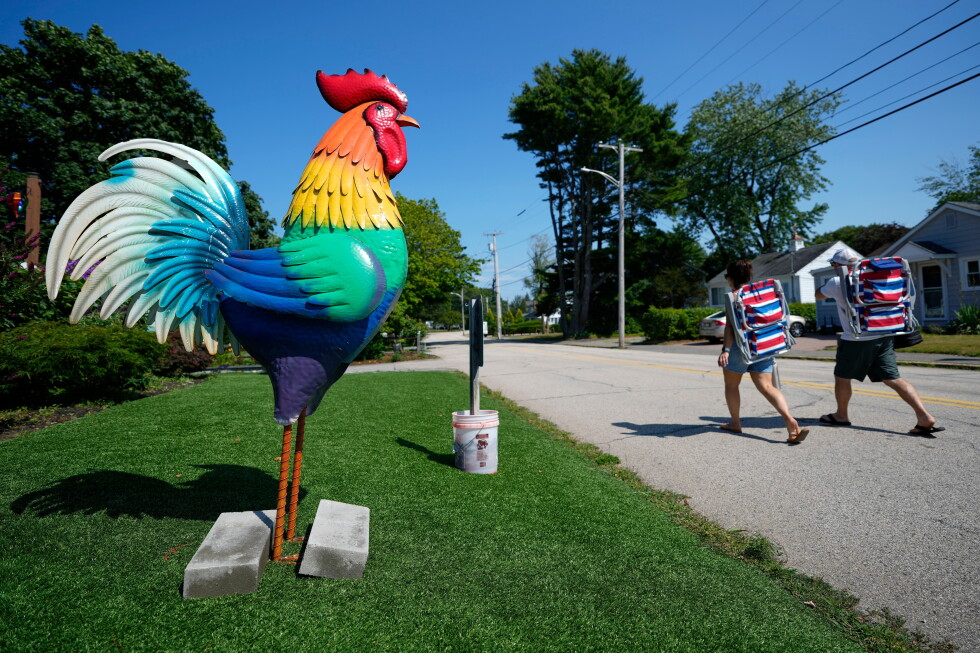
In the quiet coastal town of Ogunquit, Maine, a viral community movement centered on six-foot-tall metal rooster sculptures has captured international attention, all launched to support a 6-year-old autistic girl and her deep connection to the giant decorative creations.
The story begins with Pyper LeBlanc, a young girl adopted by David and Sara LeBlanc after joining their family as a foster child. When Pyper first arrived, she brought with her a beloved stuffed rooster, and the bird quickly became her favorite animal. During a family trip to a local Tractor Supply Store last year, Pyper spotted a large metal rooster sculpture for sale and asked her father what the statue was “saying.” David jokingly replied, “I think he wants to come home,” and the family brought the rooster home with them.
Over time, the LeBlancs’ collection grew to more than two dozen giant roosters, which they rotated on their front lawn for seasonal and holiday displays. For Pyper, the roosters became far more than just yard decor: every morning while waiting for her school bus, she hides behind one of the giant statues, a routine that her parents say helps her regulate her emotions and navigate the transition from home to school. Comfort objects like these are widely recognized as beneficial for autistic children, explained Beverley Cush Evans, a special education professor at Lesley University, noting that familiar items support emotional regulation and create a sense of safety for neurodivergent youth during periods of change.
Conflict emerged earlier this year, however, when Ogunquit code enforcement officer Tyler McOsker ruled that the lawn roosters counted as unpermitted advertising for the LeBlancs’ adjacent restaurant, The Omelette Factory. After the couple added a rooster graphic to their restaurant logo and branded merchandise, the town classified the lawn sculptures as commercial signage. McOsker issued $450 in fines in April and ordered all roosters removed, citing a 2025 local newspaper article that described the statues as an unconventional way to advertise the restaurant’s opening. David LeBlanc pushed back against this characterization, explaining that the quote was a misinterpretation of a customer’s joke, and that the roosters existed solely for Pyper’s comfort, not business promotion. McOsker later told the Zoning Board of Appeals he had no awareness of the roosters’ connection to Pyper’s autism until the couple appealed the fines.
During a June zoning board meeting, some members raised questions about the necessity of the large collection, with one member asking for medical proof of the roosters’ benefit and questioning how many sculptures the family actually needed. Ultimately, the board ruled it did not have the authority to cancel the existing fines, but it approved a disability variance allowing the LeBlancs to keep two roosters on their property, with the caveat that the number would not be allowed to grow. The variance requires the roosters to be integrated into a home railing, however; since the family has so far only bolted the roosters to their front steps, they have been issued an additional $500 in fines for noncompliance.
Rather than fighting the ruling, David LeBlanc chose to reframe the situation, offering the extra roosters to community members who wanted to foster them as a show of support for Pyper and autism acceptance. What started as a local gesture quickly spread into a global movement, amplified by local news coverage and the *Roosters of Ogunquit* Facebook page. Giant roosters have now appeared on front lawns across southern Maine, from motel properties in nearby Wells to the grounds of Ogunquit’s Memorial Library. Support has even reached as far as New Zealand, where one supporter shared photos of his own family’s rooster display in solidarity.
Hetal Patel, owner of a motel in Wells who has a neurodivergent relative, was so moved by Pyper’s story that she drove all the way to New Hampshire to track down a rooster after local stock sold out. “We found the last one,” she said. “We couldn’t wait to put it out. People were so supportive, they were honking. It was so nice to see all the love for Pyper.”
LeBlanc says Pyper understands the silver lining of the conflict: “She understands that the roosters being taken away were the lemons, and Sam and his friends, fostering them, are the lemonade. It’s a beautiful thing.”