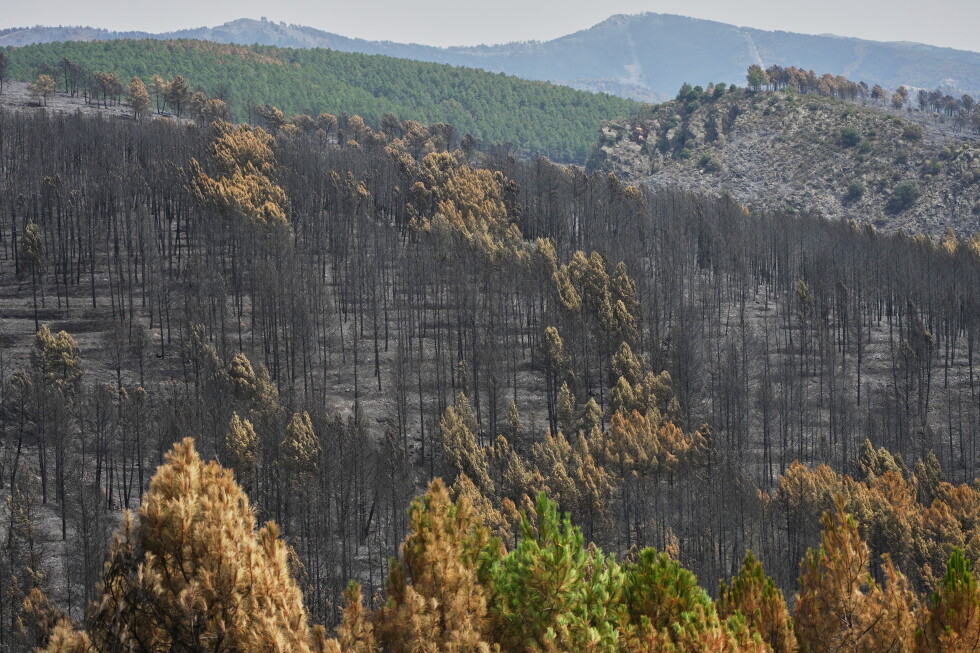
On July 22, 2026, hundreds of firefighters and aerial water-bombing teams continued their battle against an unprecedented wildfire burning through rural central Spain’s Guadalajara province, a blaze already ranked as one of the largest the southern European nation has faced in modern history. As of Wednesday, the inferno had scorched more than 32,000 hectares (79,000 acres) of land, 90% of which lies within a protected national park, forcing the evacuation of 34 nearby villages.
The emergency comes less than two weeks after a far deadlier wildfire ripped through a small coastal expat community in southern Spain, killing 13 people—including multiple foreign residents—in one of Spain’s deadliest wildfire events on record. Unlike that earlier blaze, no fatalities or critical injuries have been reported from the Guadalajara fire so far, a small relief for responding authorities.
During an official visit to the fire-stricken town of Tamajón, a two-hour drive northeast of the Spanish capital Madrid, Prime Minister Pedro Sánchez highlighted the clear link between rising global temperatures and the growing wildfire crisis facing the nation. “Year after year we clearly see how climate change kills and destroys wealth in our communities,” Sánchez told reporters on site. He emphasized that the threat of climate breakdown is not a partisan political issue, but a fact-backed scientific reality, and issued a call for all national political parties to join a unified cross-party pact to strengthen Spain’s climate action and wildfire preparedness.
Sánchez also shared grim new data showing the accelerating scale of Spain’s 2026 wildfire season: the country has already recorded 22 major blazes (defined as fires burning more than 500 hectares) this year. The total area scorched by wildfires across Spain in 2026 is already four times the amount burned by this point in 2025, with more than 100,000 hectares (247,000 acres) lost as of mid-July—already matching the full-year average recorded over the past decade.
Spain’s Minister for the Ecological Transition, Sara Aagesen, confirmed that the Guadalajara fire is the largest wildfire ever recorded in the Castilla-La Mancha region, and one of the largest in the country’s recent history. Regional president of Castilla-La Mancha Emiliano García-Page noted that responding teams have successfully protected all residential properties across 40 villages in the fire’s path, and crews are aiming to bring the week-old blaze under full control by Friday. That timeline, however, is at growing risk from an incoming extreme heat wave that is already raising temperatures across the country.
Spain’s national weather agency has placed Guadalajara and much of inland Spain under high temperature alerts, with the current heat wave peaking between Wednesday and Thursday. Forecasters predict temperatures will climb to nearly 40°C (104°F) in most inland areas, and could exceed 42°C (108°F) in parts of southern Spain’s Andalusia region. Like many Mediterranean nations, Spain is facing a perfect storm of wildfire conditions: extreme heat, persistent drought, low rainfall and gusty winds that allow small ignitions to spread rapidly into large, out-of-control infernos.
Local officials have praised the tireless work of frontline firefighting teams. Miguel Ángel Moreno, mayor of the evacuated village Zarzuela de Jadraque, told Spain’s national broadcaster TVE that all 100 of the town’s residents were evacuated the previous Friday, with 14 residents taking shelter at a local Red Cross facility. While two local barns were destroyed in the blaze, firefighters managed to save every residential home in the village. “Besides the heroes who won the World Cup, we have other heroes who remain nameless,” Moreno said, comparing the firefighters to the nation’s recently victorious World Cup soccer squad. “(They) had to run from one side of the village to the other putting out fires.”
Climate scientists have long warned that wildfire risk across southern Europe will grow more severe as the planet warms. Data from the European Union’s Copernicus Climate Change Service confirms that Europe is warming faster than any other continent on Earth, with temperatures rising twice as quickly as the global average since the 1980s. Globally, 2025 was the third-hottest year ever recorded, bringing repeated extreme heat events across the continent. Researchers warn that climate change is intensifying the frequency and severity of heat waves and drought across southern and southeastern Europe, leaving the region far more vulnerable to destructive wildfires and public health crises.