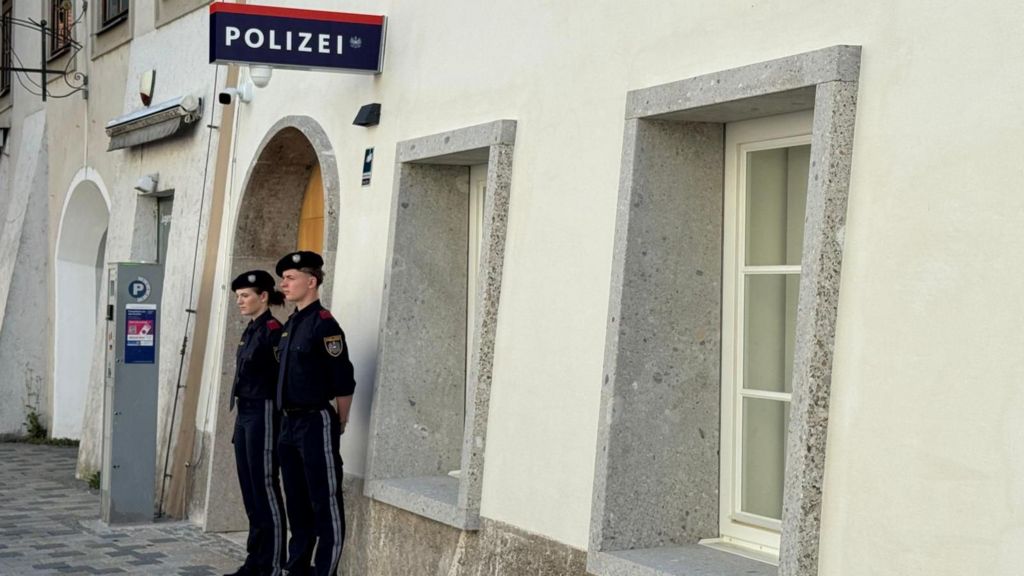
After more than a decade of public debate, legal battles, and extensive renovations, Austria has formally opened a new police station in the 17th-century building where Nazi dictator Adolf Hitler was born in the small border town of Braunau am Inn. The completion of this project marks the end of one of the most politically fraught legacy projects in modern Austrian history, as officials have long worked to block the site from becoming a shrine for neo-Nazi sympathizers and far-right extremists.
Hitler, born in the building in April 1889, only stayed at the address Salzburger Vorstadt 15 for a few weeks before his family moved within the town, and they left Braunau permanently when he was three years old. He made only one brief return visit in 1938, shortly after annexing Austria to Nazi Germany, on his route to Vienna.
For decades, Austrian authorities took a proactive step to prevent far-right tourism by renting the property from its long-time private owner, local resident Gerlinde Pommer, paying her above-market rent to block any extremist takeovers. For many years, the building housed a day center and workshop run by local disability charity Lebenshilfe, supporting people with special needs. That arrangement collapsed in 2011, when Pommer refused to approve government-led renovations and rejected repeated offers to sell the property to the state, leaving the building vacant for years amid ongoing negotiations.
The stalemate broke in 2016, when Austria’s national parliament passed a special law allowing the government to expropriate the building, awarding Pommer €812,000 (approximately £690,000) in compensation. Pommer challenged the compensation sum in court, arguing it was far below the property’s market value, but ultimately lost her legal challenge. At the time, then-Interior Minister Wolfgang Sobotka called for the entire structure to be demolished and replaced with a new building, echoing an earlier provocative proposal from a Russian lawmaker who offered to purchase the site to destroy it. That plan sparked widespread public outcry, with critics arguing that demolishing the building would amount to erasing Austria’s complicit role in the Nazi era.
In 2019, the government settled on a new plan: convert the property into a local police station, and launched a European-wide design competition for architects to reimagine the space. Millions of euros were invested in a full structural and cosmetic renovation, drastically altering the building’s original yellow-plaster facade to remove any visual connection to its historic association. The project opened to the public on Wednesday, with uniformed police posted permanently outside the building to monitor visitors.
Not all stakeholders have supported the final plan, however. Critics argue that turning Hitler’s birthplace into a police station sends the wrong symbolic message, with many calling for a dedicated educational center focused on confronting Austria’s Nazi history. Even local historian Florian Kotanko, who previously supported a plan to let Lebenshilfe return to the site, acknowledged that the charity itself declined to come back, fearing it would be used as a political token to avoid harder conversations about the past.
Today, there are no markers on the building itself noting its connection to Hitler. High-resolution security cameras are installed across the property to track any potential neo-Nazi pilgrims, and the only public reference to the site’s history is a memorial stone installed on the sidewalk outside in 1989. Quarried from the nearby former Mauthausen concentration camp, the stone bears the inscription: “For Peace, Freedom and Democracy – Never Again Fascism – Millions of Dead Warn,” and never mentions Hitler by name.
Kotanko notes that even with the new police station and reduced extremist traffic, the site’s painful history can never be erased. “You have to deal with it, and so we all try to deal with it in an open and correct way. It’s not a matter of being proud, but it’s a matter of dealing with the fact,” he told the BBC.