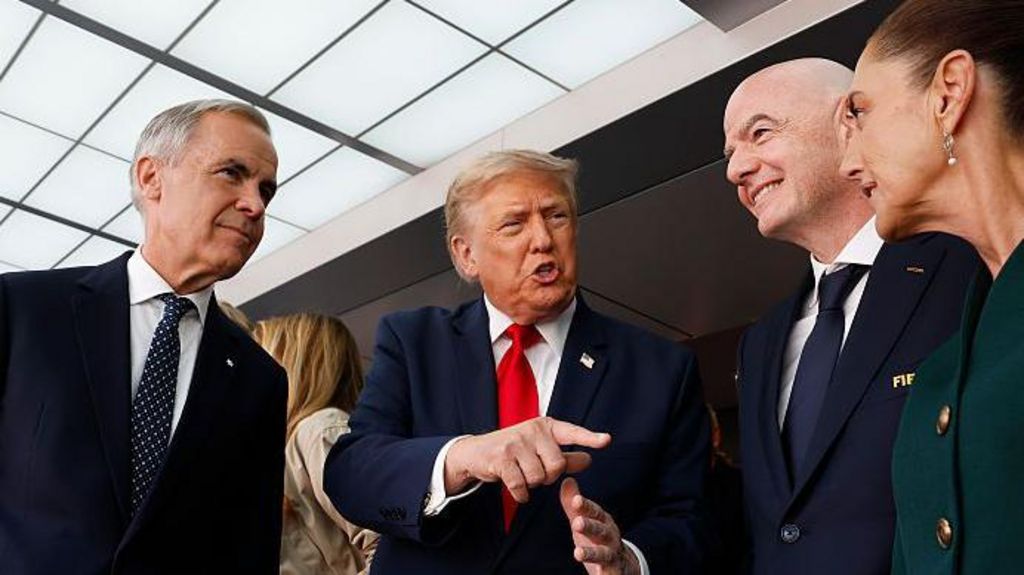
Just days after a cordial public appearance alongside their Mexican counterpart at the 2026 World Cup final in New Jersey, a surprise trade escalation has upended relations between the United States and Canada – one of America’s closest long-term trading partners.
On Monday, mere hours after photographers captured US President Donald Trump and Canadian Prime Minister Mark Carney smiling and conversing in the stadium stands during the final match of the co-hosted North American World Cup (a tournament that has been broadly deemed a success despite widespread criticism of exorbitant ticket prices and travel costs), the Trump administration announced a sweeping new round of 50% tariffs on a quirky range of Canadian goods, spanning from hockey sticks to candles and synthetic wigs. The levies are scheduled to go into effect on August 19.
The sudden announcement arrives at a pivotal moment for North American trade: after months of stop-start negotiations to renew the trilateral United States-Mexico-Canada Agreement (USMCA), talks are finally back on track. Just this week, the long-delayed Gordie Howe International Bridge – a critical infrastructure project designed to boost cross-border trade between the automotive hubs of Windsor, Ontario and Detroit, Michigan – is set to open, after Canada agreed to revised revenue-sharing terms with the US. Prior recent threats, including tariffs on Canadian civilian aircraft and demands for restitution over wildfire smoke drifting south from Canada, were widely written off as empty political posturing from Trump.
Washington has framed the new tariffs as a response to what it calls “unequal treatment” of American automobiles, dairy products and alcohol in the Canadian market. Trade analysts and insiders, however, widely interpret the move as a calculated pressure tactic to force Canada into concessions on the stalled USMCA renewal talks.
“This is nothing more than a strong-arm play from the Trump administration to gain maximum leverage ahead of a final deal,” explained Mahmood Nanji, a fellow at Western University’s Ivey Business School, in an interview with the BBC. “He’s pulling every trick out of the book to tilt the negotiations in his favor.”
Stakeholders tracking the trade negotiations have not been caught completely off guard. US officials have repeatedly vented publicly about their frustration with Canada’s existing retaliatory tariffs, noting that Canada is the only country besides China that has maintained countermeasures against previous US levies. Candace Laing, CEO of the Canadian Chamber of Commerce, acknowledged in a statement that her organization had anticipated trade talks would get rockier before reaching a final resolution.
This latest move marks a significant escalation of the ongoing trade friction between the two neighbors, stacking new barriers on top of existing trade restrictions. The US already imposes tariffs ranging from 15% to 50% on Canadian steel, aluminum and copper, a 35% duty on Canadian softwood lumber, and a 25% tax on non-US automotive parts. In response, Canada has levied its own 25% counter-tariffs on select US imports of steel, aluminum and vehicles, and most Canadian provinces pulled American alcohol products from store shelves last year. Canada is currently seeking relief from these existing sectoral tariffs as part of the ongoing USMCA talks.
The timing also adds extra pressure on Prime Minister Carney: parallel US trade talks with Mexico are progressing far faster than negotiations with Ottawa, and US Trade Representative Jamieson Greer is in Mexico this week for a new round of formal discussions. Last week, Greer told the Aspen Security Forum that while US negotiators speak weekly with their Canadian counterparts, “we just haven’t seen a lot of movement” on key sticking points.
The US was also the only party to decline an immediate long-term renewal of the USMCA – the agreement that underpins roughly $2 trillion in annual trilateral trade – this month. Without a long-term extension, the deal will enter a cycle of annual reviews before expiring in 10 years.
The new tariff announcement also signals that the Trump administration is gearing up for a broader expansion of global tariffs, analysts warn. Canada has historically been an early target for US trade actions that are later expanded globally, making it a key indicator of future American trade policy direction. On Tuesday, Greer appeared to confirm this trajectory, telling CNBC that more global US tariffs would be announced soon, though he declined to share a specific timeline, citing obligations to brief Congress and stakeholders first.
In response to the announcement, Carney told reporters Tuesday that he had already spoken with Trump, and the two leaders had agreed to intensify ongoing trade talks. Carney stressed that Canada would “explore all possible response options” if the new tariffs take effect next month, and reaffirmed his long-standing position that “no deal is better than a bad deal” on trade, while noting that Canada’s core goal remains reaching a comprehensive, mutually beneficial agreement. The prime minister is scheduled to meet with Canadian provincial premiers Tuesday afternoon to coordinate a response to the new US pressure, and some provincial leaders are already pushing for a strong retaliation.
Ontario Premier Doug Ford, one of the most vocal Canadian critics of Trump’s trade agenda, said Tuesday: “We can’t keep rolling over, we can’t keep backing down, we have to go full tilt.” Lawrence Herman, a trade expert with the independent Canadian think tank CD Howe Institute, echoed that call, arguing that making concessions now to appease Washington would be a strategic mistake that damages Canada’s national pride and global standing.
Public opinion polling suggests Carney has broad public support to take a hard line. Pollster David Coletto, CEO of Abacus Data, notes that most Canadians have already grown accustomed to weathering trade disputes with the Trump administration, and deep distrust of Washington is widespread. “Most Canadians hold the view that they cannot trust the Trump administration,” Coletto explained. “There is deep anger over what the public sees as unfair treatment from the US, and most people do not want Prime Minister Carney to give in.” The latest tariff move, he added, has only hardened that public resolve.
As the August 19 implementation deadline approaches, Canada faces difficult choices: Nanji argues that Canada may need to concede on some remaining sticking points to secure long-term trade certainty, but Ottawa must also clearly define its red lines. While Canada is currently signaling calm and avoiding panic, Nanji says a breaking point could be reached soon. “Canada will likely retaliate, but right now they’re trying to stay cool and avoid escalation,” he said. “But there will come a point where we have to draw a line: you cannot cross this.”