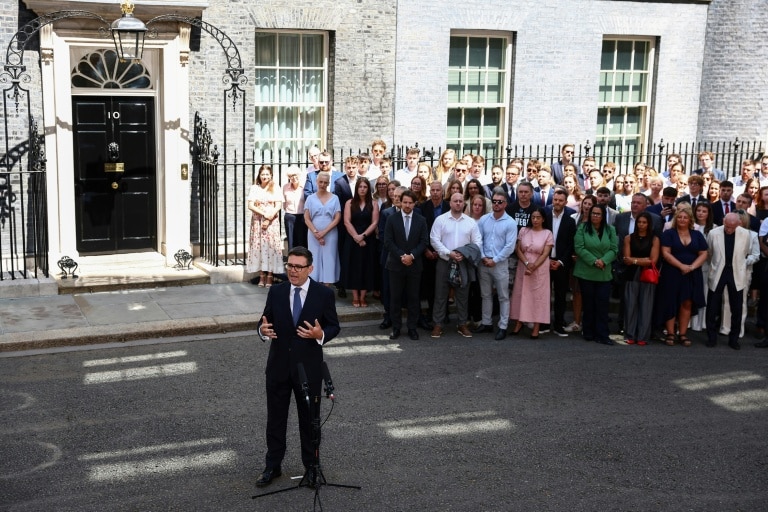
Britain’s newly inaugurated Prime Minister Andy Burnham kicked off his first full working day in office on Tuesday, convening his freshly assembled cabinet and rolling out his first flagship policy: a value-added tax (VAT) elimination on residential electricity bills, designed to alleviate widespread cost-of-living strain across the country.
Burnham’s ascent to 10 Downing Street came just one day after he replaced former Prime Minister Keir Starmer, following a vote of no confidence in Starmer’s leadership brought by majority Labour lawmakers. Notably, Burnham is the seventh person to hold the UK’s highest office since 2016, marking a decade of unprecedented political turnover in Westminster.
Under the new policy set to take effect on October 1, UK households will see no VAT added to their electricity bills, translating to an average annual saving of roughly £45 ($61) per home. The measure is projected to cost the UK government approximately £850 million ($1.14 billion) in the current fiscal year. Burnham’s administration says the tax cut will be fully funded by scrapping Starmer’s proposed digital ID scheme, a program that was estimated to cost taxpayers £1.8 billion.
“We’re taking immediate action to cut taxes on energy bills, put more money in people’s pockets and bring back hope,” Burnham said in an official statement outlining the policy.
However, the new premier’s first policy announcement has already sparked internal friction within the Labour Party. Darren Jones, a former cabinet minister and loyal ally of Starmer who was one of several Starmer allies removed from cabinet in Burnham’s Monday reshuffle, has publicly questioned the funding plan. Posting on social platform X, Jones claimed the digital ID scheme was already unfunded under Starmer’s administration, arguing that “The government will have to set out how it will pay for its new policies at the budget.” The backlash has cast early doubt on Burnham’s call for unified party cohesion, raising signs that internal factional divisions could persist despite his vows to end infighting.
Burnham’s cabinet reshuffle, completed on Monday, signaled a clear leftward shift for the Labour government, aligning with the new prime minister’s long-standing criticism of Starmer’s centrist policy approach. Most prominent allies of the former prime minister were removed from top posts: former finance minister Rachel Reeves was replaced by John Healey, while former deputy prime minister David Lammy stepped down from his role. Key allies of Burnham were elevated to senior positions: former Labour leader Ed Miliband took over as foreign secretary, Wes Streeting – who withdrew his own bid for the Labour leadership to support Burnham – was named defence secretary, and prominent left-wing figure Angela Rayner returned to government after being out of cabinet under Starmer.
Beyond the energy tax cut, Burnham has outlined a broad policy agenda focused on easing household financial pressure. His administration is currently exploring new national rent control regulations and caps on public bus fares. In his inaugural address as prime minister on Monday, Burnham pledged to reindustrialize the UK’s struggling regional economies and decentralize political power away from London to devolved governments across the country’s nations and regions. He has also promised to publish a 10-year national strategy that will likely expand public ownership of critical utility infrastructure and increase the construction of new public housing.
Shortly after taking office on Monday, Burnham held introductory calls with key global leaders, including U.S. President Donald Trump, Ukrainian President Volodymyr Zelenskyy, and French President Emmanuel Macron.
Burnham’s political trajectory to Downing Street is unconventional: he served nine years as mayor of Greater Manchester, only returning to the House of Commons four weeks ago before being elected Labour leader and prime minister. Labour lawmakers currently hold a large parliamentary majority, and the party is counting on Burnham’s widely known down-to-earth public persona to reverse slipping poll numbers and stem growing support for the right-wing anti-immigration Reform UK party, led by Nigel Farage, ahead of the next scheduled general election in 2029. Farage has already rejected Burnham’s mandate as prime minister, calling for an immediate snap general election to let voters weigh in on the new leadership.
Despite the early policy push, Burnham faces a daunting array of challenges that threaten to derail his agenda. The UK continues to grapple with sluggish economic growth, elevated government borrowing costs, a rapidly growing welfare budget, and persistent irregular migrant crossings via small boats in the English Channel. Global energy market volatility stemming from the ongoing US-Iran conflict, plus uncertain bilateral relations with the United States under the second Trump administration, add further instability to his premiership. Constrained by high levels of existing public debt and binding fiscal rules that require balanced spending and revenue, Burnham has very limited room to implement large new spending programs. Critics have also pointed out that his rapid rise to power came without him releasing a detailed, costed blueprint for how he will deliver on his ambitious policy pledges.