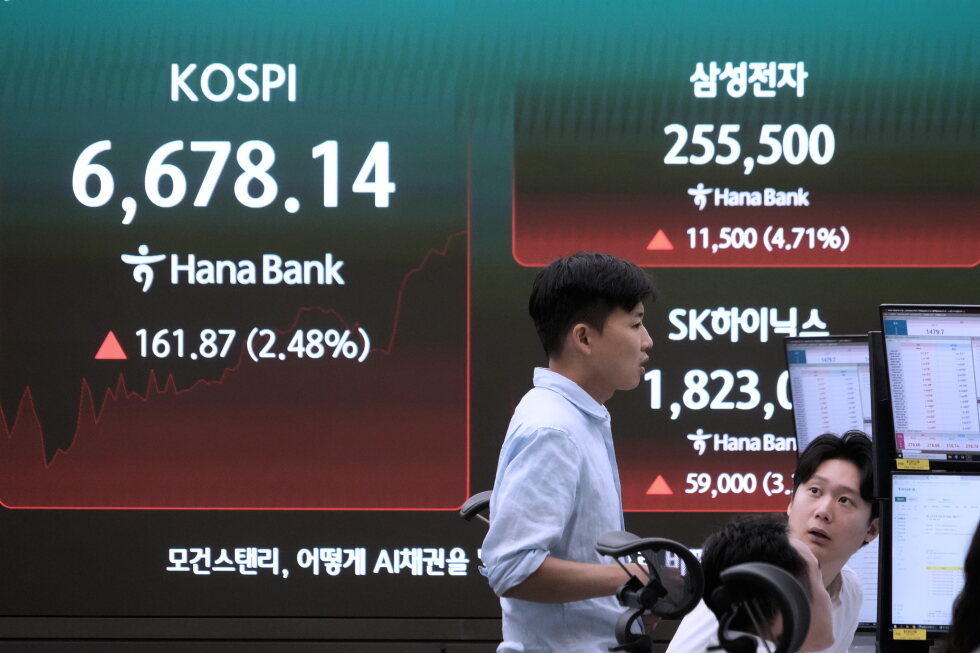
After a sharp sell-off of artificial intelligence-linked equities that dragged down major regional benchmarks in recent weeks, most Asian stock markets staged a notable rebound during Tuesday’s trading session, while U.S. futures ticked modestly upward and global crude prices edged lower amid ongoing Middle East geopolitical instability.
South Korea’s benchmark Kospi index, which has a heavy concentration of AI and semiconductor manufacturing stocks, led the recovery with a 4.7% jump to close at 6,821.41. This strong gain came one day after the index dropped 4.5%, and reverses part of the broader 20% correction the Kospi has seen over the past month. Despite the recent pullback, the index has still delivered a total gain of more than 50% since the start of the year. The sell-off was driven by investor profit-taking, fueled by growing concerns that AI-focused investments may have formed a speculative bubble. Leading the upward move on Tuesday, Samsung Electronics surged 7.4%, while major memory chip producer SK Hynix climbed 6.4%.
In Japan, the Nikkei 225 gained 2.8% to reach 65,926.41, recovering a portion of last week’s losses after Japanese markets were closed for a public holiday on Monday. Chip-related stocks also led gains in Tokyo: memory manufacturer Kioxia Holdings jumped 15.9%, chip testing equipment maker Advantest rose 6.9%, OpenAI investor SoftBank Group added 6.1%, and chip equipment producer Tokyo Electron gained 1.3%. Further along the Asian tech supply chain, Taiwan’s Taiex index, which has also outperformed this year amid the global AI boom, climbed 3.6%, with leading advanced AI chip manufacturer TSMC advancing 2.8%.
In other East Asian markets, Hong Kong’s Hang Seng Index edged less than 0.1% higher to 25,150.75, while mainland China’s Shanghai Composite Index added 0.6% to 3,819.66. Australia’s S&P/ASX 200 notched a modest 0.1% gain to 8,798.00, while India’s Sensex ticked 0.1% lower in Tuesday trading.
Global oil prices slipped lower in early Tuesday trading after rising in the prior session. International benchmark Brent crude fell 0.7% to $88.63 per barrel, dipping below the $90 threshold, while U.S. benchmark crude lost 0.3% to trade at $82.24 per barrel. Even with the drop, both benchmarks remain far above levels seen before the outbreak of regional conflict in late February, when Brent traded around $72 per barrel.
Oil price movements come amid escalating and sustained geopolitical tension across the Middle East. Early Tuesday, Iran launched an attack on another commercial tanker transiting the Strait of Hormuz, the critical global chokepoint that carries roughly a fifth of the world’s daily oil and gas supplies. The U.S. has launched its 10th consecutive night of airstrikes targeting Iranian assets, and Iran has retaliated against U.S. allies across the region. In a tentative step toward diplomacy, Iran’s interior minister traveled to Pakistan, a key regional mediator, for talks aimed at de-escalation, though it remains unclear whether any negotiated breakthrough can be reached.
“In the current environment, there is some hope that tensions between the U.S. and Iran can cool,” ING commodities strategists Warren Patterson and Ewa Manthey noted in a Tuesday market commentary. They added, “This will not be a straightforward process, however, as deep divisions still remain between the two sides.” The analysts also pointed to added supply risk from another ongoing conflict: a naval blockade imposed by Yemen’s Iran-aligned Houthi movement on Saudi shipping has raised the threat of disruptions to global oil exports.
On Wall Street, major U.S. benchmarks closed slightly lower in Monday’s session: the S&P 500 slipped 0.2% to 7,443.28, the Dow Jones Industrial Average fell 0.6% to 51,839.26, and the tech-heavy Nasdaq Composite dipped less than 0.1% to 25,508.07. Even with the overall minor dip for the benchmark indexes, many leading U.S. AI and chip stocks posted gains: Nvidia rose 0.2%, Micron Technology climbed 1.9%, Broadcom gained 2%, and Advanced Micro Devices (AMD) added 1.6% following the announcement of an expanded AI partnership with Microsoft. In currency markets Tuesday, the U.S. dollar edged slightly lower to 162.48 Japanese yen, down from 162.50 yen on Monday, while the euro held steady at $1.1414.
This report was contributed to by AP Business Writers Stan Choe and Matt Ott.