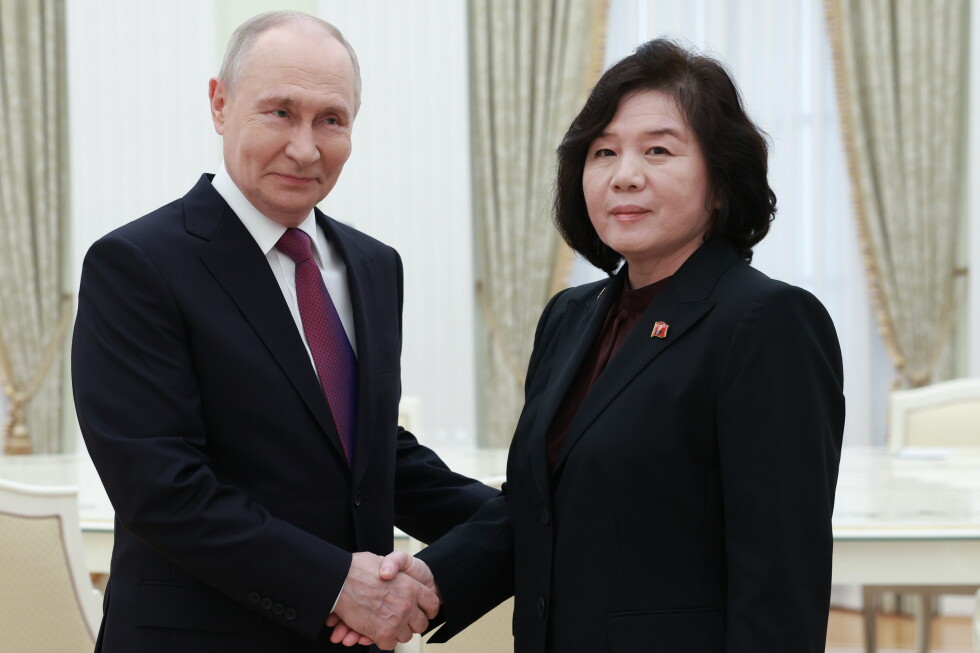
High-stakes diplomatic engagement between Russia and North Korea has entered a new active phase, after Russian President Vladimir Putin held a closed-door meeting with North Korean Foreign Minister Choe Son Hui at the Kremlin, where he openly thanked Pyongyang for its backing of Russia’s full-scale invasion of Ukraine, Russian state media has confirmed.
Choe’s unannounced, unscheduled trip to Russia — extended at the formal invitation of Russian Foreign Minister Sergey Lavrov, with North Korean state media confirming her departure from Pyongyang over the weekend — has sparked widespread international speculation that the visit lays the groundwork for a new potential trip to Russia by North Korean leader Kim Jong Un. To date, Pyongyang has not released any detailed statement on the core agenda of Choe’s meetings in Moscow beyond confirming the visit itself.
South Korea’s Unification Ministry, the government body tasked with managing inter-Korean affairs, announced Monday that Seoul is maintaining close, real-time monitoring of the diplomatic exchanges between Moscow and Pyongyang. Spokesperson Yoon Min Ho declined to offer any on-the-record assessment of whether a new summit between Putin and Kim is currently under negotiation.
According to Russia’s state-owned Tass news agency, Putin used Sunday’s meeting to reinforce his public praise for the steady deepening of bilateral ties between the two nations. He repeated explicit gratitude to “the North Korean leadership and people” for their consistent support of Russia’s military operations in Ukraine. In response, Tass reported, Choe conveyed to Putin that Kim remains fully committed to advancing the “comprehensive development” of the Russia-North Korea relationship.
This latest meeting builds on a years-long trend of rapidly expanding strategic cooperation between the two authoritarian states. Kim has already traveled to Russia’s Far East for two separate summits with Putin, in 2019 and 2023. During a landmark June 2024 summit in Pyongyang, Putin extended a formal invitation for Kim to make a return visit to Russia, and the two leaders signed a sweeping new strategic partnership agreement that includes pledges of mutual military assistance if either nation faces an act of aggression.
Over the past several years, Kim has prioritized alignment with Moscow as a core pillar of North Korea’s foreign policy. Independent defense analysts widely confirm that Pyongyang has supplied Russia with thousands of artillery rounds, millions of artillery shells, and short-range ballistic missiles to support its war effort in Ukraine, alongside deploying thousands of North Korean troops to frontline operations. In exchange, experts say North Korea has received badly needed economic aid and access to advanced Russian military and aerospace technology that has accelerated the development of Pyongyang’s domestic nuclear and intercontinental ballistic missile programs.
Choe’s trip to Moscow comes on the heels of a flurry of high-level diplomatic exchanges between North Korea and China, another key partner for Pyongyang as it works to build a united bloc opposing U.S. influence in the Indo-Pacific. Earlier this month, North Korean Premier Pak Thae Song, Kim’s top economic advisor, traveled to Beijing to meet with Chinese President Xi Jinping, and senior Chinese Politburo Standing Committee member Wang Huning traveled to Pyongyang for talks with Kim. Kim hosted Xi for a formal summit in Pyongyang earlier this summer, as part of Pyongyang’s strategy of positioning itself as a core member of a so-called “new Cold War” front against Washington.
Since the 2019 collapse of nuclear disarmament talks with then-U.S. President Donald Trump, Kim has frozen all substantive diplomatic engagement with both the United States and South Korea. Analysts note that Kim has leveraged global attention focused on Russia’s war in Ukraine to speed up development of North Korea’s nuclear and missile programs, while repeatedly refusing to enter new talks with Washington unless the U.S. abandons its requirement that Pyongyang commit to nuclear disarmament as a precondition for any negotiation.