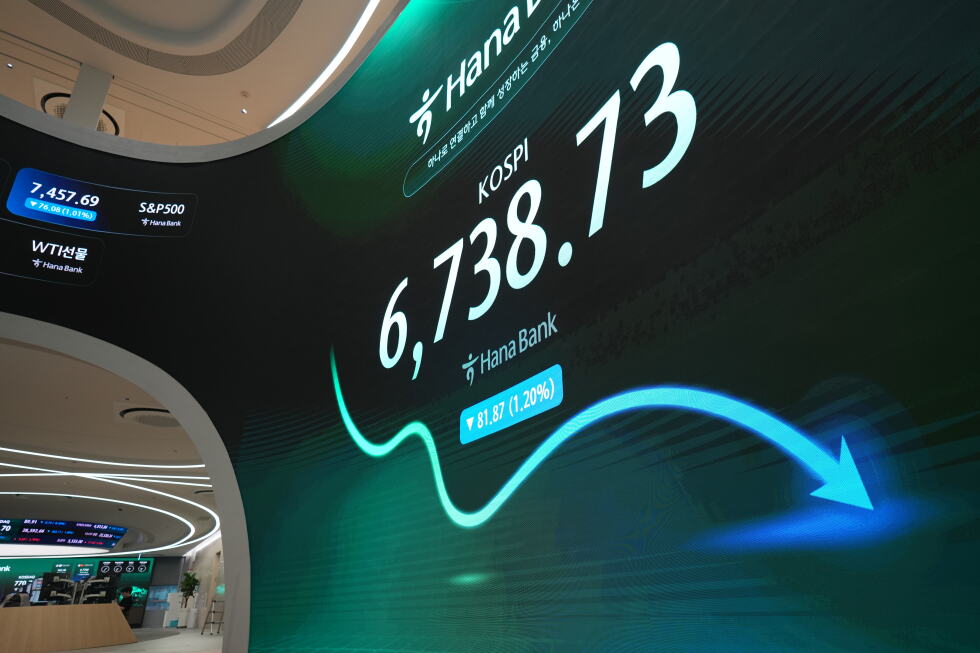
On a trading day marked by dual market shocks from geopolitical risk and profit-taking in the booming technology sector, most major Asian equity benchmarks booked modest gains on Monday, but South Korea’s benchmark Kospi index plummeted nearly 5% amid a widespread selloff of artificial intelligence-linked stocks.
Japanese financial markets remained closed for a national holiday, leaving regional trading without one of its largest liquidity providers, while U.S. equity futures pointed to a mixed opening following last week’s broad downturn. The most dramatic market movement came outside of equities, however, as oil prices surged more than 2% following nine consecutive nights of U.S. military strikes in the Middle East, with escalating exchanges of attacks between Washington and Tehran pushing the two nations closer to full-scale open conflict.
By early Monday trading, international benchmark Brent crude climbed 2.6% to settle at $90.40 per barrel, crossing the key $90 threshold that has not been hit in recent months. U.S. benchmark West Texas Intermediate crude rose 2.2% to reach $83.58 per barrel. Commodities strategists Warren Patterson and Ewa Manthey of ING warned in a client note on Monday that ongoing tit-for-tat strikes between the U.S. and Iran have already produced heavy casualties on both sides, and unconstrained escalation could trigger a wave of large-scale attacks across the Persian Gulf that would upend global energy supplies.
The analysts added that commercial tanker traffic through the Strait of Hormuz, the world’s most critical chokepoint for global oil shipments that carries roughly a fifth of the world’s daily oil consumption, has already slowed to a near standstill, creating immediate upward pressure on energy prices across the board.
The selloff in AI-linked equities hit South Korea particularly hard, as the Kospi has been one of the biggest beneficiaries of the multi-year global AI investment boom. The index sank 4.9% to close at 6,490.97, with two of its largest market capitalization stocks leading the downturn: Samsung Electronics dropped 4.4%, while major memory chip manufacturer SK Hynix declined 3.3%.
In Taiwan, another market heavily weighted toward AI and semiconductor stocks, the Taiex index posted a marginal loss of less than 0.1% in a far milder downturn. A notable bright spot in the region was leading chipmaker Taiwan Semiconductor Manufacturing Co. (TSMC), which climbed 2% following a 7.3% drop on Friday. The Friday dip came after TSMC announced plans to invest an extra $100 billion to expand chip manufacturing capacity across the United States.
Elsewhere in Asia, the picture was far more positive. Hong Kong’s Hang Seng Index gained 2.1% to close at 25,105.78, while mainland China’s Shanghai Composite Index rose 1.2% to 3,808.39. Australia’s S&P/ASX 200 notched a small 0.2% gain to 8,815.30, while India’s Sensex bucked the regional upward trend to slip 0.9%.
The current wave of AI stock selling originated on global markets last Friday, when chip and AI-related equities dropped sharply that pulled major global benchmarks lower. Investor jitters have grown in recent weeks as massive new capital expenditure pledges for AI expansion have fueled fears that the sector may be entering an asset price bubble, prompting many institutional and retail investors to sell positions to lock in profits after months of strong double-digit gains.
Market sentiment was further shaken last week by the launch of a new high-powered Chinese AI model from Beijing-based technology firm Moonshot AI. The release of the Kimi K3 open-source AI model mirrored the market impact of the so-called “DeepSeek moment” that rattled global equity markets in early 2025. The new model is seen as further evidence that lower-cost, high-capability Chinese AI developers are increasingly gaining market share at the expense of Western rivals including Anthropic’s Claude and OpenAI’s GPT series.
The downturn in AI equities spilled over into Wall Street at the end of last week, with the benchmark S&P 500 closing the week down 1% at 7,457.69. The Dow Jones Industrial Average lost 0.8% to end at 52,146.42, while the technology-heavy Nasdaq composite dropped 1.4% to 25,520.24. Leading U.S. chip stocks all posted losses: AI chip giant Nvidia fell 2.2%, while Broadcom and Advanced Micro Devices (AMD) each dropped 1%.
Separately, SpaceX, Elon Musk’s commercial rocket company, dropped 5.4% to fall below its $135 per share initial public offering price, hitting its lowest level since the stock began public trading on the Nasdaq last month.
In currency markets, movements were relatively muted: the U.S. dollar edged slightly lower to 162.37 Japanese yen from 162.43 yen in prior trading, while the euro appreciated marginally to $1.1446, up from $1.1438.