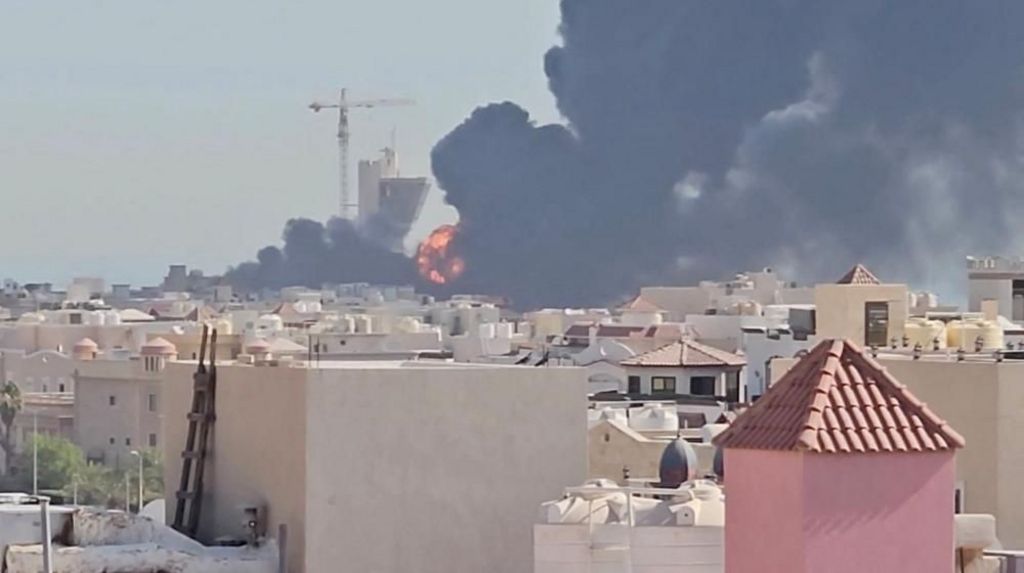
An eight-day cycle of escalating reciprocal strikes between the United States and Iran has sent shockwaves across the Middle East, driving up casualty counts, drawing sharp international condemnation, and reigniting fears of a full-scale regional conflict after a short-lived preliminary ceasefire collapsed earlier this month.
The latest violence unfolded quickly over the weekend, following a Friday attack on a US military base in Jordan that left two American soldiers dead and one service member unaccounted for. On Saturday, a third US service member was killed while conducting a controlled detonation of unexploded ordnance from a downed Iranian attack drone in northern Iraq, US Central Command (Centcom) confirmed. A second service member was wounded in the same operation. Centcom also announced that search teams had recovered unidentified remains at the Jordan attack site, with formal identification processes still ongoing.
Verified footage obtained from inside the Jordanian air base confirms that at least one Iranian projectile struck the facility, showing clear signs of multiple impact sites and a large explosion. In a subsequent incident, Jordan’s military intercepted three Iranian missiles launched toward the kingdom, while a fourth crashed in an unpopulated remote area. The strike came after US intelligence warnings that the Jordanian port of Aqaba faced imminent targeting. Jordanian authorities swiftly summoned Iran’s acting head of mission in Amman to issue a formal protest, demanding an immediate end to what the foreign ministry described as “unjustified and blatant Iranian attacks,” and emphasizing that Jordanian national security is an inviolable red line.
Across the border in Israel, the Israel Defense Forces confirmed it launched several interceptors to destroy incoming missile debris headed toward Israeli territory, preventing impacts in populated areas. Fragments from one interceptor landed near the southern border city of Eilat, but no injuries or damage were reported.
The conflict has spread to other Gulf states in recent days. In Kuwait, local officials confirmed that an electricity and water plant that was hit by an Iranian strike on Saturday was targeted a second time, sparking a large fire that left critical infrastructure damaged. The Gulf Cooperation Council (GCC), a regional alliance comprising Bahrain, Kuwait, Oman, Qatar, Saudi Arabia and the United Arab Emirates, condemned Iran for targeting civilian facilities, calling the attacks a clear violation of international law.
Overnight attacks on Sunday targeted sites inside Iran, with Iranian state media confirming that an under-construction nuclear power plant in the southwestern city of Darkhoveyn and locations on Qeshm Island were hit. The International Atomic Energy Agency (IAEA), the United Nations’ nuclear oversight body, issued an urgent call for all parties to exercise maximum restraint, noting that the Darkhoveyn facility is still in early construction phases and held no nuclear material during the watchdog’s most recent inspection.
Tensions have also flared around the Strait of Hormuz, one of the world’s most critical energy chokepoints. After Washington reimposed a full blockade on Iranian ports following the ceasefire’s collapse, Tehran announced it was closing the strait to commercial shipping linked to US and allied interests. The Islamic Revolutionary Guard Corps (IRGC), Iran’s elite military force, claimed two commercial vessels that ignored Iranian warnings about using unauthorized transit routes were involved in a “maritime accident” this week, and issued a blunt warning that all vessels “influenced by the United States” that use “unsafe routes” will “certainly face accidents” going forward. The US says its latest strikes against Iranian targets are intended to degrade Tehran’s ability to threaten commercial shipping in the strait and punish IRGC forces it blames for the Jordan base attack.
Casualty figures on both sides continue to climb. The total US death toll from the conflict that began in late February now stands at 17, after a missing American Navy pilot was formally declared dead earlier this week. Iran’s health ministry reports that at least 50 Iranians have been killed and more than 500 injured in US strikes carried out over the past three weeks.
Both sides have traded accusations over targeting civilian infrastructure, a breach of international humanitarian law that prohibits deliberate attacks on non-military sites. Iran accuses the US of striking civilian bridges, a commercial airport and a train station in recent strikes. Washington has repeatedly denied the claims, asserting that all of its operations target exclusively military objectives, including military logistics infrastructure. Under international law, civilian objects can lose their protected status if they are used to directly support an adversary’s military campaign.
The current escalation comes after a preliminary ceasefire agreement between Washington and Tehran reached in June fell apart in less than a month. US President Donald Trump officially declared the deal “over” on July 8. In a written statement released late Saturday, Iran’s Supreme Leader Mojtaba Khamenei blamed repeated US violations of the agreement for its collapse, arguing that the breakdown exposed a core reality: “the signature of the US president is utterly worthless and devoid of credibility.”