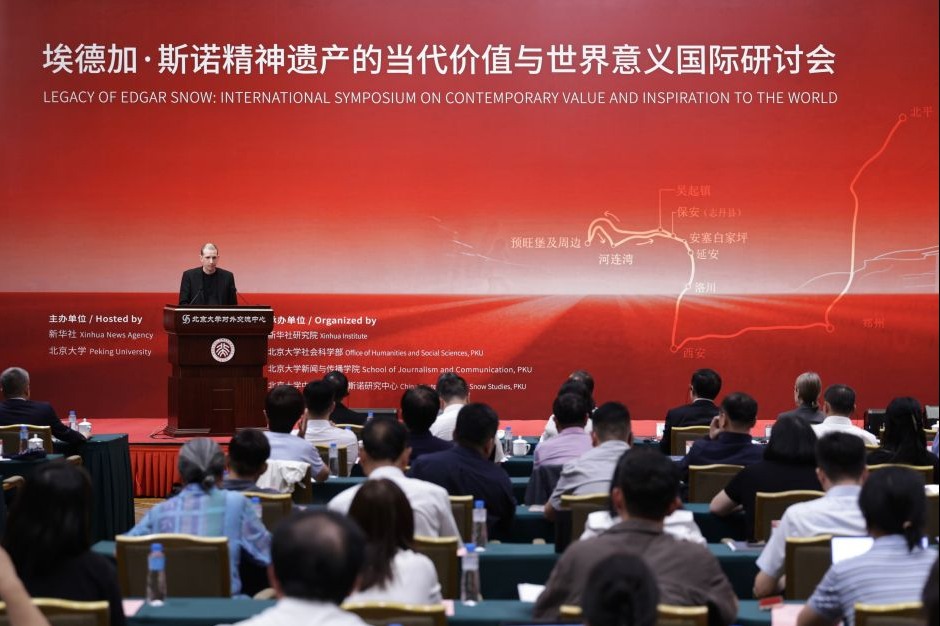
Ninety years after American journalist Edgar Snow completed his groundbreaking journey to China’s northern Shaanxi revolutionary base area, scholars, family representatives, and legacy stewards from around the globe gathered at Peking University this Tuesday to reaffirm the enduring global relevance of his work: a commitment to truthful reporting that builds bridges of understanding across deeply divided societies.
Hosted under the theme *Legacy of Edgar Snow: International Symposium on Contemporary Value and Inspiration to the World*, the event drew a diverse cohort of attendees, including members of Snow’s direct family, leadership from the U.S.-based Edgar Snow Memorial Foundation, and Chinese and international researchers who have spent decades studying Snow’s life and impact. Experts from a range of academic and policy fields also joined the conversation to contextualize his work for 21st-century geopolitics.
In 1936, Snow made history as the first Western journalist to secure on-the-ground access to China’s revolutionary base areas, at a time when most of the world had almost no accurate information about the Chinese Communist Party, the Red Army, and the unfolding Chinese revolution. His resulting book, *Red Star Over China*, became the first widely circulated, authoritative account of China’s revolutionary movement for global audiences, shaping how generations of people outside China understood the country’s trajectory.
A personal statement from Snow’s daughter, delivered to symposium attendees by his great-grandnephew Samuel Colin Maclean, outlined the core journalistic principles that guided Snow’s work throughout his career. Snow, she wrote, held firm to the belief that a journalist’s core duty is to witness events firsthand and report what they see freely, independently, and without bias. “When he saw progress, he reported it. When he saw problems, he reported those too,” the statement read, adding that Snow wished to be remembered as two things above all: a loyal friend of the Chinese people, and a truth-seeking reporter dedicated to fostering deeper mutual understanding and peaceful relations between people of all nations.
Sidne Ward, president of the Edgar Snow Memorial Foundation in the United States, framed the symposium as more than a commemorative event—it was an opportunity to reflect on how Snow’s values speak directly to the challenges of today’s interconnected yet fractured world. Ward noted that Snow built his work on four core commitments: curiosity, open dialogue, intentional understanding, and the courage to step into unfamiliar contexts to listen to perspectives that differ from one’s own. Through his unflinching, on-the-ground reporting, she said, Snow helped people on opposite sides of geopolitical divides see each other more clearly.
Ward emphasized that few bilateral relationships carry as much global weight today as the relationship between China and the United States, and that Snow’s legacy is more relevant now than ever. Unlike many historical legacies that are tied to a single institution or nation, she added, Snow’s work is now sustained by a dynamic, global network of researchers and advocates committed to his values.
Rigorous, fact-based reporting, rigorous academic scholarship, and sincere person-to-person connection remain the most effective tools to cut through misunderstanding and build mutual respect, Ward argued. Snow’s greatest contribution to the world, she said, is not just the landmark stories he wrote, but the cross-cultural bridges of understanding he helped build between peoples and communities separated by ideological and geographic divides.
He Guangcai, secretary of the Communist Party of China Peking University Committee, echoed that framing, noting that when Snow traveled to northern Shaanxi in 1936, the outside world operated with profound misinformation and limited knowledge of the Chinese Communist Party. Snow broke through information blockades to get to the ground and report what he actually saw, He said.
Through his firsthand writing and original photojournalism, Snow accurately recorded the realities of the Chinese revolution and opened a critical window for the global community to understand the Chinese Communist Party, as well as the core ideals and mission of Chinese communists, He added. Looking back at Snow’s full life and career, his legacy offers clear, urgent lessons for today’s world: a non-negotiable commitment to truth, facts, and firsthand observation, paired with a deep humanistic commitment to global peace and equality.
Along with panel discussions and keynote addresses, the symposium also marked two key new initiatives to expand global research into Snow’s legacy: attendees oversaw the release of a new think tank report exploring the contemporary value and global significance of Snow’s work, and formally launched a new global academic research program dedicated to studying Snow’s life and lasting impact.