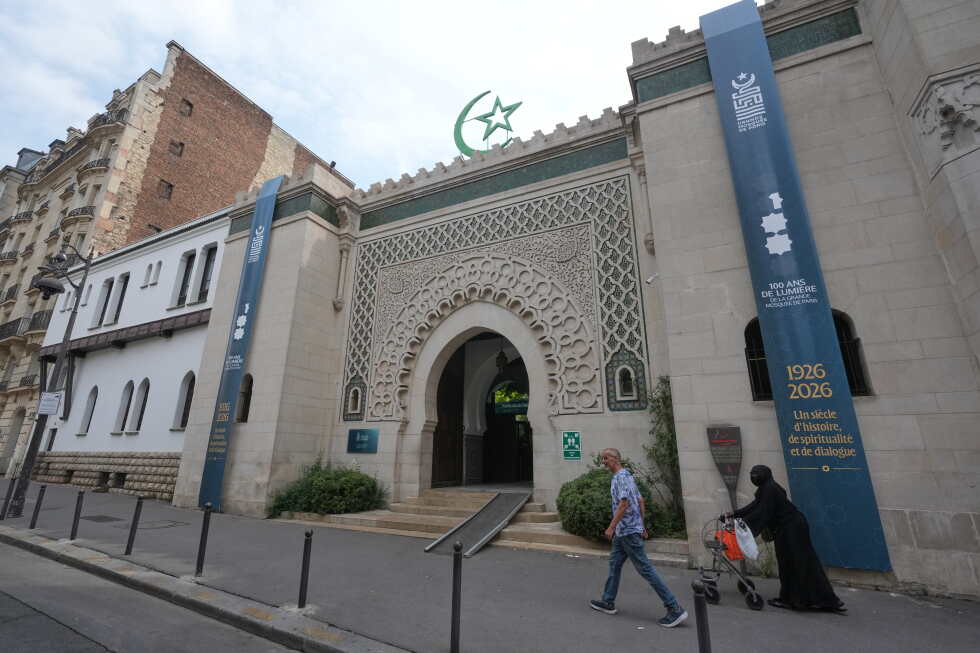
One hundred years after its construction to honor colonial Muslim soldiers who fought and died for France in World War I, the Grand Mosque of Paris is celebrating its centenary, even as worshippers and leaders grapple with rising religious tensions and growing far-right rhetoric ahead of the country’s 2025 presidential election. Nestled in the heart of Paris’ bustling Latin Quarter, the mosque has grown far beyond a place of worship over the past century, evolving into an integral landmark of the French capital that draws worshippers and tourists from across the globe.
Designed with architectural inspiration from Spain’s Alhambra palace, the 33-meter minaret of the mosque stands overlooking the Seine River, complementing the silhouette of nearby Notre Dame Cathedral without overshadowing the iconic landmark. Its ornate, carpeted prayer room is listed as a top must-see attraction on Paris City Hall’s official tourism portal, and the site also hosts a popular traditional tea room and public hammam steam bath that attract both local Parisians and international visitors. For the Muslim community that gathers here weekly, however, the mosque’s meaning is rooted in a century-old promise of inclusion.
When French authorities approved and inaugurated the mosque in 1926, the project was framed as a tribute to the estimated 100,000 Muslim soldiers from French colonial territories across Africa and beyond who died defending France in the trenches of World War I, from Verdun to the Western Front. Then-French President Gaston Doumergue emphasized in his opening address that France’s cultural and religious diversity would only strengthen the national community, a message that current rector Chems-eddine Hafiz says remains just as relevant today.
Hafiz, who has led the mosque for years, frames the historic site as a enduring symbol of interfaith dialogue and the richness of France’s pluralistic society. But he has raised urgent alarms over escalating religious divisions in the country, stoked by ongoing conflicts in the Middle East and the increasingly polarizing rhetoric of the upcoming presidential election campaign. “It’s the responsibility of everyone to see Muslims as a part of the national community,” Hafiz told the Associated Press in an interview ahead of the centenary celebrations.
Today, Islam is the second largest religion in France, which is home to Western Europe’s largest Muslim population. But decades of stigma, amplified by deadly Islamic extremist attacks across the country over the past 15 years, have left many French Muslims facing systemic discrimination and social exclusion. As campaigning for the 2025 presidential election ramps up, far-right leader Marine Le Pen and her National Rally party have centered their platform on targeting Islam and restricting immigration, amplifying anti-Muslim rhetoric across national political discourse.
Fatma Chouchane, a volunteer at the Grand Mosque, spoke to the AP about the daily barriers many Muslim women face across France, including legal restrictions on wearing traditional Muslim headscarves in public schools and certain workplaces. “I ask France to leave these people alone and let them make their religious choices,” she said. Despite these challenges, Chouchane joined other worshippers in framing the centenary as an occasion to reaffirm messages of tolerance and solidarity. “It’s a symbol, it is the Paris museum for Muslims,” she said. “We must all be in solidarity.”
For centenary prayers held Friday, worshippers traveled from across the greater Paris region, representing generations of Muslim communities in France: some born in the country, others who migrated over decades from Algeria, Senegal and other former French colonies, with many tracing their family roots to the very colonial soldiers the mosque was built to honor. For Ibrahima Seye, who first visited the mosque shortly after moving to France from Senegal, it has long served as a welcoming home for new arrivals and a point of pride for the entire community. “It’s always open,” he said. “It’s good for the Muslim community, and I see that it is a mosque that is appreciated by a lot of tourists, too.”
Hafiz emphasized that the core political promise of the mosque, as a testament to Muslim contributions to French national life, has not wavered since its opening 100 years ago. “The problem lies in people’s attitudes,” he said. “Today, anti-Muslim acts are still being committed against Muslims. Islam is often misunderstood, and talking about Muslims or Islam can trigger hostility.” As the mosque marks its 100th year, community leaders say its centenary is not just a moment to celebrate history, but to reaffirm the founding vision of a diverse, inclusive France where all religious communities belong.