Brows furrowed in unbroken concentration, Juliette Sebastien grips her well-worn Rubik’s Cube, her fingers flying across the colored faces at a dizzying pace. In just 25.03 seconds, she twists the final block into place and slaps the completed puzzle onto the competition table—one of thousands of lightning-fast solves unfolding at the 11th European Speedcubing Championships, hosted this year in Arnhem, in the eastern Netherlands. The event brings 1,200 competitors from 53 nations together to test their puzzle-solving speed across a wide range of unique and challenging disciplines.
Sebastien, France’s national speedcubing champion, has dedicated countless hours to honing her craft ahead of the tournament, putting in three to four hours of daily practice in the lead-up after months of at least one hour of training daily. Her preparation was not without setbacks, however: a painful wasp sting to her dominant hand threw off her training routine in the final weeks before the competition. “I do training blocks of 100, 200, sometimes 300 solves,” the 25-year-old student explained in an interview with AFP. “There are always new techniques that you can learn.”
While Sebastien’s 25-second solve for the 4×4 cube category—an event slightly more complex than the standard 3×3 Rubik’s Cube—is widely viewed as a strong result, top competitors in the fastest divisions reach speeds that defy belief. The current 2×2 Rubik’s Cube world record, held by Chinese speedcuber Ziyu Ye, stands at a staggering 0.39 seconds, a time faster than most people can blink.
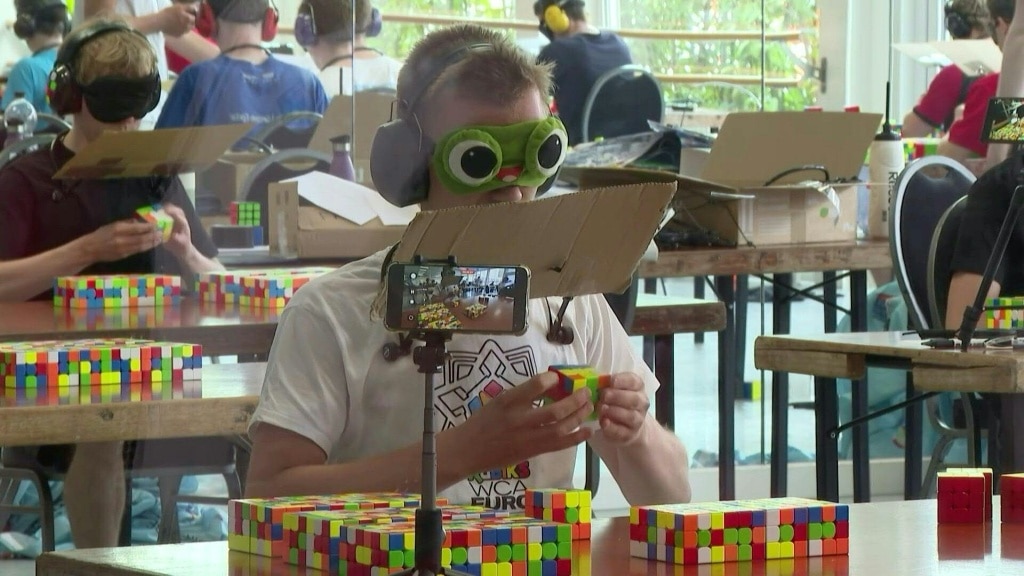
The constant, rhythmic clack of twisting cube faces echoes across the five large sports halls that house the championships. Competitors wander the venue’s corridors in team-branded gear, many solving practice cubes absent-mindedly without looking, or even using only one hand. “There are more cubes here than people,” joked 31-year-old Dutch competitor and programmer Jeroen Plug, a quip that rings true across the puzzle-filled venue.
Far from being a casual hobby gathering, the tournament is run with strict regulations and military-level precision to ensure fair play. Before each round, competitors hand their custom cubes to official scramblers, who reset each puzzle to an identical starting configuration for every athlete, eliminating any advantage from pre-adjusted cube setups. Two competitors compete side-by-side during each round, each monitored closely by a dedicated referee with a camera tracking every movement, while a digital timer records solve times down to one hundredth of a second. Scrambled cubes are kept hidden in opaque boxes until the start of a round; once the box is opened, competitors get 15 seconds to inspect the cube’s layout before placing their hands on a touch sensor to start the timer and begin their solve.
The tight regulations come in response to a recent controversy that shook the global speedcubing community: the so-called “Sliding Scandal”. The incident involved competitors cheating by surreptitiously moving their hands from the starting sensor to the cube early, gaining critical fractions of a second that could be the difference between a world record and a mid-tier result. In the wake of the scandal, multiple previously approved world records were stripped from the official record books, and the controversy remains a quiet topic of conversation among participants on the sidelines of the Arnhem tournament.
One of the most surprising open secrets of competitive speedcubing is the key role that custom lubrication plays in top performance. Every competitor applies a precise, personalized amount of specialty lube to their cubes to adjust the turning speed and feel to match their solving style, explained Loes Wentink, who manages the official lube station at the championships. “It makes a big difference to the competition,” said the 21-year-old electrical engineering student. Some lubricants actually increase friction, she noted, because many new high-performance cubes come from the factory so smooth that they turn too fast for competitors to control. “Sometimes you can’t control it… and if you can’t control it, then your solve won’t be as good,” she said. Other lubes are designed to eliminate the dreaded “sandy” feel, a gritty, rough texture that can develop in well-used cubes over time. Just as professional tennis players customize their racket string tension or cricket players adjust their bat weight, each speedcuber’s cube and lube combination is a deeply personal setup tailored to their unique technique.
Recent technological advances have reshaped training for the sport, even as many high-tech tools remain banned from competition. Many competitors mount GoPro cameras to their heads during training to record their solves and review their technique for errors. So-called “smartcubes” equipped with Bluetooth sensors can track every turn in a companion mobile app and suggest adjustments to improve speed, but these devices are not allowed during official competition. Technology offers no advantage anyway in one of the event’s most popular disciplines: blindfolded speedcubing, one of 17 total categories offered at the championships. In blindfolded competition, competitors have one hour to memorize the starting layout of as many cubes as possible, then solve all of them while wearing a blindfold. The current world record for the discipline stands at 63 correctly solved cubes in a single round.
Heading up the 1,200-participant event alongside 250 volunteers and officials is Yinte Dik, the 25-year-old accountant and longtime speedcuber who has competed internationally since 2017. Dik noted that the tournament draws participants across a wide generational range, from competitors as young as 8 years old to seasoned players up to 71. At the European continental level, Poland’s national team is widely recognized as the powerhouse to beat, while the United States and China field the strongest competitors globally.
While competitive speedcubing can be an intense, high-pressure sport, Dik emphasized that it is built around an inclusive, tight-knit global community that welcomes new participants of all backgrounds. “Everyone can train, so it’s not that you have to have big brains or something, everyone can do it,” Dik told AFP. “You just have to practise a lot and you can make it.”