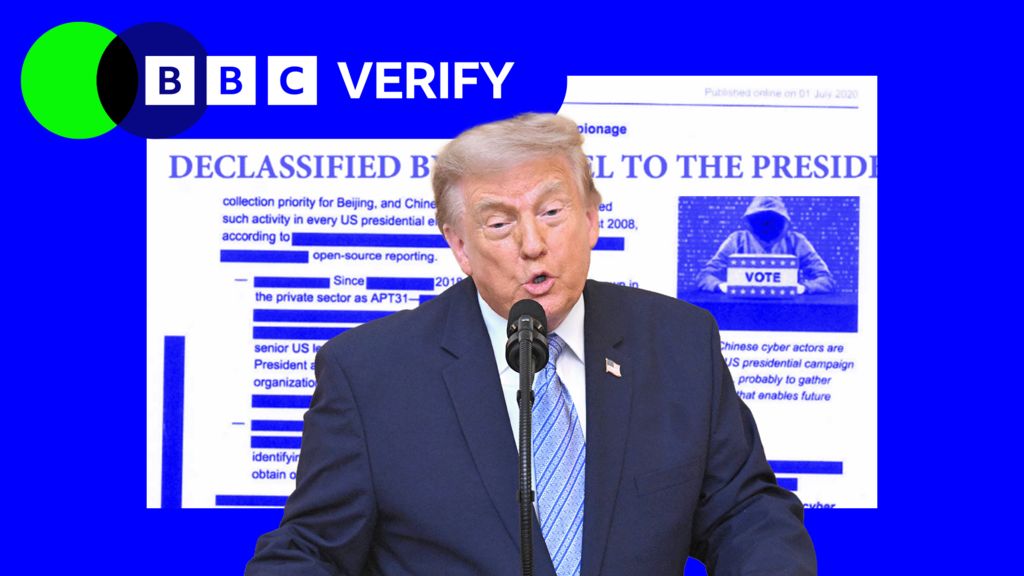
In a 26-minute address delivered from the White House East Room — the same venue where former President Barack Obama announced the killing of al-Qaeda leader Osama bin Laden in 2011 — former and current President Donald Trump resurrected long-standing, unsubstantiated claims of widespread election fraud and foreign interference in U.S. electoral processes.
During the speech, Trump framed the current U.S. election system as dangerously unsecure, claiming that hundreds of newly declassified intelligence documents would expose what he called “shocking vulnerabilities” in the nation’s voting infrastructure. Following the address, the White House published four collections of declassified “election integrity” documents, which were independently analyzed by BBC Verify. While many of the released files were heavily redacted, the review found no explosive new revelations and no concrete evidence that any foreign interference or domestic fraud altered the outcome of any previous U.S. election, including the 2020 presidential contest that Trump lost to Joe Biden.
A core narrative of Trump’s speech centered on casting China as the primary malign actor in alleged election meddling, describing Beijing as a nefarious force conducting “sinister election meddling” in U.S. elections. The released documents do confirm that Chinese actors took steps to acquire U.S. voter data — much of which was already publicly available or purchasable on open markets — and explored potential avenues to influence U.S. public opinion. However, these activities fall far short of the large-scale election tampering Trump implied, and are far smaller in scope than the 2016 election interference campaign conducted by Russia, which Trump only mentioned once in his address. This aligns with a 2021 declassified assessment from the U.S. National Intelligence Council (NIC), which concluded with “high confidence” that China did not interfere in the 2020 U.S. presidential election.
In his address, Trump claimed that “over a period of years starting during the 2020 election cycle, the People’s Republic of China carried out what is believed to be the largest compromise of election data in history, resulting in China’s illicit acquisition of 220 million U.S. voter files,” adding that “tens of millions of voters’ data in 18 states” had been “bought, stolen or hacked by China.” A July 13, 2026 statement from the White House’s Government Transparency Force included in the released document batch echoed the claim that voter rolls from at least 18 states and more than 200 million total voter records had been compromised by China, without specifying a timeframe. One heavily redacted declassified document includes a table dated 2016 listing 204,822,241 unspecified U.S. voter records as “likely leaked, compromised data,” but the extensive redactions make it impossible to confirm the full context or veracity of this entry.
Strengthening U.S. election infrastructure has been a bipartisan policy priority for decades. Following the contested 2000 presidential election and again after confirmed Russian interference in 2016, U.S. policymakers implemented new national security standards to shore up voting systems, and most states now require paper ballots as a verifiable backup to digital voting systems, even as election administration remains under state control. However, analysts note Trump’s revival of these fraud claims carries clear partisan goals: casting ongoing doubt on the legitimacy of his 2020 loss and laying groundwork to question the outcome of future elections he may contest or lose.
Trump also used his speech to claim that declassified assessments prove U.S. voting machines are “extremely exposed to attack,” quoting an assessment that reads, “we judged that the United States’ adversaries, including, at a minimum, Russia, China, Iran, North Korea, as well as non-state groups have the capability to compromise U.S. election infrastructure.” The released documents do include a January 2020 declassified NIC assessment that acknowledged ballot and voting machine preparation faces potential risks from cyberattacks, supply chain compromise, and insider threats, noting that machines without paper backup are particularly vulnerable to cyber manipulation. Crucially, however, the same assessment also concluded that existing security mitigations and the decentralized nature of U.S. voting storage make it extremely difficult for any foreign adversary to coordinate a widespread campaign to manipulate results across an entire state or multiple states. A separate August 2020 declassified NIC report, which Trump appeared to reference, does note that foreign actors could seek to compromise election infrastructure, but does not confirm that any successful large-scale manipulation has ever occurred. It is also worth noting that the Trump administration has moved to cut funding and undermine the independence of federal agencies tasked with monitoring and protecting U.S. election security in recent years.
Michigan, a key battleground state that Trump won in 2016 and 2024 but lost in 2020, has long been a focal point of Trump’s fraud allegations, and he highlighted the state again in Thursday’s speech. The president claimed there was massive hidden evidence of fraud in Michigan ahead of the 2020 election that had been covered up. The released documents reference an ongoing investigation into fraudulent voter registration applications in Muskegon, Michigan, launched in October 2020, with one document noting between 8,000 and 10,000 suspicious applications. The case was referred to law enforcement, and FBI testing of a sample found 91 out of 107 applications returned no matching results in government database checks. After nearly five years of investigation, the FBI closed the case in September 2025, concluding that “the investigation to date did not identify a criminal violation.” Despite this closing, Trump announced he has asked new FBI Director Kash Patel to open a full new investigation into the matter. Local news outlets did originally report on the irregularities identified by Muskegon election officials at the time the investigation opened in 2020.
One of the most specific claims from Trump’s address centered on non-citizen registration, with the president announcing the White House was releasing “the results of a stunning investigation by the Department of Homeland Security” that “identified approximately 278,000 non-citizens who are registered to vote in federal elections.” The one-page DHS document released confirms that “over 250,000 non-citizens are illegally registered to vote in just the four U.S. states for which public data files have been reviewed.” However, the document provides no supporting evidence, does not link to the underlying data, does not explain how the figures were collected or verified, and offers no breakdown of methodology, making it impossible to independently confirm the claim’s validity. Multiple independent studies have documented that non-citizen voting is extremely rare in U.S. elections, with only a handful of verified cases across the country in every election cycle. Trump has repeatedly claimed that Democratic candidates rely on votes from millions of undocumented migrants, and has argued that passing his proposed federal election security legislation would allow Republicans to secure permanent control of the U.S. government.