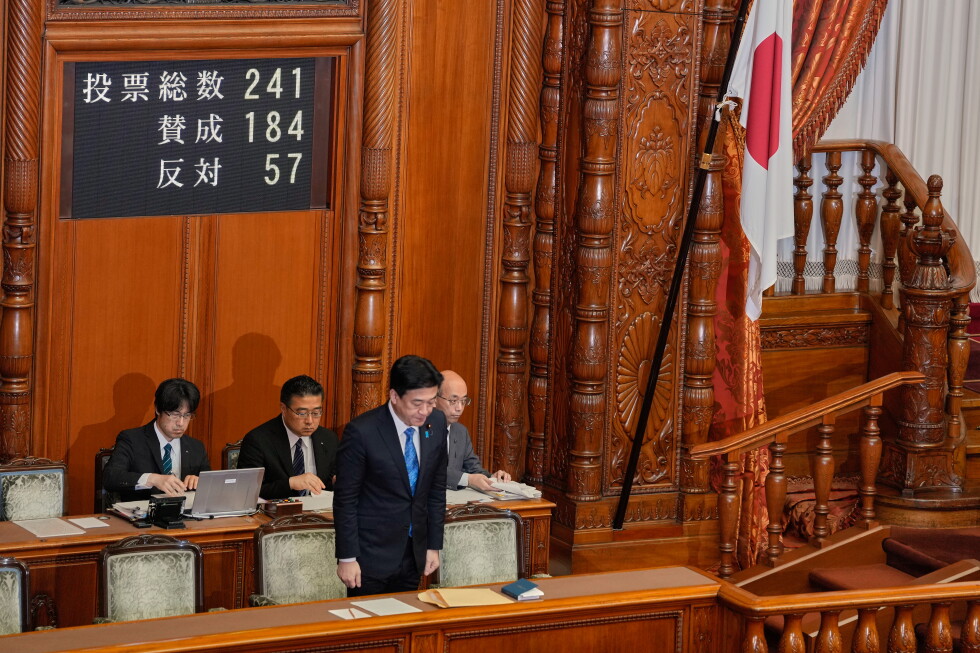
TOKYO – In a landmark victory for Prime Minister Sanae Takaichi’s right-wing policy platform, Japan has formally enacted a divisive new law that criminalizes the desecration of the country’s national hinomaru flag, triggering fierce pushback from opposition lawmakers, legal scholars, and free speech advocates who warn the legislation threatens core constitutional protections.
The new law, enacted Friday, imposes harsh penalties for any public act that damages, removes, or defaces the national flag in a manner deemed to cause “extreme discomfort or sense of disgust” to others. Violators can face up to two years in prison or a fine of 200,000 Japanese yen, equivalent to roughly $1,230. The legislation explicitly includes footage of desecration shared via livestream or social media uploads, even when the act itself occurs in a private space, while carving out narrow exceptions for non-tangible flag depictions in art, AI-generated content, anime, and small decorative flags used for food garnishes.
For Takaichi and her ruling Liberal Democratic Party (LDP), the legislation fills a longstanding gap in Japanese law. Japan already has statutes in place that penalize vandalism of foreign national flags displayed at diplomatic facilities, designed to prevent international diplomatic disputes. Takaichi has argued that the absence of similar protections for Japan’s own flag was inherently wrong.
Today, the hinomaru – a simple red sun disc set against a white field – is a ubiquitous sight across Japan, flown at government offices, featured prominently at international summits and athletic competitions, and waved by imperial well-wishers at public events hosted by the Imperial Palace. A second variant, the 16-rayed kyokujitsuki, remains a source of intense regional controversy: it was the official flag of Japan’s pre-WWII imperial navy, used during the country’s colonization of the Korean Peninsula and military occupation of parts of China and other East Asian nations, drawing consistent vehement protest from neighboring countries.
Despite the LDP’s framing of the law as a measure to protect public respect for national symbols, critics have roundly condemned it for its intentionally vague language. Opponents argue the broadly worded statute is designed to intimidate citizens and suppress political dissent against Takaichi’s administration, risking violations of Japan’s constitutional guarantee of freedom of expression. They warn the ambiguous wording could chill legitimate use of flag imagery in protest art, political demonstration, and critical speech.
Many top legal experts share these concerns. Motohiro Hashimoto, a constitutional law professor at Tokyo’s Chuo University, told a recent parliamentary hearing that criminalizing flag desecration effectively equates criticism of the government with a criminal offense. Lawmakers from opposition parties have also highlighted the lack of clear guidelines to define punishable conduct. During parliamentary debate, Ayaka Shiomura, a lawmaker from the opposition Constitutional Democratic Party of Japan, repeatedly pressed ruling party officials on whether crossing out a flag during a political rally would qualify as an offense. LDP lawmaker Akihisa Shiozaki acknowledged the ambiguity, responding that no clear standards can be set ahead of an actual incident.
Legal analysts note that while other developed nations including the United States and multiple European countries have flag desecration laws on their books, those regulations typically include far clearer eligibility criteria and stronger guardrails to protect free speech.
Controversy over Japan’s national flag is not a new issue. The design traces its roots to ancient Japanese sun worship, and was formally adopted as the flag for Japanese commercial vessels in 1870. During World War II, it was a common patriotic symbol carried by soldiers deploying to the front lines. However, it was not formally recognized as Japan’s official national flag until 1999, due to decades of public division over its ties to the country’s wartime imperial past.
From the 1980s onward, Japanese government efforts to promote the hinomaru and the national anthem Kimigayo in public schools sparked sustained protest from teachers who opposed their use for compulsory patriotic education. The tension reached a tragic head in 1999, when a Hiroshima school principal died by suicide on the eve of a graduation ceremony, caught between conflicting demands from protesting teachers and local education officials who ordered mandatory display of the flag.
The enactment of the new law marks a clear political win for Takaichi and her right-wing base, as the prime minister continues to advance a nationalist policy agenda that has reshaped Japanese domestic politics in recent months.