Bangladesh’s $45 billion ready-made garment sector, the second-largest globally behind only China, has uncovered a surprisingly simple, low-cost intervention to boost worker output, reduce waste, and improve quality of life for its 4 million strong workforce: affordable reading glasses. For thousands of frontline sewing operators like Ruma Aktar, this small, $10 tool has already transformed both their daily work and long-term professional stability.
Aktar’s role demands extreme precision: every worker is tasked with producing thousands of individual garment pieces each day, and even minor missteps can slow entire production lines or result in full batches of rejected product that require costly rework. Before receiving her free pair of reading glasses through the new workplace program, Aktar struggled for minutes to thread a single needle on her machine, a repetitive task that left her with constant headaches and persistent eye strain. Today, she threads needles in seconds, makes far fewer mistakes that require alterations, and works far more comfortably through her full shift.
“Before I got the glasses, it took me a long time to thread the needle. Now I can thread it in just a short time. I make far fewer alterations than before,” Aktar explained.
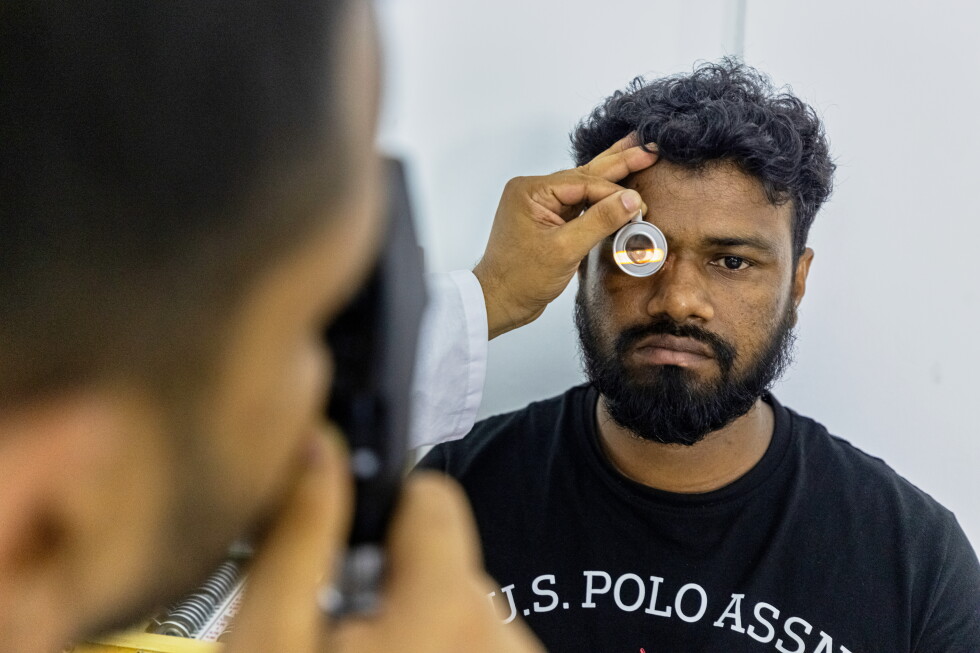
Industry data estimates that roughly one in three Bangladeshi garment workers need corrective vision to do their work properly, yet lack access to affordable glasses, according to VisionSpring, a global non-profit social enterprise dedicated to delivering low-cost eyecare to low-income communities in developing nations. To address this gap, the organization has partnered with the Bangladesh Garment Manufacturers and Exporters Association (BGMEA), the country’s leading factory industry group, to deliver on-site vision screenings and glasses that cost less than $10 per pair to participating factory workforces.
Early results from the program have been immediate and striking, according to VisionSpring CEO Ella Gudwin. Workers who receive glasses can consistently meet production and quality targets, and the reduction in common errors like skipped stitches, uneven hems, and misplaced buttons cuts down the hours of rework that factories must schedule to fix flawed products. The program has also revealed that most workers do not report undiagnosed vision problems to management, leaving widespread unaddressed impairment invisible to factory leadership for years.
That aligns with the experience of Masco Group, one of Bangladesh’s leading garment manufacturers, which has already rolled out screenings to 5,000 of its over 25,000 total employees. Fahima Akhter, a director at Masco Group, told reporters that roughly 30% of screened workers required reading glasses, and the company now plans to expand the program to all remaining employees. For Masco, the initiative is not an unnecessary expense, but a high-return core investment.
“We don’t consider it a cost. It is an investment. If the workers are working with better vision, their productivity and workplace safety will improve, and eventually this will translate into better productivity and profit for the company,” Akhter said.
Data from independent academic research backs up that claim. A randomized controlled trial co-authored by Gudwin, focused on sewing operators in India, found that workers who received free reading glasses saw a 6% jump in overall productivity alongside a measurable drop in error rates. The study, published in April in the *British Journal of Ophthalmology*, calculated that every $1 spent on combined vision screenings and glasses generated $3.37 in net productivity gains for employers over just 12 weeks.
Scaled across the entire global garment and textile industry, researchers estimate that rolling out similar low-cost programs could unlock as much as $27 billion in additional annual global output, a massive gain for an industry that relies on thin profit margins and incremental efficiency improvements.
Gudwin explained that the issue of unaddressed vision impairment in garment factories has flown under the radar for decades because corrective eyeglasses were incorrectly framed as a personal luxury rather than an essential workplace tool. Many frontline workers, who often develop age-related near-vision impairment in their late 30s and early 40s, assume that glasses will be too expensive for them to afford, so they delay seeking care and continue struggling with impaired vision on the job. Bringing screenings and low-cost glasses directly onto factory floors eliminates the financial and logistical barriers that keep workers from accessing the care they need.
Akhter added that Bangladesh’s garment sector should formalize the practice by making on-site vision screening and affordable glasses a standard mandatory workplace benefit. For the millions of workers who power the country’s biggest export industry, clear vision is no longer a luxury—it is a basic work necessity that benefits both employees and employers.