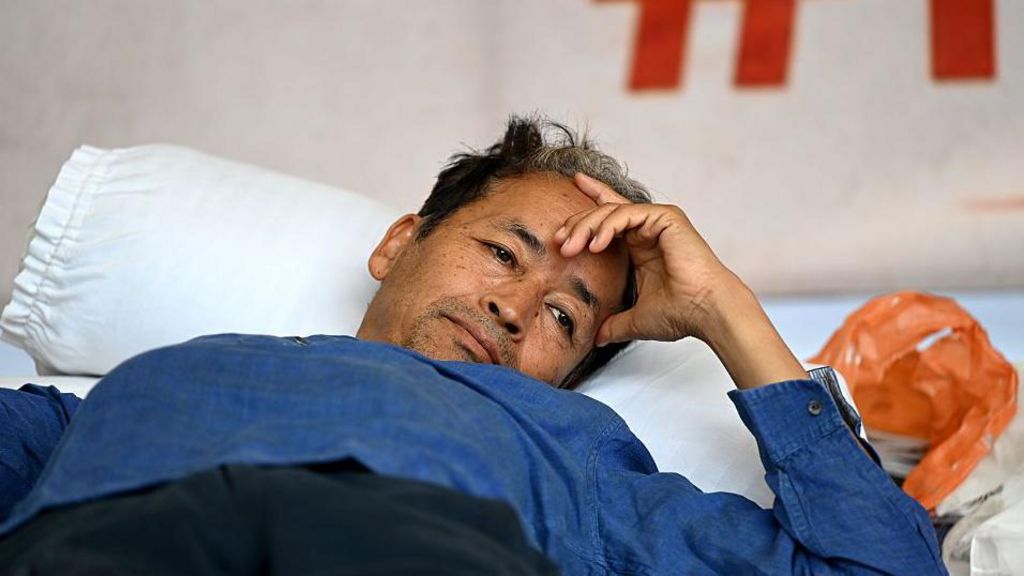
A growing national outcry is mounting in India over the rapidly declining health of renowned educationist and activist Sonam Wangchuk, who has entered his 19th day of an indefinite hunger strike demanding sweeping changes to the country’s education system. The 59-year-old, an internationally recognized public figure from Ladakh, has subsisted only on salt water since the protest began, losing 9.1 kilograms and now suffering from extreme weakness that leaves him unable to stand unassisted, according to his close aides.
Wangchuk launched his hunger strike in solidarity with the Cockroach Janta Party (CJP), an online satirical grassroots movement that rose to prominence following the cancellation of a critical national medical entrance exam in early May. The exam, a high-stakes test for aspiring doctors across India, was scrapped after widespread revelations of a major question paper leak. At the core of the CJP’s demands is the resignation of India’s Education Minister Dharmendra Pradhan, who protesters argue must take moral accountability for the security failure that upended the futures of thousands of young aspirants. To date, Prime Minister Narendra Modi’s central government has refused to open dialogue with the movement, with Pradhan dismissing CJP and its backers as the “B-team of disruptive elements.”
A household name across India, Wangchuk is no ordinary activist. His pioneering work in education innovation earned him the 2018 Ramon Magsaysay Award, widely known as Asia’s equivalent of the Nobel Prize, and his life story served as the inspiration for *Three Idiots*, the 2009 blockbuster Bollywood film that remains one of the highest-grossing Indian movies of all time. He has also made high-profile public appearances, including a guest spot on *Kaun Banega Crorepati*, India’s iconic adaptation of *Who Wants to Be a Millionaire* hosted by Amitabh Bachchan.
As Wangchuk’s condition has deteriorated sharply over the past week, appeals from across India’s political, cultural and academic spheres have flooded in, urging the activist to end his fast. More than 1,800 artists, writers, academics and public figures have signed an open letter requesting Wangchuk to stop his protest, arguing that “the government does not have a heart or a conscience” to respond to his sacrifice. Leading opposition figures have added their voices to the calls: Samajwadi Party leader Akhilesh Yadav posted on X that “the nation is in great need of his moral strength,” urging him to prioritize his health to continue fighting for reform long-term. Congress party Member of Parliament Shashi Tharoor made a heartfelt appeal, noting that Wangchuk had already succeeded in “awakened the conscience of the nation” and that lawmakers would raise students’ demands in the upcoming parliamentary session, making a fatal fast unnecessary.
Legendary Bollywood actor Zeenat Aman also joined the plea, calling on the central government to open immediate dialogue. “We must not become a society that sits back and watches one of its greatest minds be sacrificed,” she wrote on Instagram.
Despite the widespread urgent appeals, Wangchuk has so far refused to end his hunger strike, telling the BBC this week that he intends to see his protest through to “its logical conclusion.” Viral footage circulating on social media this week showed the frail activist requiring assistance to walk, before clutching his leg in visible agony and sitting down.
A legal petition filed before the Delhi High Court is set to be heard Thursday, calling for urgent court intervention to force the government to provide immediate medical care to Wangchuk, warning that he could die within 48 hours without intervention. A separate plea has gone further, asking the court to order that Wangchuk be moved to a government hospital and force-fed to prevent his death. The petition argues that the government’s inaction treats Wangchuk “like a hardcore criminal, terrorist or traitor to the nation,” and that his death would be “a matter of great shame for the country and the world.”
Wangchuk is not the only protester risking his health at the demonstration site at Jantar Mantar, the iconic 18th-century public space in central New Delhi that has long been a hub for political protests. Several other activists and student organization members are also on hunger strike alongside him, with one already hospitalized earlier this week after a sudden decline in health. Protesters have called for a mass day of hunger strike on Thursday, the same day the Delhi High Court hears the petition, and are planning a large march to the Indian Parliament when its new session opens on July 20 to escalate their demands for education reform and accountability.