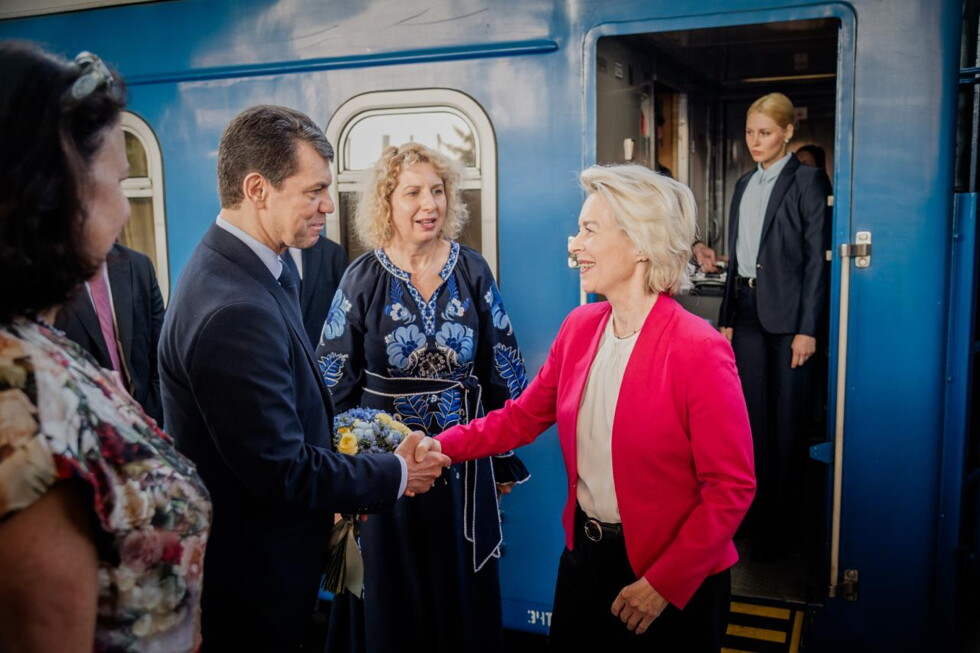
On Ukraine’s annual Statehood Day, European Commission President Ursula von der Leyen traveled to Kyiv Wednesday to reaffirm unwavering European Union backing for the country’s ongoing defense against Russia’s full-scale invasion, now in its third year. The visit marked von der Leyen’s 11th trip to Ukraine since Moscow launched its large-scale incursion in February 2022, and comes as Kyiv has built growing battlefield momentum through deep strikes inside Russian territory.
Ukraine’s Statehood Day, a national public holiday, honors the country’s right to self-determination — a principle that has been under active threat for more than a decade. Russian forces first seized and illegally annexed Ukraine’s Crimean Peninsula in 2014, before expanding their aggression with the full-scale invasion eight years later. The war has already claimed thousands of military and civilian lives, displaced millions of people, reduced major Ukrainian urban centers to rubble, and stoked global fears of a broader direct confrontation between Russia and the NATO alliance.
Alongside von der Leyen, senior leaders from across Southeast Europe gathered in Kyiv Wednesday for a regular summit focused on Black Sea and regional security. Notably, Serbia’s Moscow-aligned President Aleksandar Vucic joined the gathering, marking a high-profile appearance from a Balkan state that has refused to join Western sanctions on Russia, despite officially recognizing Ukraine’s territorial integrity. Serbia remains almost entirely dependent on Russian energy imports. The 2023 iteration of this summit was held in Odesa, where leaders collectively reaffirmed their commitment to upholding Ukraine’s sovereignty and territorial integrity.
During her visit, von der Leyen announced new targeted EU support packages tailored to Ukraine’s immediate and long-term needs. The bloc will advance new integration measures linking European and Ukrainian defense industries, and deliver additional assistance to strengthen Ukrainian air defenses ahead of the coming winter — a season when Russia has repeatedly launched large-scale strikes to cripple Ukraine’s critical energy infrastructure. To date, the EU has committed tens of billions of euros in military, financial, and diplomatic backing to Kyiv, and remains watchful of Russia’s broader expansionist ambitions across the European continent.
The high-level diplomatic visit coincides with a shifting battlefield dynamic, Western military analysts and officials confirm. Ukraine’s increasingly frequent and precision drone and missile strikes are now successfully striking high-value targets deep inside Russian territory, disrupting key Russian military supply lines and triggering widespread civilian fuel shortages across multiple Russian regions. “Ukraine has built a strong military momentum. The tide is turning,” von der Leyen wrote on social media ahead of her Kyiv engagements.
The day was marked by fresh Russian attacks across Ukrainian territory, which left at least eight civilians dead and 11 more injured. Three people were killed and seven wounded when Russian forces dropped six powerful glide bombs on infrastructure targets in Ukraine’s northern Sumy region, regional military governor Oleh Hryhorov confirmed. A separate Russian strike on the southern port city of Odesa killed three more civilians and injured three others, according to Odesa military head Serhii Lysak. In northern Chernihiv region, two civilians died and an 18-year-old was seriously wounded in a Russian drone attack, regional governor Viacheslav Chaus reported.
In a corresponding update, Russia’s Defense Ministry claimed its air defense forces intercepted 93 Ukrainian drones overnight across multiple Russian regions, as well as over occupied Crimea, the Sea of Azov, and the Black Sea. No immediate reports of casualties or major damage from the intercepted drones were released by Russian officials.
Von der Leyen’s visit adds to a string of recent international support pledges secured by Ukrainian President Volodymyr Zelenskyy, including new commitments from the Group of Seven leading industrialized nations and the broad “Coalition of the Willing” backing Kyiv’s defense. To date, no negotiated peace settlement has emerged to end the conflict, which remains deadlocked along hundreds of kilometers of front line.