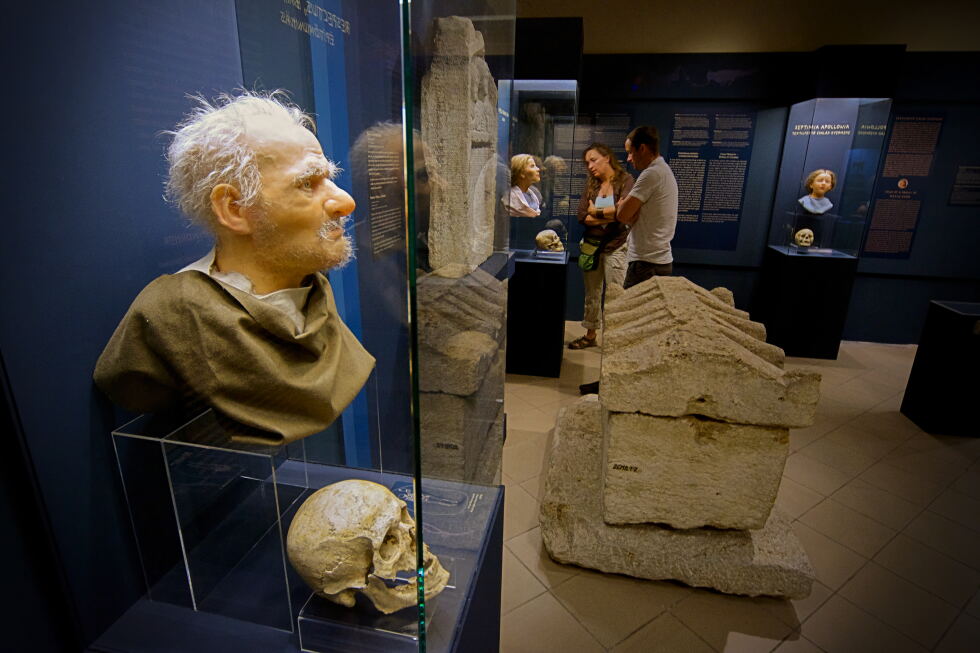
Nearly two millennia after Aquincum thrived as a busy military and commercial outpost on the Roman Empire’s Danube frontier, the ordinary people who called this ancient settlement home — now located in modern-day Budapest, Hungary — are stepping out of historical obscurity into vivid, life-sized view. A groundbreaking new exhibition at Budapest’s Aquincum Museum has recreated the faces and life stories of 16 residents of the long-gone city, blending cutting-edge genetic science, classical archaeological methods and handcrafted art to pull these forgotten people from the footnotes of Roman history.
Running through October 31, the exhibition centers on 16 detailed facial reconstructions built from excavated human skulls uncovered at the Aquincum archaeological site. Six of the models are fully realized, hyperrealistic silicon sculptures, complete with period-accurate clothing, authentic hair work and hand-painted features, all crafted to match the physical traits researchers confirmed through scientific analysis.
Unlike digital AI-generated facial models that only exist on screen, these physical reconstructions allow visitors to walk around the life-sized figures and study their features from every angle, creating an intimate connection that digital renderings cannot match. “Our core goal was to bridge the 2,000-year gap between these ancient people and modern visitors,” explained Loránt Vass, an archaeologist and co-curator of the exhibition. Named “Once We Were Like You,” the project seeks to answer the quiet, universal questions that surround ordinary members of ancient societies: What did they actually look like? What kind of lives did they lead? What marked their days and their fates?
To build each reconstruction, experts combined multiple scientific disciplines to get the most accurate portrait possible. DNA extracted from preserved ancient bones revealed specific details including skin tone, natural hair color, eye color, and even whether an individual was prone to freckles. Analysis of the skull’s shape, bone density and structure helped researchers pinpoint the person’s age at death, identify past injuries, and detect traces of chronic disease that plagued them during their lifetime. The original excavated skulls are even displayed directly beneath their corresponding reconstructions, giving visitors full access to the primary evidence behind the project.
While the actual names and full life histories of these people were lost to time, curators assigned names, occupations and narrative biographies to each figure, all rooted in the scientific data they gathered and well-documented context of daily life in Aquincum. Co-curator Péter Vámos emphasized that all invented details are built on “authentic historical foundations” that align with what anthropological and genetic research revealed about each person. “Unfortunately, we will never know their real names, but we worked to incorporate every single insight science could give us about their life stories,” Vámos noted.
One of the most compelling portraits is that of Respectus, a working-class construction worker who made his living plastering walls and splitting stone blocks. The heavy physical labor of his trade left clear evidence of wear and inflammation on his bones, and researchers confirmed he suffered a broken nose and knocked-out tooth from a violent, alcohol-fueled fight in a local tavern.
Respectus’s experience is representative of almost all the individuals featured in the exhibition. Voss explained that analysis of the skeletons found a consistently high rate of chronic inflammation across almost all remains. “These people did heavy manual labor every day, and many of them faced periods of starvation over their lifetimes,” he said. “This tells us most of them belonged to the lower middle class of Roman society — the group that is most often forgotten in historical records.”
Genetic analysis also shed new light on the extraordinary cultural and ethnic diversity of Aquincum, a frontier trading hub that drew people from across the vast Roman Empire and surrounding regions. Researchers confirmed the residents had origins ranging from the Italian heartland of the empire, to Iron Age Celtic communities that had lived in the region for centuries before Roman rule, to nomadic Sarmatian tribes from the Eurasian steppe, and even people born as far away as modern-day Scotland and Syria.
Emese Gábor, the artist who handcrafted the silicon facial reconstructions, explained why physical sculpting offers unique value even in an age of AI-generated facial modeling. “AI can create a face that shows up on a screen, but these physical pieces can be exhibited in a museum, viewed from every angle, and they are exactly life-sized,” she said. “I stick to rigorous scientific methods, and this work combines classical sculpting techniques with modern scientific data to get the most accurate result possible.”
For the museum’s curatorial team, the project is about far more than displaying archaeological finds. In most standard excavations, Vass noted, human remains are documented, studied, and stored away, leaving the people who once owned them stripped of their humanity, reduced to mere data points. By putting tangible, humanized portraits of these ordinary people front and center, the museum aims to help modern visitors see themselves reflected in the ancient past. “The exhibition’s title says it all: these people were just like us. They had the same kinds of jobs, the same kinds of everyday problems,” Vass said. “Their living conditions and social statuses were different, of course, but people are people. That hasn’t changed much across thousands of years of history.”