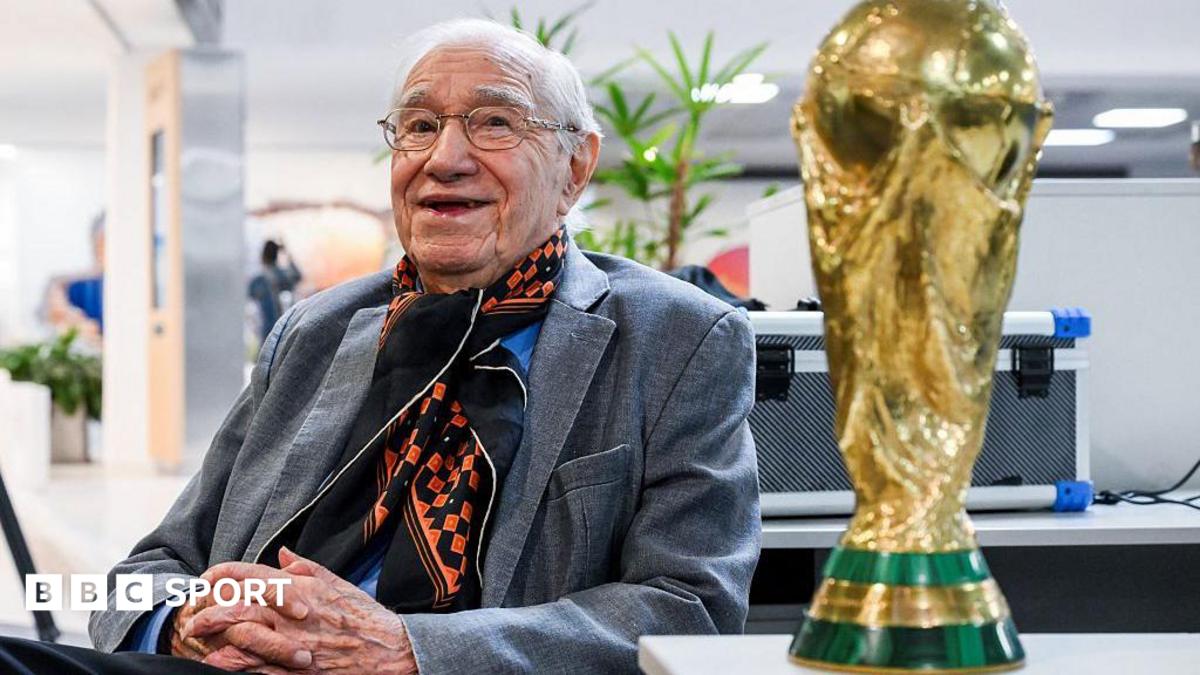
As Argentina prepares to lock horns with old rival England in the 2026 FIFA World Cup semifinal at 20:00 BST on July 15, one beloved figure in the press box is drawing global attention for a once-in-a-lifetime milestone: 91-year-old Spanish broadcaster Enrique Macaya Márquez, better known simply as Macaya, has covered every men’s World Cup since the iconic 1958 tournament in Sweden, an unmatched streak of 18 consecutive editions that spans nearly 70 years of football history.
Macaya was just 24 when he received his first World Cup assignment, sent to the 1958 Swedish tournament to cover a field that introduced 17-year-old Brazilian prodigy Pelé to the world. One of his earliest matches was Pelé’s Brazil against Austria, but the moment that remains indelibly etched in his memory is what Argentine football fans still call the “Disaster of Sweden” — Argentina’s stunning 6-1 defeat to Czechoslovakia. “We knew almost nothing about Czechoslovakia. We had no information, no data, and they surprised us,” Macaya recalled in an interview.
Over the course of his seven-decade career, Macaya has witnessed the transformation of men’s football from a regional pastime to a $30 billion global spectacle. He has reported from pitchside on every generation of the game’s greatest stars, from Pelé and Diego Maradona to the current era’s Lionel Messi, watching as analog broadcast technology evolved into high-definition digital streaming, and post-match print analysis shifted to real-time, data-driven instant statistics. Yet through all these sweeping changes, Macaya has held fast to one core journalistic principle: he refuses to rush to snap judgments.
That approach shaped his view back in 2018, when Lionel Scaloni — a relatively unknown former player — was unexpectedly appointed head coach of the Argentine national team. At the time, Macaya admitted he had little confidence in the appointment. “I didn’t have high hopes, I didn’t know him,” the DSPORTS Radio commentator said. But Scaloni’s tenure has defied all expectations: he has led Argentina to three major trophies, including the 2022 World Cup title, turning what was widely labeled one of the riskiest coaching appointments in football history into one of its greatest success stories. For Macaya, that turnaround only reinforced his long-held belief: “You can’t pass judgement without a much deeper, more complete understanding of the person being judged.”
Today, as Argentina returns to the World Cup semifinal stage to face England, Macaya is confident the South American side has what it takes to lift the trophy for a second consecutive time. “Of course they can,” he said. “If we’re talking about what is possible, about the future, I believe Argentina is capable of winning.”
When asked to name his favorite player in the current squad, he did not hesitate: “Clearly, it’s Messi.” But the iconic broadcaster pushed back against the perennial debate over who holds the title of the greatest footballer of all time, refusing to draw simplistic comparisons between eras. “That question deserves a smile,” he said. “There’s no way to measure players throughout history. Times have changed. Opponents have changed. Every player is unique. I can say who I personally liked, but that doesn’t mean I believe that player was the best in history.”
This nuanced perspective extends to all cross-era comparisons, from the rivalry between Messi and Maradona (two of Argentina’s greatest number 10s) to the 1970 Brazilian side led by Pelé and Maradona’s 1986 World Cup-winning team. “It is very difficult to make a cold comparison,” he explained. “The opponents were different. The needs were different. The support from their team-mates was different. Each had their own life and their own history.”
Macaya also noted that defeats are just as important to football history as victory. “Negative results are also part of that memory,” he said. Even so, he acknowledges that World Cup triumphs hold a special place in his heart as an Argentine journalist, particularly Maradona’s 1986 win. “Winning the World Cup is my favourite memory, and in Maradona’s case, I think the trophy had finally given him the answer he sought his entire life: to be a world champion.”
After nearly 70 years of traveling the world to cover football’s biggest tournament, Macaya says retirement is finally on the horizon. “I’m going to retire at some point,” he said with a laugh. “I’m retiring now… so I’ll hang up and leave it for another time.” For a man who has spent a lifetime documenting the history of the World Cup, a gentle, gradual goodbye feels like a fitting end to a remarkable career — one that has already cemented his place in football lore. True to his open-ended approach to the game, though, Macaya’s farewell never feels truly final.
The 2026 World Cup semifinal between England and Argentina will be broadcast live globally, with full UK coverage available on BBC One and BBC iPlayer starting at 19:00 BST, with radio commentary on BBC Radio 5 Live and BBC Sounds from 18:00 BST.