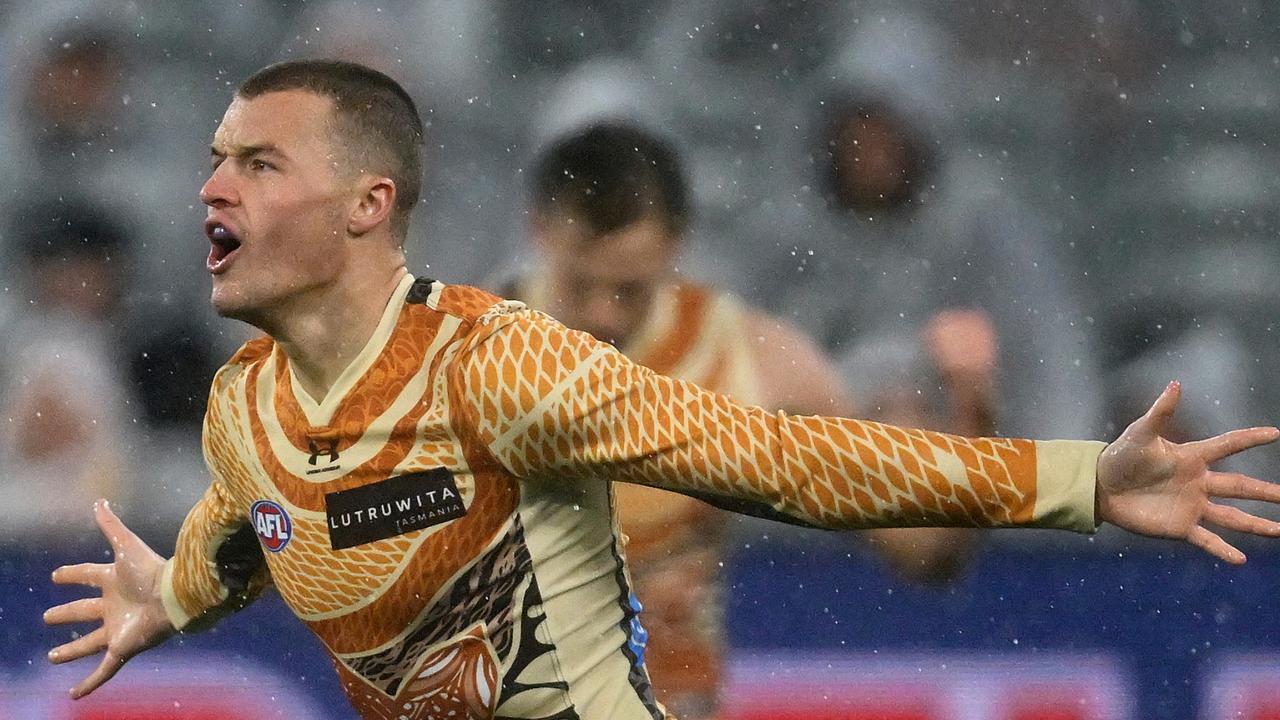
A growing wave of criticism against the Australian Football League’s polarizing stand rule has gained a high-profile new critic, with Hawthorn Hawks star playmaker Jack Ginnivan becoming the latest prominent voice to call out the regulation, arguing it undermines the quality of play and creates unnecessary confusion for athletes and officials alike.
Introduced back in 2021, the stand rule was designed with a clear on-field goal: to prevent players positioned on the mark from moving laterally before a set shot, in turn opening up attacking space and creating more dynamic play across the ground. But from its launch, the regulation has split opinions across the league, drawing consistent pushback from players, coaches, and fans who argue it creates more problems than it solves.
Ginnivan, who knows the rule’s inconsistent impacts firsthand after benefiting from a controversial 50-meter penalty under the regulation during Hawthorn’s rain-soaked clash against Carlton at the Melbourne Cricket Ground last Saturday, doubled down on those criticisms in a recent appearance on the Ball Magnets podcast. The forward, known for his straightforward, unfiltered comments to media, did not mince words when assessing the rule.
“I think it’s the worst rule the AFL has, like easily,” Ginnivan said. “It’s just so confusing for players and umpires to adjudicate. It just doesn’t need to exist, it creates unnecessary 50-meter penalties that can directly lead to a goal out of nowhere, and it sort of just ruins the game.”
The controversial incident from Saturday’s match perfectly illustrates the confusion Ginnivan highlighted. As the Hawks prepared for a difficult set shot in heavy, slippery rain, Carlton’s Adam Cerra stepped off the mark just as the umpire appeared to call play-on. Despite the call, officials awarded Ginnivan a 50-meter penalty, moving his shot from a tough angle to an unmissable position directly in front of goal. Ginnivan went on to convert the kick, but he stressed that the chaos of the moment was not the fault of the officiating team—it was the fault of a poorly written rule.
Ginnivan sympathized with veteran umpire Matt Stevic, who was forced to make the split-second call in the chaotic moment. “It’s just so hard for Matt Stevic to umpire it because the rule is so bad,” he explained.
Offering his own perspective on how set shots should work, Ginnivan argued the old system allowed for more flexibility and strategic play without unnecessary confusion. “I felt like if I was to run straight, if Dimma (Blake Hardwick) was there, I could feign the handball if I wanted to. But if I wanted to run straight, I am OK. I don’t think I stepped off my line, I am pretty sure I was still running straight. But then the confusion of, ‘Oh (he) called play-on’, it’s just so hard for everyone involved.”
Ginnivan’s public criticism adds to a growing body of discontent with the stand rule, reigniting calls for the AFL to revisit the regulation and consider adjustments ahead of the next season to restore clarity and consistency to on-field officiating.