HONG KONG – New data released by China’s General Administration of Customs on Tuesday shows the country’s export growth accelerated sharply in June, climbing 27% year-on-year in a performance that outpaced nearly all economist projections. The reading marked a notable jump from May’s 19.4% annual growth, with industry analysts linking the stronger-than-expected expansion to multiple global market factors, most prominently the worldwide boom in artificial intelligence development.
Imports also saw stronger growth than forecast in June, surging 36% compared to the same period last year, up from May’s 27.4% annual increase. Analysts note that rising geopolitical tensions, particularly the ongoing conflict involving Iran, have pushed up global commodity and energy costs, contributing to the higher overall value of China’s import volumes for the month. The country’s monthly trade surplus widened to $125.6 billion in June, up from $105.4 billion recorded in May.
Julian Evans-Pritchard, head of China Economics at Capital Economics, highlighted in a client note released Tuesday that the surge in trade values reflects a broader market shift tied to AI development. “Trade values took another big leg up in June,” Evans-Pritchard wrote. “This predominantly reflects the recent surge in semiconductor prices on the back of the AI boom. But even putting that aside, foreign demand for Chinese goods remains robust.”
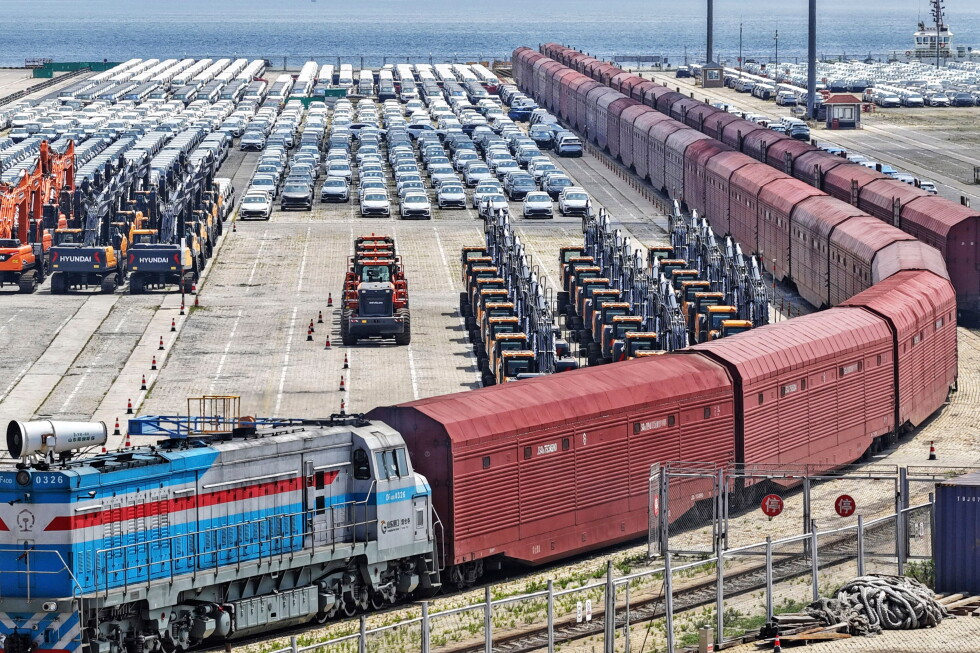
Beyond semiconductors, China has seen rapid export growth in two key high-value sectors: electric vehicles (EVs) and other technology-focused manufactured goods. As global industries rush to integrate AI tools into operations, demand for semiconductors, circuit boards and other electronic components produced in Chinese factories has risen sharply, driving the overall export expansion. EV exports have emerged as a particularly bright spot, with separate data showing China’s passenger vehicle exports jumped 80% year-on-year in June amid rising global demand for affordable electric vehicles.
The strong performance of China’s export manufacturing sector has provided critical support for the country’s overall economic growth this year, offsetting persistent softness in domestic consumer spending and fixed investment. The sluggishness in domestic activity stems largely from a prolonged downturn in China’s real estate industry, which has historically accounted for a large share of the country’s economic output and household wealth.
For the first half of 2026 overall, Chinese customs data shows exports grew 17.6% year-on-year, while imports rose 26.6% over the same period. Breaking down export growth by region, shipments to Southeast Asia surged nearly 35% year-on-year in June, while exports to the European Union and Latin America rose more than 18% and 28% respectively. Exports to the United States also climbed almost 14% from a year earlier, a gain partially driven by comparison to weak 2025 volumes that dropped after former U.S. President Donald Trump implemented new higher tariffs on Chinese goods during his second term.
Policymakers in the U.S. and Europe have repeatedly raised concerns over growing bilateral trade deficits with China in recent years. In response to trade barriers including higher tariffs, many Chinese manufacturing firms have relocated production capacity to regional hubs across Europe and other global markets to bypass import restrictions. China has also actively diversified its export markets, ramping up shipments to fast-growing economies in Southeast Asia, Latin America and Africa to reduce reliance on traditional Western markets.
While many analysts project China’s export growth will continue in the coming months, they warn the expansion is increasingly fragile. Wei Li, head of Multi-Asset Investments at BNP Paribas Securities (China), noted that the strong growth in auto and AI-related goods exports remains heavily dependent on sustained global consumer and business demand, as well as future changes to international trade regulations that could create new headwinds.
China is scheduled to release its official second-quarter gross domestic product (GDP) growth data on Wednesday. Chinese policymakers have set an annual GDP growth target of 4.5% to 5% for 2026, which is slightly lower than the 5% growth the country recorded in 2025. Last week, the International Monetary Fund (IMF) upgraded its 2026 growth forecast for China by 0.2 percentage points to 4.6%, but the organization projects China’s annual growth will slow to 4.1% by 2027 amid long-term structural headwinds.
To counter softness in domestic demand, Chinese leaders have rolled out a series of stimulus measures aimed at boosting consumer spending, including trade-in subsidies for new vehicles and home appliances. However, many households remain cautious amid ongoing economic uncertainty, with many consumers delaying large, big-ticket purchases to preserve savings.