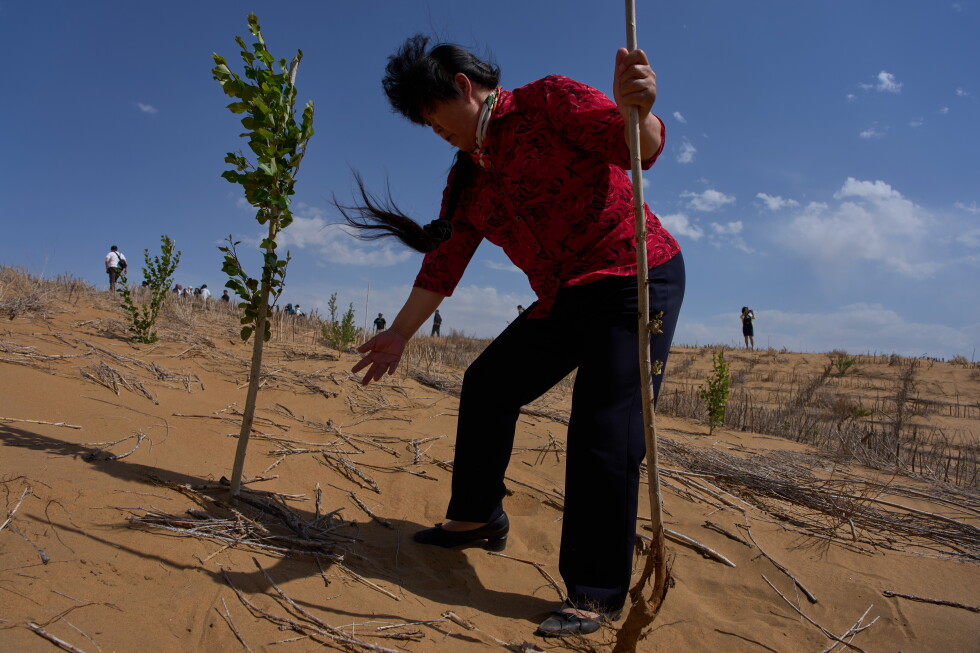
In the arid sandscapes of northern China’s Kubuqi Desert, a quiet, decades-long revolution against one of the world’s most persistent ecological threats has unfolded. For half a century, millions of workers have carved order into shifting dunes one grid at a time: driving forearm-length straw sticks into loose sand in intersecting lines to create a widespread checkerboard pattern, then planting native saplings at the center of each small square. This low-tech but highly effective technique, called straw checkerboarding, stabilizes dunes against strong desert winds, traps moisture, and gives young seedlings the stable environment they need to put down roots.
This vast greening effort is the backbone of the Three-North Protective Forest Program, more widely known globally as China’s Green Great Wall. Launched in 1978, the ambitious initiative is designed to roll back the steady expansion of desertification, a process driven by centuries of drought, overgrazing, and unsustainable farming that stripped northern China of vegetation, degraded soil, and left communities vulnerable to devastating wind and sandstorms.
Generations of steady work have delivered striking, measurable results. Official state data shows that desertified land across northern China peaked in 2000, and has shrunk by more than 1,000 square kilometers every year since that turning point. As of 2024, the cumulative forest area established through the program covers more than 500,000 square kilometers — an area roughly the size of Spain. Long-term monitoring from a team of researchers at the Chinese Academy of Sciences’ Institute of Applied Ecology found that overall desertified land in China has fallen by roughly 10% since 2000, while areas of severe and extreme desertification have dropped by more than 40%. Forest coverage across the program’s working area has jumped from just 5% in 1978 to 14% in 2022.
For frontline workers like 60-year-old Yin Yuzhen, who has spent four decades fighting sand near the Mu Us Desert adjacent to Kubuqi, that transformation is personal. Yin recalled her early years on the sand line as a time of profound isolation: when even a single bird passing overhead was enough to lift her spirits, and blowing sand often blocked visibility just a few feet ahead. Today, she says the horizon is clear, greenery stretches for miles, and permanent roads cut through landscapes that were once unnavigable shifting dunes. Even after 40 years, she still works from dawn to midday every day tending saplings and repairing worn checkerboards, a task now joined by her children and occasional local volunteers. Researchers estimate more than 300 million rural laborers have contributed to the program over its history, mostly as paid part-time participants.
Scientists and environmental experts across the globe have hailed the program as a landmark model for landscape restoration. Barron Joseph Orr, chief scientist for the United Nations Convention to Combat Desertification, noted that the Three-North Program’s greatest contribution goes beyond the sheer scale of land restored. What sets it apart, he says, is the sustained political and financial commitment that has kept the initiative running for five decades. “Reversing desertification is possible when it becomes part of long-term development strategies,” Orr explained in comments to the Associated Press. The Green Great Wall has inspired similar large-scale efforts worldwide, including the Great Green Wall initiative launched across 11 African nations in 2007 to hold back the expanding Sahara Desert.
Yet despite the remarkable progress, experts stress that the work is far from finished. Preserving the hard-won gains of the past 50 years will require decades more consistent investment and management, researchers say. Restored dryland ecosystems can become increasingly self-sustaining over time, but they remain dependent on long-term monitoring, careful management, and favorable conditions including adequate water access and healthy soil.
Many Chinese environmental advocates and researchers also point to a key ongoing challenge: aligning ecological restoration with local community livelihoods, to avoid framing conservation and economic development as opposing goals. Zhao Zhong, founder of Gansu-based environmental advocacy group Green Camel Bell, which works with local farmers and herders to plant native vegetation and educate communities on desertification risks, notes that projects that deliver tangible economic benefits to local populations have far higher long-term success rates. Orr echoed this assessment, noting that community buy-in through shared economic benefit is a critical predictor of restoration success.
For Dr. Zhu Jiaojun, the Chinese Academy of Sciences ecologist who has spent decades studying the program, the biggest open question remains how to sustain conservation gains if future levels of state investment and human intervention decrease. “This is what we are very concerned with and this is also the biggest challenge,” he said. For frontline workers like Yin, the solution lies in passing the work on to coming generations, and cultivating a shared sense of stewardship for the land. “We need to teach young people to love this Earth,” Yin said. “If we love it with all our hearts, nature will love us in return.”