On Sunday, a coalition of 14 nations led by the United States and the United Kingdom issued a joint statement from Manila reaffirming that China’s sweeping territorial claims over the South China Sea lack any legal foundation, in a public backing of the landmark 2016 international arbitration ruling.
The statement was timed to mark the anniversary of the July 12, 2016, decision handed down by a permanent arbitration tribunal based in The Hague. The tribunal was convened under the framework of the United Nations Convention on the Law of the Sea (UNCLOS), the global treaty that governs all maritime activity. The joint statement describes the arbitration outcome as a definitive, final and legally binding milestone that settles core legal questions around competing claims in the strategic waterway.
The arbitration case was first launched by the Philippines in 2013, one year after a tense months-long standoff at a contested shoal ended with China taking effective control of the feature. China declined to participate in the proceedings, and has refused to acknowledge the ruling ever since it was issued. Beijing continues to assert sovereignty over nearly the entire South China Sea, a critical global shipping chokepoint that has been labeled one of the most dangerous potential conflict flashpoints in East Asia.
The waterway is claimed in whole or in part by multiple governments: China, the Philippines, Vietnam, Malaysia, Brunei and Taiwan. Repeated territorial standoffs between claimant states have played out in the region for decades, with confrontations growing more frequent and high-risk in recent years.
Beyond the U.S. and UK, the other signatories to Sunday’s statement are the Philippines, Japan, Australia, New Zealand, Canada, Germany, Italy, Estonia, Latvia, Lithuania, Romania and Slovenia. In the text, the coalition explicitly rejected “China’s expansive maritime claims in the South China Sea, including those based on ‘historic rights,’” echoing the core finding of the 2016 tribunal.
The 2016 ruling sided overwhelmingly with the Philippines’ legal arguments, concluding that UNCLOS provides no legal support for China’s claims to historic resource rights in areas of the South China Sea beyond its internationally recognized territorial boundaries. UNCLOS, which entered into force in 1994, has been ratified by more than 170 countries and regions including both China and the Philippines.
The 14-nation statement condemned destabilizing unilateral actions across the disputed waters, singling out the use of coast guard vessels, military assets and maritime militia to intimidate and obstruct lawful maritime and air operations conducted by other states. “Such actions endanger the safety of personnel and fishermen and seriously degrade regional peace and security,” the statement read.
The coalition stressed that freedom of navigation and overflight, as enshrined in UNCLOS, must be protected and preserved, and called for all territorial disputes to be resolved through peaceful diplomatic means consistent with the 1982 UNCLOS framework.
China had not issued a public response to Sunday’s joint statement as of press time. But in recent public comments through its embassy in Manila, Beijing has repeatedly made clear it will never recognize the 2016 ruling, which it labels “illegal, null and void.” “The award will not alter the historical and factual basis for China’s sovereignty over the islands of the South China Sea and their adjacent waters,” the embassy said in a previous statement, adding that the outcome “will not weaken China’s resolve and determination to safeguard its sovereignty and maritime rights and interests.”
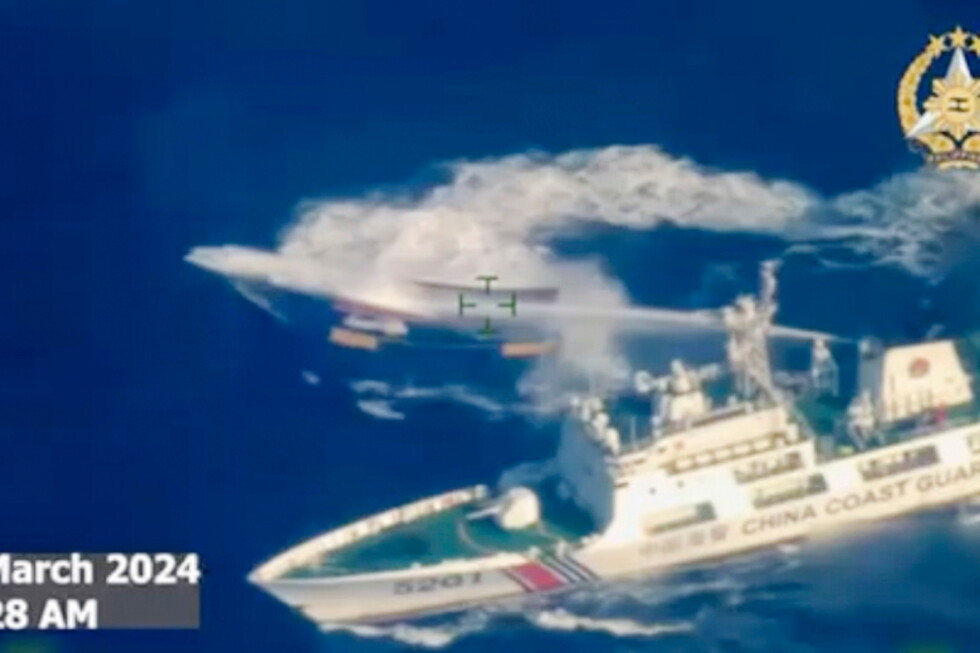
Territorial tensions in the South China Sea have spiked in recent years, most frequently involving Chinese forces and vessels alongside Philippine and Vietnamese fishing fleets and government vessels. Chinese coast guard vessels have been documented using high-powered water cannons, military-grade laser dazzlers, and dangerous blocking maneuvers against Philippine vessels and fishermen from other claimant states. These actions have led to high-seas collisions and multiple high-risk near encounters between aircraft and vessels in the area.
Washington has repeatedly pressured Beijing to comply with the 2016 arbitration ruling. Both the current Biden administration and previous Trump administration have reaffirmed that as part of the long-standing mutual defense treaty between the U.S. and the Philippines — America’s oldest treaty ally in Asia — Washington is legally obligated to come to the Philippines’ defense if Filipino forces, civilian or military vessels, or aircraft come under armed attack in the South China Sea.