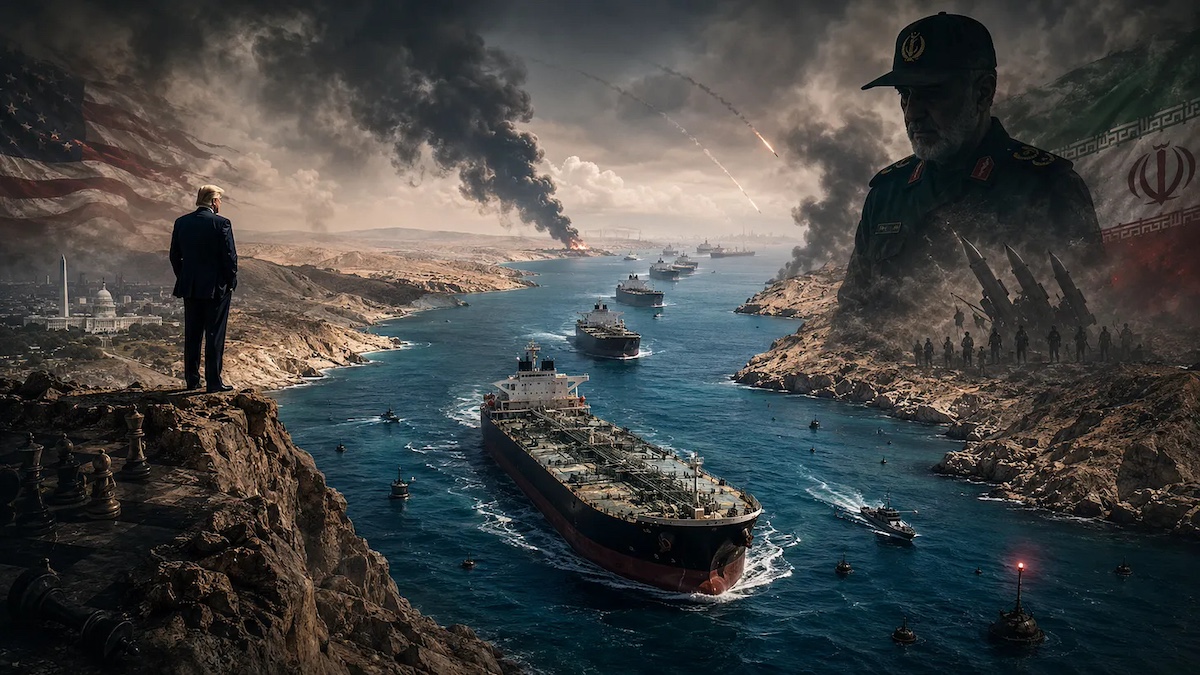
For weeks, analysts have hesitated to dissect the fragile U.S.-Iran ceasefire, mired in contradictory rhetoric and half-baked commitments around the so-called “framework agreement”. But the recent resumption of open hostilities makes it impossible to ignore the catastrophic consequences of an ill-conceived conflict born from strategic emptiness. Like all weak deals built on wishful thinking rather than tangible compromise, this ceasefire has crumbled at the first sign of genuine pressure.
This week, direct exchanges of fire resumed between Washington and Tehran. After a series of attacks on liquefied natural gas tankers transiting the Strait of Hormuz, U.S. forces launched strikes on Iranian targets, prompting Tehran to retaliate against American military installations in Bahrain and Kuwait. Speaking to reporters on the sidelines of the NATO summit in Ankara, former President Donald Trump declared the interim agreement “over”, even as he left the door open for future negotiations. In response to the collapse, global oil prices have already begun to climb, as markets price in the growing risk that the world’s most critical energy chokepoint will no longer operate under predictable, open access rules.
Since the framework was first announced, the public has been flooded with a chaotic stream of statements, threats, retractions, counter-threats, last-minute social media posts, and improvised press conferences – all fitting the Orwellian definition of competing “truths” that obscure rather than clarify. Tracking every twist implies there is a coherent strategy to follow, but in reality, no such strategy exists. There are only reactions to events: missile strikes, drone attacks, disrupted tanker traffic, volatile oil markets, NATO allies scrambling to interpret shifting White House positions, and Iranian hardliners testing just how far they can push control of the Strait of Hormuz before Washington pushes back. This chaos is not a side effect of the process – it is the process, a product of total lack of clear direction and long-term planning from the very beginning.
To understand where things went wrong, it is first necessary to examine what the 14-point interim Islamabad Memorandum of Understanding actually promised. The framework was designed to halt active conflict, reopen the Strait of Hormuz, create a 60-day window for final negotiations, outline a path to U.S. sanctions relief, and conveniently kick the most contentious issue – Iran’s nuclear program – down the road to a future final deal. All the hardest questions, including how to roll back Iran’s enrichment activities, were simply deferred for later.
This is precisely the issue that the original Joint Comprehensive Plan of Action (JCPOA), reached in 2015, was built to address through years of careful negotiation, rigorous verification protocols, and binding enforcement mechanisms. Trump withdrew the U.S. from that agreement in his first term, dismissing it as the “worst deal in history”. The current framework is thinner, weaker, far more vulnerable to coercion, and by any measure, significantly worse than the deal it replaced.
On paper, the arrangement appeared to offer a controlled off-ramp from escalating conflict, and delivered a perceived political win for Trump as domestic political pressure mounted. In practice, it was nothing more than a fraying rope bridge spanning an active volcano. Its core terms carried fatal flaws from the start:
First, a full ceasefire across all fronts, including Lebanon, sounded like a sweeping breakthrough, but it immediately created an insurmountable enforcement gap. Iran could always point to Israeli strikes on Hezbollah and its continued military presence in Lebanon as a breach, while the U.S. could cite any Iranian-linked activity as justification to walk away. Israel, for its part, never agreed to adjust its threat assessments to suit Washington’s desire for a deal with Tehran, and has grown increasingly assertive in disregarding White House priorities, further undermining the agreement.
Second, the 60-day negotiating window was billed as a way to build urgency and momentum toward a final deal. In reality, the short timeline handed Iran maximum leverage. Every delay at Hormuz, every tanker incident, every ambiguous move by the Islamic Revolutionary Guard Corps (IRGC), and every resulting shock to global oil markets increases pressure on Washington to offer concessions in exchange for even temporary stability. This puts the U.S. in a position of weakness, effectively negotiating under the threat of higher gasoline prices for American consumers.
Third, the framework required the U.S. to lift its naval blockade and reduce military pressure on Iran, while all major Iranian concessions were pushed to future talks. This meant Washington gave up its primary leverage early, allowing Iran to resume oil exports and gain immediate sanctions relief that has shored up the IRGC, which was previously reeling from severe economic distress. That gives Iran room to bank the economic benefits of the deal, test its boundaries, and haggle over the meaning of core terms later when concessions are finally due.
Fourth, Iran agreed to allow commercial vessels to pass through Hormuz without charge for only 60 days. That small phrase “for 60 days only” hides the greatest long-term risk. The deal also allowed Iran to hold talks with Oman and other Gulf states on “future administration and maritime services” for the strait. Tehran has already begun framing new access requirements under different labels – permits, maritime safety fees, routing systems, demining charges, coastal state services, and technical clearance requirements – all of which amount to a de facto toll on shipping that Iran controls. The deal effectively enshrined Iran’s right to dictate which vessels can pass and what routes they must take.
Fifth, Iran reaffirmed its commitment not to develop nuclear weapons. This sounds like a win, but it is nothing more than empty language. The size of Iran’s enriched uranium stockpile, plans for down-blending under International Atomic Energy Agency (IAEA) supervision, and the future of Iran’s enrichment program itself were all left for future negotiations. In short, the nuclear issue – the very justification Trump cited to launch the conflict in the first place after withdrawing from the JCPOA – remains completely unresolved, tucked away in the “deal with it later” basket where it has sat for years.
Finally, the U.S. put significant concessions on the table: sanctions relief, oil export waivers, the release of frozen Iranian assets, and a proposed $300 billion reconstruction and development plan. This amounts to the largest political victory the Iranian regime could have asked for. Tehran can now frame the war as proof that its policy of resistance works: absorb U.S. strikes, threaten to close Hormuz, force Washington to the negotiating table, and walk away with sanctions relief and new investment. Before the war, the IRGC was at its weakest point since the 1979 Islamic Revolution, with widespread economic turmoil fueling massive internal unrest that culminated in mass protests earlier this year, where tens of thousands of innocent civilian protesters were reportedly killed by regime forces. Now, the IRGC has access to new funds to crush remaining dissent, rearm its regional proxies, and solidify its grip on power.
In the end, this framework, celebrated by some as a major breakthrough, solved none of the core issues at hand. It only temporarily rebranded them, while simultaneously strengthening a brutal, repressive theocratic regime that much of the international community has long sought to constrain.
Contrary to Trump’s claims that Iran’s actions came as an unexpected surprise, the closure of Hormuz and Tehran’s efforts to control the strait were entirely predictable. Back in March, Trump claimed Iranian retaliation against Gulf states had shocked his administration, but this is one of the most basic lessons of Middle East geopolitics. Military and policy analysts explicitly warned the Trump administration before it launched strikes that Iran would retaliate against U.S. Gulf allies and move to control the Strait of Hormuz in response to any attack.
The Strait of Hormuz is no obscure, classified vulnerability known only to naval planners and oil traders. It is a textbook example of how geography shapes global power: roughly one-fifth of the world’s total oil supply transits through its waters every day. Control of the strait has always been Iran’s ultimate geopolitical trump card. Tehran was reluctant to use it for decades, fearing that a failed attempt to close it would permanently disarm the regime of its most powerful coercive tool. But that calculation has now shifted.
By demonstrating its ability to disrupt traffic without defeating the U.S. Navy outright, Iran has rewritten the rules of the strait. Tehran does not need to sink ships or block every waterway to exert control: all it needs to do is make transit prohibitively expensive, unpredictably risky, and politically painful for consuming nations. That is a far lower bar to achieve, and Iran has already cleared it. Trump’s claims that the strait is now “open” must be taken with a heavy grain of salt. While some vessels continue to move, normal, unimpeded access has not returned. Following the latest round of hostilities, multiple oil and gas tankers have already turned around rather than attempt to transit the strait. Multiple confirmed reports show Iranian forces have ordered vessels to turn back, and Iran’s strait authority has issued public advisories stating no vessel may transit without a valid government-issued permit. That is not open access – that is access only on Iran’s terms.
While the war damaged some Iranian military infrastructure and disrupted the national economy, it has not shifted the regional balance of power in the U.S.’s favor. If anything, the IRGC is stronger today than it was before the conflict. It now has a far more powerful domestic and regional narrative: it can claim to have survived massive U.S. and Israeli strikes, kept the nuclear program intact, forced Washington into direct negotiations, secured sanctions relief, and proven it can use Hormuz as a coercive lever whenever it chooses.
Before the war, Iranian hardliners were under immense domestic pressure: economic collapse, crippling sanctions, widespread public anger over social repression, and a growing legitimacy crisis had created deep internal fissures within the regime. The war gave the IRGC exactly what it needed: a national security emergency that justifies cracking down on dissent at home while rallying nationalist support around resistance to foreign aggression abroad.
The result is a perverse outcome for the U.S. and Israel, who marketed the war as a campaign to eliminate Iran’s nuclear threat and dismantle its regional network of proxies. Instead, the emerging settlement leaves the nuclear question unresolved, elevates Hormuz to Iran’s most effective negotiating weapon, and paves the way for sanctions relief that will flow directly to the sectors of the Iranian economy controlled most tightly by the IRGC.
The latest collapse of the ceasefire is not an unexpected outlier – it is the inevitable outcome of a process built on lack of strategy. The real story is not the latest exchange of fire, but the consistent chaos that has defined the Trump administration’s approach to Iran from the start. One day the deal is a historic triumph; the next it is over. One day talks will continue; the next all concessions are revoked. One day we need to protect shipping; the next we need to avoid escalation. One day Iran must be punished; the next allies must fall in line behind Washington. And through it all, the administration acts shocked when Iran does the most predictable thing possible: uses its control of Hormuz to advance its own interests.
This entire fiasco is a testament to the absence of any coherent U.S. strategy. It is nothing more than the noise of ad hoc decision-making from a White House driven by the personal whims of a president who lacks even a basic understanding of core geopolitical principles. There is no clear end goal, no logical sequence of steps, and no plan for how to respond when Iran acts exactly as experts predicted it would.
A coherent Iran strategy would have answered basic questions before the first strike was launched: What is the core political objective? Rollback of Iran’s nuclear program, weakening or replacing the regime, deterrence, guaranteed maritime access, reassuring regional allies, or just a political spectacle for domestic consumption? What concessions are acceptable? What costs can the U.S. sustain long-term? What happens if Iran attacks Gulf allies? What happens if shipping is disrupted? What happens if the IRGC survives and claims victory? What will Washington do if Israel and Iran interpret ceasefire obligations in completely different ways? None of these questions were ever answered, despite their simplicity.
The uncomfortable, unavoidable conclusion is that nearly every actor except Iranian hardliners is now in a worse position than before the conflict started. The U.S. has proven it can strike Iranian targets, but it has also proven it cannot turn military power into lasting political outcomes. Domestic political opposition to long-term conflict means Washington does not have the public support to mobilize a ground invasion, which would be required to achieve regime change or total disarmament. Israel has demonstrated its military reach in the region, but global public support for the country – including support within the U.S. – is at its lowest point in history, with a growing share of the global public viewing Israel as a rogue, belligerent actor that disregards the harm its actions inflict on others. Gulf Arab states have been reminded once again that they are stuck in the blast zone of decisions made in Washington and Tel Aviv, with little regard for the collateral damage they will bear. Europe and Asia are once again facing volatile oil prices because of a narrow waterway they have no power to control. NATO allies have been repeatedly berated by Trump for not contributing enough, even as Trump claims he has already won the war and does not need their help. Shipping companies, insurers, and energy firms now have to price the risk of unplanned U.S. political improvisation into every single transit decision through the Gulf.
For Iran, the conflict has taught a dangerous lesson: Tehran can force the world to negotiate over control of key geography. It can threaten Hormuz, reopen it partially, introduce new permit requirements, test the limits of the agreement, and use every delay to commercial shipping as leverage to extract more concessions. The lesson Tehran will take away is not that escalation is too costly. It is that controlled, gradual escalation works when the other side is more afraid of a sustained crisis than you are.
This is the quagmire the world now finds itself in. It is not a traditional failed invasion, not a costly occupation, not a clear battlefield defeat. It is a distinctly modern failure: a war launched to restore U.S. leverage in the Gulf that instead exposed how much leverage Iran already held, and how little strategic planning Washington put into taking it away.