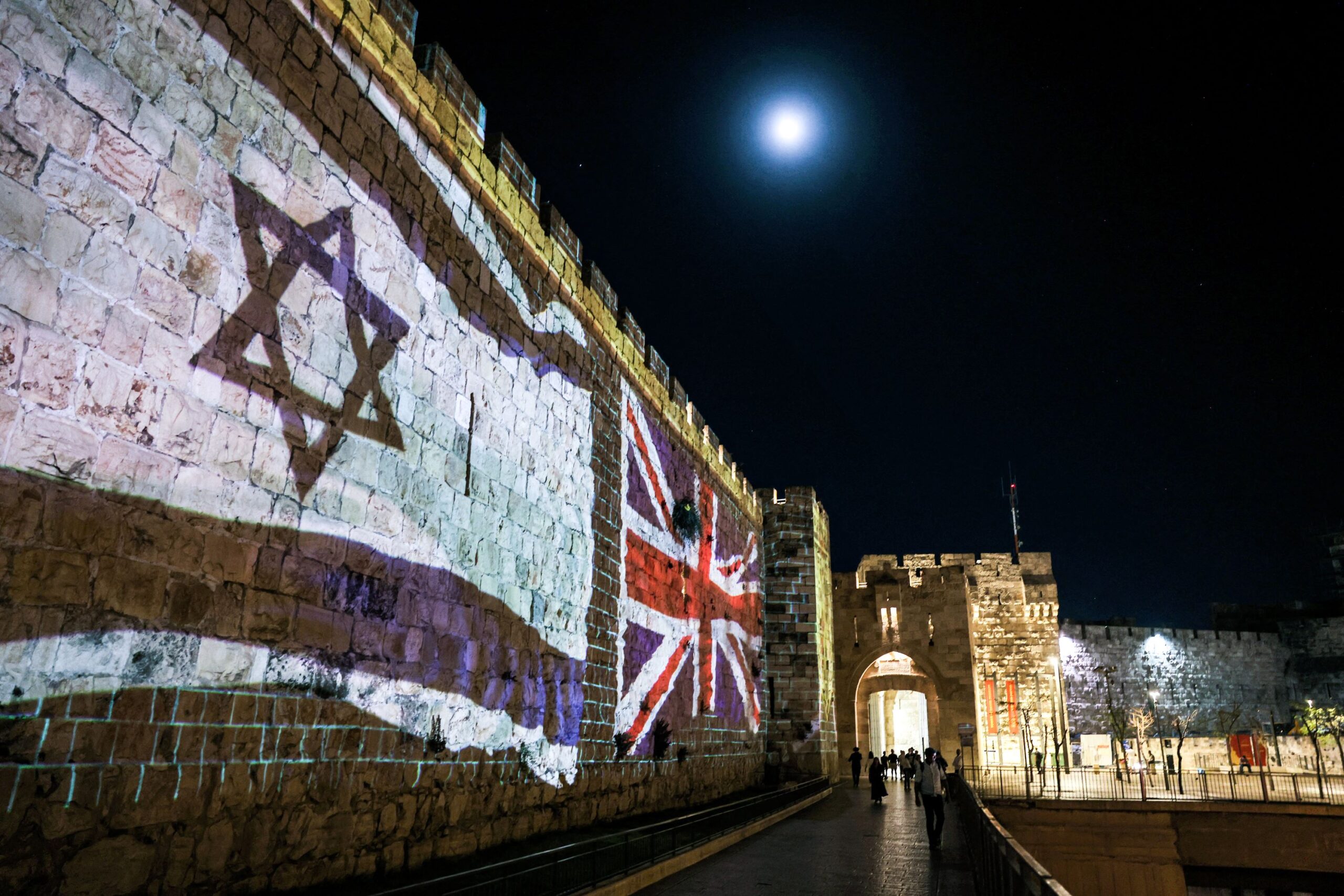
A decades-high number of British citizens moved to Israel in 2025, with 742 Britons completing the migration – the largest annual figure recorded since the 1980s. An investigation by Middle East Eye (MEE) has revealed that UK-registered charities and advocacy groups are actively facilitating this migration through structured programs, including subsidized travel, gap year placements, and direct migration support, many of which operate in violation of international law by accessing illegally occupied Palestinian and Syrian territories.
The most influential of these groups is the United Jewish Israel Appeal (UJIA), a UK charity that reported a £12.8 million ($17 million) annual income in 2024. UJIA’s public mission centers on cultivating a connection between young Jewish people in the UK and Israel through funding for travel and educational programs. The organization traces its roots back more than a century to Keren Hayesod, a global fundraising body established to support the Zionist movement and the state of Israel, which maintains formal institutional ties to the Israeli government. A 2010 cooperation agreement was signed between then-Israeli Prime Minister Benjamin Netanyahu and Keren Hayesod, which remains a registered UK charity in its own right and is still listed as UJIA’s parent affiliate. Neither organization responded to MEE’s requests for comment on the extent of their ongoing collaboration.
While UJIA does not publicly advertise direct migration (called Aliyah under Israeli law, which grants automatic citizenship to any Jewish person who immigrates), it lays early groundwork for permanent relocation through subsidized “birthright” tours and gap year programs. Keren Hayesod, by contrast, has partnered with the Israeli government to facilitate the migration of more than 3 million Jews to Israel since 1920.
MEE’s investigation found that multiple gap year programs promoted on UJIA’s official website include scheduled excursions into territories occupied by Israel since the 1967 Six-Day War, which the International Court of Justice (ICJ) ruled in July 2024 are held under unlawful occupation. For example, Aardvark, an Israeli-run organization, offers the UJIA-advertised Israel Classic Track 5-to-10 month gap year program, which includes weekly trips to sites in the occupied West Bank such as Ein Mabua Natural Spring and the Judean Desert. The group’s Tech Track and Culinary Track programs, also promoted by UJIA, add visits to Hebron, the occupied West Bank Palestinian city where illegal Israeli settlers are stationed under military protection, as well as the West Bank’s Herodian fortress and the occupied Syrian Golan Heights for overnight trips. Another UJIA-endorsed program, run by Israeli educational group Bina, also includes excursions to Hebron and the Golan Heights marketed as travel “throughout Israel.”
Beyond visits to occupied territories, the Aardvark program gives participants the option to join Marva, a voluntary Israeli military simulation course run jointly by the Israel Defense Forces (IDF) and the Jewish Agency for Israel. The program’s marketing frames it as a hands-on opportunity to experience IDF enlistment life, with participants living on an active IDF base for 6 to 8 weeks, wearing official Israeli military uniforms, carrying firearms, and receiving training in combat survival, navigation, self-defense, and field tactics. The IDF describes the program’s goal as giving participants a first-hand understanding of military service for Jewish youth from abroad.
UJIA also provides substantial funding to Bnei Akiva, the world’s largest religious Zionist youth movement, which operates 20 local branches across the UK. UJIA awarded £194,000 ($260,000) in grants to Bnei Akiva in 2023, following a £214,000 ($287,000) grant in 2022. Bnei Akiva’s UK operations are supported by the registered charity Friends of Bnei Akiva (Bachad), which reported a £141,735 ($189,000) income and £390,347 ($522,000) expenditure in 2025, with reserves totaling approximately £1.86 million ($2.5 million). The charity shares a registered address with Bnei Akiva UK’s London office and explicitly states its core activity is providing grants to the youth movement.
Like the other programs MEE investigated, Bnei Akiva’s gap year initiatives operate in illegally occupied West Bank settlements. The movement’s Mechina Olamit pre-army gap year program housed participants in Migdal Oz, an illegal Israeli settlement in the West Bank, listing the settlement as the program’s base on its website until shortly after MEE reached out for comment. While the international website was updated to list Jerusalem as the base, the FAQ section still confirms Mechina Olamit is based in Migdal Oz, where international participants live alongside Israeli peers. Google Maps records additional Bnei Akiva operations in multiple other illegal West Bank settlements, including Giv’at Ze’ev, Ofra, and Sha’arei Tikva. Bnei Akiva also posts images of its youth excursions to other occupied West Bank locations such as Wadi Qelt, framed as exploring “the beauty of Israel.”
While Bnei Akiva claims it does not require Mechina Olamit participants to enlist in the IDF, it confirms it prepares any participants who wish to join the military, offering specialized classes on military service and mandatory physical training three times a week. British program graduates have posted public testimonials describing the program as inspiring pre-enlistment preparation. Bnei Akiva’s UK-based Kadima gap year program also regularly sends participants to the Marva military course, posting public images of participants in IDF uniforms posing with firearms.
The movement’s stated core goal is to encourage permanent migration to Israel, and it has partnered with the Israeli Ministry of Aliyah and Immigrant Absorption to facilitate more than 100,000 migrations since its founding in 1929. MEE was unable to clarify whether UK-raised charitable funds are used to support activities linked to the IDF or illegal settlements, as Bnei Akiva and UJIA declined to respond to questions on the topic. UJIA’s annual report claims its Israeli expenditures are “restricted to projects within its internationally recognised borders,” despite advertising programs that explicitly operate in occupied territories.
Legal experts from the International Centre of Justice for Palestinians (ICJP) note that the activities of these UK-based charities raise serious compliance issues under international law, following the ICJ’s 2024 ruling that Israel’s occupation of Palestinian territories is unlawful and requires all states to avoid aiding or recognizing the illegal occupation. “The UK government cannot simply disregard that legal position; it is the authoritative statement of international law on the issue,” the ICJP told MEE, adding that the UK is legally obligated to prevent organizations operating within its jurisdiction from assisting the illegal occupation. “You cannot promote settlements or take participants there, because settlements themselves are illegal.”
On the Marva military program, the ICJP added that the activities go far beyond cultural or educational exchange: “Carrying guns, wearing uniforms and staying on an army base resembles pre-enlistment military training rather than cultural exchange.”
This investigation was published by Middle East Eye, an independent media outlet covering the Middle East and North Africa region.