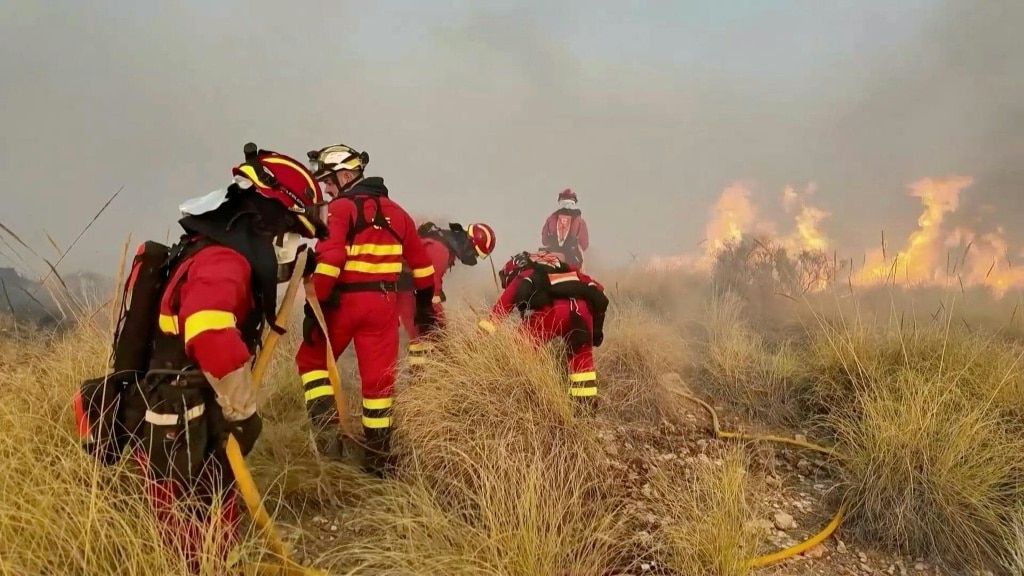
A devastating out-of-control wildfire ripping through rugged, forested terrain in Spain’s southern Andalusia region has left 11 people dead and 19 others unaccounted for, regional authorities confirmed Friday. Among the fatalities, four are suspected to be British nationals, in what is already one of the deadliest wildfire events to hit Spain in recent years.
Most of the victims are believed to be foreign nationals visiting or residing in Bédar, a quiet whitewashed village located just 15 kilometers inland from Spain’s popular Mediterranean coast. A favorite getaway for travelers seeking a more low-key alternative to crowded nearby beach resorts, Bédar also draws a large community of foreign permanent residents. Many victims died while attempting to outrun the rapidly advancing blaze across the region’s steep, uneven landscape, emergency officials confirmed.
Juan Manuel Moreno Bonilla, president of the Andalusia regional government, told Spanish broadcasters that four of the deceased were found inside a right-hand drive vehicle, burned to death as the fire overtook their escape route. Local mayor Angel Francisco Collado shared that while emergency teams urged all at-risk residents to evacuate immediately — even those reluctant to leave their homes — seven people lost their lives trying to flee on foot, and two more were transported to local hospitals for treatment.
Antonio Sanz, Andalusia’s emergency management minister, released an official update via the social platform X confirming the rising death toll and the scope of the disaster. “At the moment, we have confirmed that 11 people have lost their lives in the Los Gallardos fire; there are no words for such grief,” he said. “Everything indicates that the deceased are, mostly or entirely, foreign nationals,”,”.”
Emergency responders have described the fire as uniquely challenging to contain. The blaze is burning across a landscape crisscrossed by deep ravines, which prevents the use of heavy firefighting equipment to clear fire breaks, and many residential properties are scattered across isolated forested plots. Approximately 500 firefighters and military troops have been deployed to battle the inferno, with Spain’s Military Emergency Unit (UME) called in to support ground and air operations.
Strong overnight winds fanned the fire’s rapid spread across more than 3,150 hectares of forest and agricultural land, though winds had calmed by Friday morning. Forecasters warn that wind speeds are expected to pick up and shift direction later in the day, potentially creating new challenges for containment crews. Eight people have been injured in the fire, four of them seriously, and roughly 800 local residents and visitors have been evacuated. Around 200 of those displaced are being housed in emergency shelters, with 150 more accommodated at a local cultural center. Emergency services received more than 150 distress calls in the first hours of the blaze, and flames were visible from a major highway running near Bédar, prompting immediate road closures.
Witnesses have told investigators the fire likely started when a falling power line ignited dry scrub vegetation, though regional authorities have not yet officially confirmed the cause. The outbreak coincided with an extreme heatwave baking both Spain and Southern France, with forecasted temperatures hitting 40 degrees Celsius across wide swathes of both countries on Friday. Southern Spain has been under an orange heat warning — the country’s second-highest alert level — for several days amid the sustained extreme heat.
Spanish Prime Minister Pedro Sánchez posted his reaction to the disaster on X, writing that he was “deeply saddened and devastated by the terrible consequences of the wildfire.” Sánchez previously announced in May that Spain would deploy its largest ever summer wildfire response for 2024, in a bid to prepare for what climate scientists warn will be an increasingly severe fire season.
Climate scientists have repeatedly warned that human-caused fossil fuel emissions are driving global warming that makes extreme weather events like heatwaves more frequent and more intense. In recent years, Spain has seen a sharp rise in the length and severity of seasonal heatwaves, with regular temperatures exceeding 40C creating tinder-dry conditions that are ideal for large wildfire outbreaks. Last year alone, deadly wildfires burned almost 400,000 hectares of land across Spain — the highest annual total recorded by the European Forest Fire Information System in the country’s history.