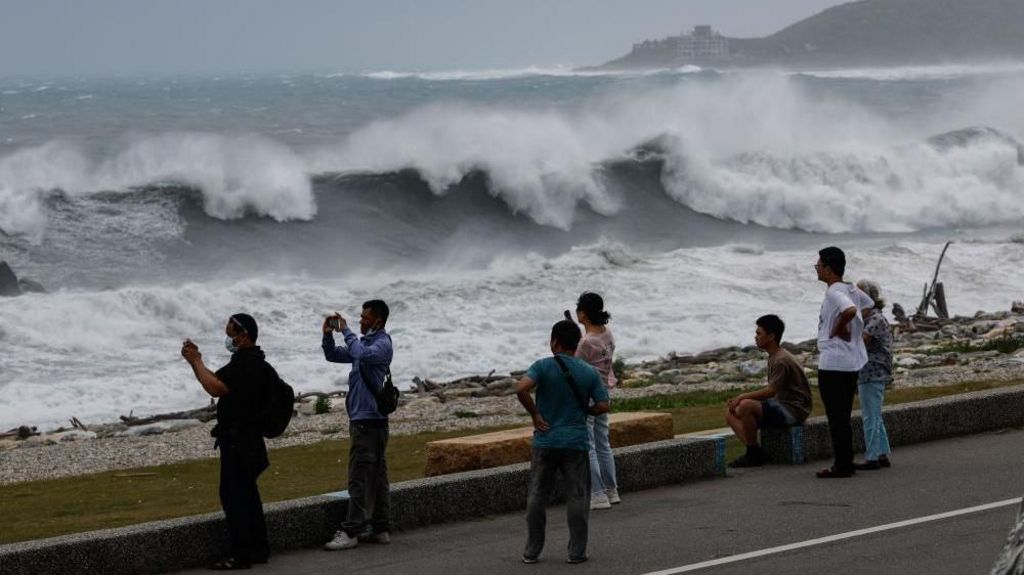
One of the most powerful tropical cyclones to form in the western Pacific in decades has already left a trail of fatal devastation in the southern Philippines, and is now barreling toward multiple East Asian regions, prompting widespread emergency preparations. With a maximum diameter of 1,000 kilometers – nearly equal to the entire width of mainland France – Typhoon Bavi is currently tracking across open Pacific waters, with its projected path taking it directly toward Taiwan before a forecasted landfall in southeastern China this weekend.
The storm’s first major impact hit the southern Philippines earlier this week, where intense rainfall from Bavi’s outer bands triggered catastrophic landslides on the island of Mindanao. The overnight mudslides buried residential areas, killing at least 15 people and leaving an unknown number of residents still unaccounted for, as rescue teams work around the clock to reach trapped and missing survivors. Philippine weather officials have cautioned that moderate to heavy downpours will continue to pelt multiple regions of the country through the end of the weekend, raising the risk of additional flood and landslide events.
As Bavi advances, authorities across East Asia have activated full emergency response protocols to mitigate potential damage. For Taiwan, the typhoon is on track to become the largest storm to hit the island since 1987, according to the Central Weather Administration, with forecasts predicting up to one full meter of rainfall in northern and eastern coastal areas. The island’s defense ministry has placed 29,000 military personnel on standby to support emergency relief and rescue operations, while local governments have distributed thousands of sandbags to vulnerable, flood-prone neighborhoods. Earlier Friday, farmers hurried to harvest mature crops and secure their fields ahead of the storm’s arrival, while fishermen across the island’s harbors reinforced moorings for their vessels. “Don’t be fooled by the nice and calm weather now. A storm like this could be the most terrifying,” 60-year-old fisherman Chen Ming-hui told reporters, echoing official warnings for residents to take the threat seriously.
Commercial air travel across the region has already been severely disrupted, with dozens of flights to and from Taiwan canceled, and major Japanese carriers scrapping more than 260 flights through Sunday across the country. The remote Sakishima Islands, which lie directly in Bavi’s projected path, have been placed on high alert, with local residents seen reinforcing home and shop windows with tape and protective wind netting. Japan Airlines has canceled over 100 flights for Friday and Saturday, disrupting travel plans for nearly 20,000 passengers, while All Nippon Airways has axed more than 160 flights through Sunday, affecting a similar number of travelers. Both Thai Airways and Malaysia Airlines have also suspended all flights to and from Taipei ahead of the storm. Schools across at-risk areas of Taiwan and Japan have already suspended classes, and grocery store shelves have been cleared out as local residents stock up on emergency water, food and supplies.
Across the Taiwan Strait, Chinese authorities are bracing for what they warn could be a “significant impact” from Bavi, which is forecast to make landfall in Fujian Province before moving northward. Experts warn that the storm’s unusually large size and high residual energy means its rain bands will reach far inland, reaching as far north as the Bohai Sea region after passing through eastern Jiangsu and Anhui provinces. Ma Jun, director of China’s Institute of Public and Environmental Affairs, noted that northern provinces, which have far less experience dealing with full-scale typhoons than their southern counterparts, must prioritize stepped-up preparedness measures. Some forecasting models even predict Bavi could make two separate landfalls across southern China.
The approaching storm comes as parts of southern China are still recovering from the deadly devastation of Typhoon Maysak, which hit the region earlier this week. Maysak has already killed at least 39 people, with rescue crews still searching rubble for missing residents, and forced the evacuation of more than 130,000 people, most in Guangxi Zhuang Autonomous Region. The earlier storm wiped out large numbers of livestock, caused hundreds of millions of dollars in agricultural damage, and even sparked two rare tornadoes in central China’s Hubei Province, compounding the challenge for disaster response teams now preparing for Bavi. Climate scientists have noted that increasing ocean temperatures driven by climate change are leading to more intense and larger tropical cyclones across the western Pacific, raising the risk of extreme storm events in the region.