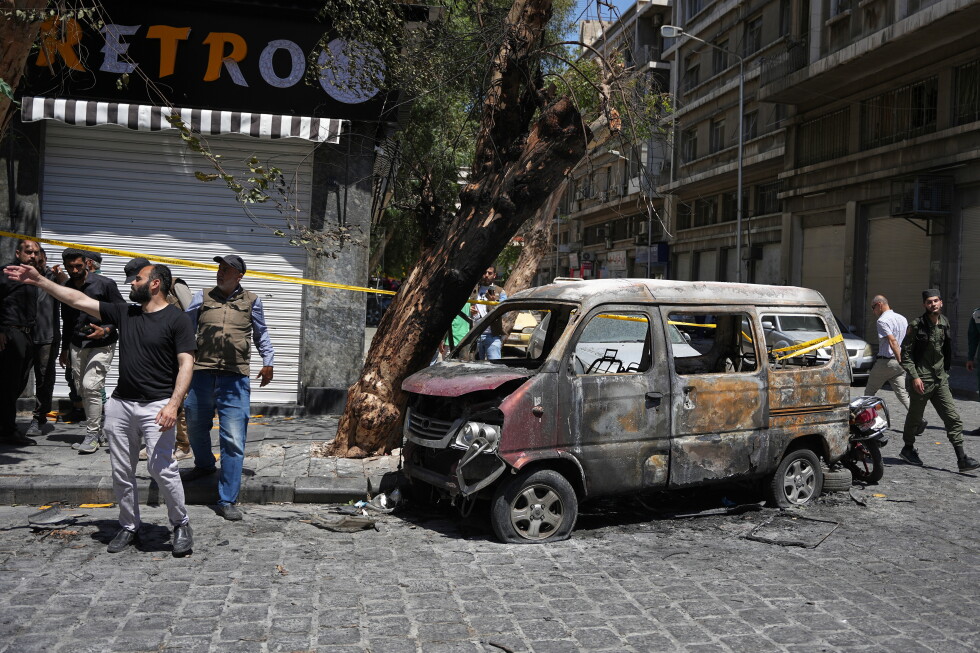
DAMASCUS, Syria – In a major security breakthrough announced Thursday, Syrian law enforcement officials have confirmed the arrest of multiple suspects tied to a series of deadly recent bombings across the capital, including two blasts that struck during French President Emmanuel Macron’s high-stakes visit earlier this week. An unnamed senior official with Syria’s Internal Security Forces has attributed the coordinated attacks to the Islamic State extremist group, though the organization has not yet issued any formal claim of responsibility for the assaults.
According to an official statement released by the Syrian Interior Ministry, security operatives launched targeted raids across Damascus and its outlying suburban regions, resulting in the complete dismantling of the extremist cell responsible for all the recent bombings. Brigadier General Ahmad al-Dalati, commander of Internal Security Forces for rural Damascus province, later told Syrian state television that all detained suspects are confirmed affiliates of the IS network. Investigators first identified one key cell member by reviewing closed-circuit security footage from the attack sites, al-Dalati explained, then tracked that suspect to uncover the identities and locations of the rest of the cell’s members.
The bombings that drew global headlines unfolded on Tuesday, during Macron’s landmark trip to Syria – the first visit by a French head of state to the war-torn country since the conclusion of nearly 14 years of civil conflict. Two explosive devices were hidden in a public garbage bin and an unoccupied parked car; the blasts occurred while Macron was holding closed-door talks at the presidential palace with Syrian President Ahmad al-Sharaa. Neither the French leader nor al-Sharaa was injured in the attack, and Macron proceeded with his scheduled diplomatic agenda after the incident.
Syria’s Ministry of Health released a final casualty count for the Macron visit bombings this week, confirming one civilian death and 36 additional people wounded, some critically. The string of attacks did not begin with this week’s bombings, however: just one week prior, another explosive device detonated inside a popular cafe located near Damascus’ central judicial complex, killing at least 10 people and leaving more than 20 others injured.
The coordinated bombings represent a significant early security challenge for al-Sharaa, who has moved rapidly to consolidate full state control across Syria since ousting former long-ruling autocrat Bashar al-Assad in a December 2024 insurgent offensive led by his Hayat Tahrir al-Sham faction. Al-Shaara has worked in recent months to court skeptical ethnic and religious minorities, who have expressed concerns over his government’s Islamist-led leadership, while also seeking to normalize relations and win backing from Western governments wary of HTS’s historical ties to al-Qaida. His transitional administration has also pledged sweeping political and economic reforms to reverse decades of repressive, centralized rule under the Assad family.
Syria’s 14-year civil conflict left a devastating humanitarian and infrastructural crisis in its wake: the war killed an estimated half a million people, displaced millions more both internally and across neighboring borders, and reduced large swathes of the country’s cities and critical infrastructure to rubble. While a number of foreign nations and private investors have already pledged large financial commitments to Syria’s reconstruction, government estimates indicate the country requires hundreds of billions of dollars in total to rebuild and lift millions of vulnerable Syrians out of extreme poverty.