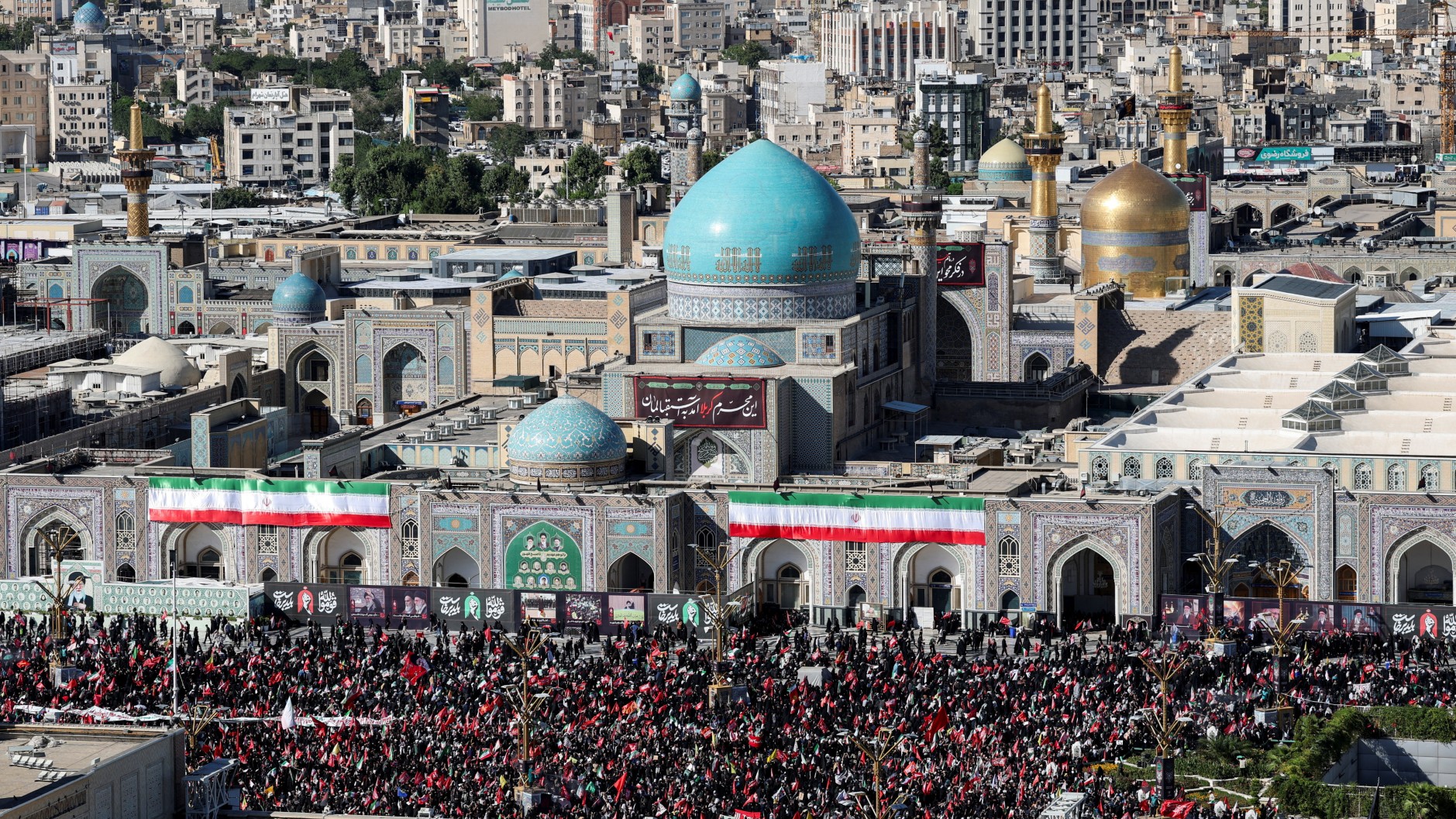
Nearly five months after Iran’s former Supreme Leader Ayatollah Ali Khamenei was killed in a US-Israeli joint military airstrike, the final chapter of his national funeral process moved to his hometown of Mashhad this week, carrying with it rising regional tensions and unprecedented displays of public grief. After a week of cross-country and cross-border mourning ceremonies, Khamenei’s remains—along with the bodies of four of his family members killed alongside him in the February 28 assassination—were transported to Mashhad’s Shahid Hasheminejad Airport early Thursday. The special flight carrying the caskets was escorted by Iranian military fighter jets, a formal honor for the country’s decades-long top leader.
Originally scheduled to take place at 6 a.m. local time, the burial service was pushed back eight hours to 2 p.m. local time, a last-minute change announced by official Iranian media just hours after the United States and Iran resumed exchange of air strikes following a brief temporary ceasefire. US airstrikes targeting railway infrastructure have damaged key bridges connecting the capital Tehran to Mashhad, disrupting overland travel between the two cities. However, senior Iranian officials have flatly rejected any connection between the delay and the renewed military attacks, instead attributing the postponement to an overwhelming influx of mourners that has strained the city’s security and logistics capacity.
Mashhad, a city of deep religious importance to Shia Islam globally, draws millions of pilgrims annually to the shrine of Imam Reza, one of the faith’s most venerated figures. Khamenei, a native of the city, left explicit instructions before his death to be interred on the grounds of the holy shrine, according to Mohammad Mohammadi Golpayegani, head of the late supreme leader’s office. Tens of thousands of mourners have flooded into the city from across Iran and neighboring Iraq in the days leading up to the burial, filling public squares and thoroughfares surrounding the shrine. Many of the gathered mourners carried signs and chanted virulent anti-US and anti-Trump slogans, with placards reading “Kill Trump” and crowds calling out “Death to America” and threats against the former US president for his administration’s role in the assassination strike.
Before Khamenei’s remains reached Iran’s northeastern holy city, they were taken to two of Shia Islam’s most sacred sites in Iraq: Najaf and Karbala, for multi-day mourning processions. Iraq’s prominent state-aligned paramilitary group Hashd al-Shaabi confirmed that more than 2.3 million people joined the procession held in Najaf alone, marking one of the largest public gatherings the country has seen in recent years. Iran’s sitting President Masoud Pezeshkian and senior commanders from the Islamic Revolutionary Guard Corps (IRGC) traveled to Iraq to take part in the memorial events.
Notably absent from all public mourning events has been Mojtaba Khamenei, Ali Khamenei’s son and the newly sworn-in Supreme Leader of Iran. A recent report from The New York Times revealed that Mojtaba’s request to attend his father’s funeral processions was denied by Iranian security officials over persistent fears that he could also be targeted for assassination. Since assuming the country’s highest office just days after his father’s killing, the new supreme leader has not made any public appearances and remains completely out of public view.
The funeral and burial come at a moment of extreme volatility across the Middle East, with the resumption of hostilities between Washington and Tehran raising fears of a broader regional conflict that could draw in neighboring powers and global stakeholders.