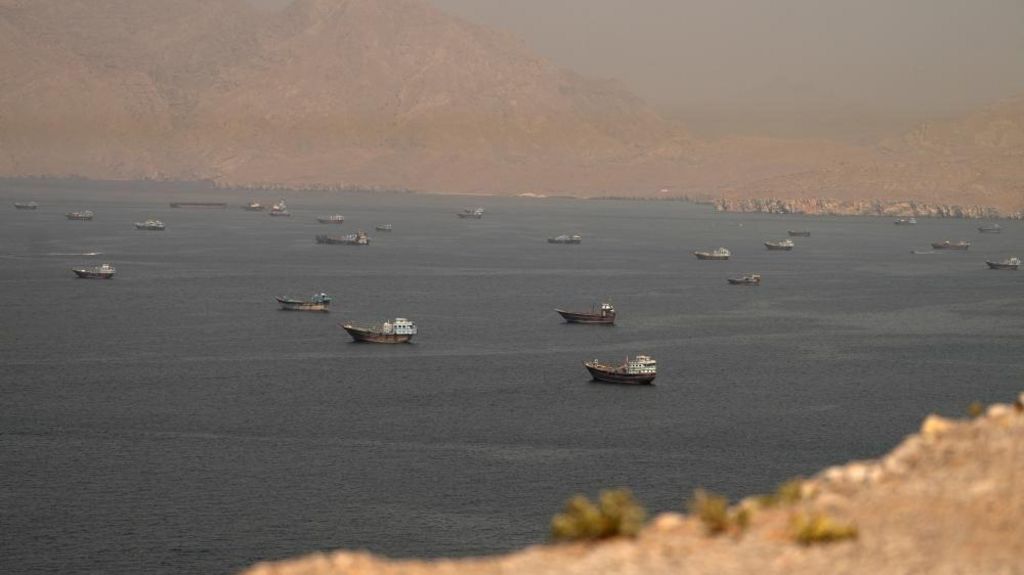
Tensions have escalated sharply across the Middle East this week after the United States launched what it calls ‘powerful retaliatory strikes’ against Iran, a direct response to a string of attacks on three commercial tankers transiting the strategically critical Strait of Hormuz. U.S. Central Command (Centcom) confirmed the operation began Tuesday, framing the action as a necessary measure to hold accountable those responsible for endangering civilian crews navigating an international waterway.
According to updates from UK Maritime Trade Operations (UKMTO), the three tanker incidents unfolded within a 24-hour window between Monday and Tuesday. The first attack saw an unknown projectile strike a vessel’s engine room, sparking a fire. Two more incidents followed on Tuesday: one tanker suffered a direct hit but remained able to sail to its scheduled next port, while a second sustained only minor structural damage. No fatalities or injuries have been reported across all three events.
Iran has not issued any formal claim of responsibility for the vessel attacks. Even before Centcom’s official announcement of the U.S. strikes, a senior anonymous U.S. official condemned the attacks as ‘wholly unacceptable’ and warned Tehran would face tangible consequences. Alongside military action, the U.S. Treasury Department moved Tuesday to revoke a critical sanctions waiver that had temporarily lifted restrictions on Iranian oil and petroleum product sales.
That waiver was a core component of a 14-point memorandum of understanding signed by Washington and Tehran just one month ago, which extended a bilateral ceasefire across all fronts. Under the terms of that agreement, Iran committed to never pursuing a nuclear weapon, and established a $300 billion fund for national reconstruction and economic development, with no mandatory contribution from the U.S. The Treasury’s notice published Tuesday confirms a wind-down period for existing approved transactions, with the waiver fully expiring on July 17.
Both Qatar and Saudi Arabia have joined the U.S. in condemning the attacks, confirming that one tanker from each nation was targeted in the strikes. Qatari foreign ministry spokesperson Majed Al Ansari wrote in a post on X that Qatar holds Iran ‘fully responsible’ for the targeted attack on the Al-Rekayyat, which was transiting near the Strait. Qatar has called on Iran to immediately halt all activities that undermine regional stability, accusing Tehran of endangering global energy supplies and shared regional resources for narrow geopolitical gains.
For its part, Saudi Arabia’s foreign ministry confirmed in its own social media statement that the Saudi-flagged tanker Wadyan was targeted while crossing the Strait. The kingdom described the attacks as a direct threat to the safety of international navigation and the security of global energy markets.
To date, Iranian foreign ministry spokesman Esmail Baghaei has only responded publicly to Qatar’s accusations, dismissing them as a violation of good neighborly principles. In a statement posted to Telegram, Baghaei argued that commercial vessels that fail to coordinate their routes with Iranian authorities or tamper with their tracking systems face inherent collision risks, and said such actions disrupt Iran’s own efforts to facilitate safe transit through the Strait.
Despite the escalation of military action and the revocation of the oil sanctions waiver, the pre-announcement U.S. official stressed that American negotiators remain committed to working in good faith to reach a final long-term agreement with Iran. Centcom’s official statement, however, left no room for ambiguity over Washington’s position on recent actions, calling Iran’s demonstrated aggression ‘unwarranted, dangerous, and a clear violation of the ceasefire’ that both sides had agreed to uphold.