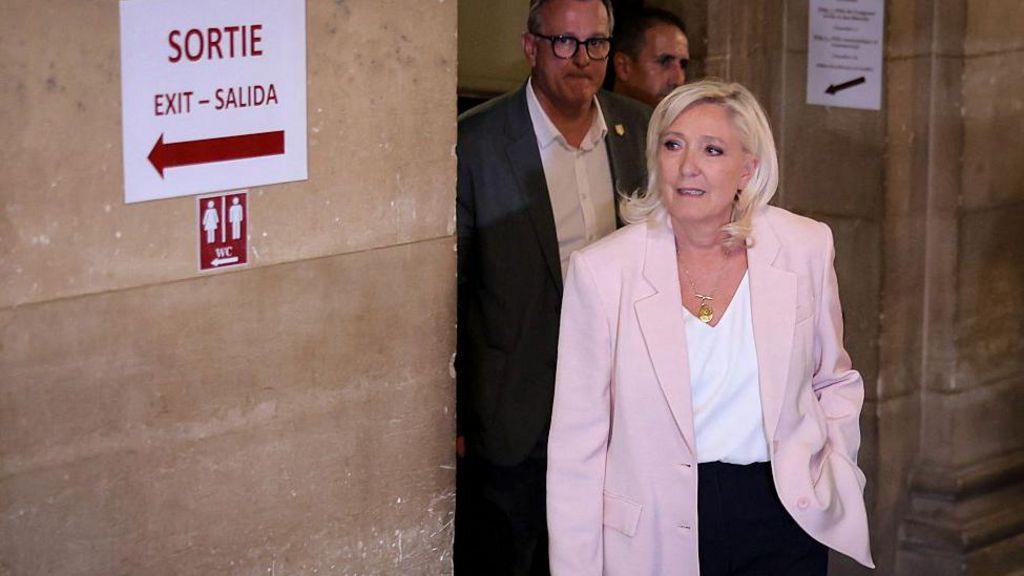
France’s most prominent hard-right political figure, Marine Le Pen, has made two sweeping announcements that have reshaped the country’s 2027 electoral landscape: she will stand as the National Rally’s candidate for president in next year’s election, and she will escalate her legal fight against a recent embezzlement conviction by bringing the case to France’s highest civil court.
Le Pen, who has led the nationalist National Rally party since 2011, made the declaration during a combative primetime interview on French national television, pushing back against the penalty handed down by a Paris appeals court earlier this week. The court found Le Pen guilty of misappropriating €2.8 million (£2.4 million) in European Union parliamentary funds through a years-long fake assistant scheme, a ruling that upholds an earlier 2024 conviction and requires the far-right leader to wear an electronic monitoring tag for 12 months. While the court confirmed Le Pen retains her eligibility to run for office even with the tag in place, Le Pen argues the monitoring device makes effective campaigning impossible.
“I can’t campaign with a tag,” Le Pen told the outlet. “I want to pursue all legal avenues to defend my innocence in this case.”
Hours after the guilty verdict was handed down, Le Pen held closed-door strategy talks with her hand-picked party successor, 30-year-old National Rally President Jordan Bardella, senior party aides, and her legal team before making her long-awaited announcement. The decision ends months of widespread political speculation that Le Pen would step aside to let Bardella lead the party’s 2027 ticket, a move that would have allowed her to avoid the political damage of campaigning while facing a criminal conviction.
When asked directly if any scenario existed where she would abandon her candidacy, Le Pen gave a definitive answer: “No, there isn’t. I am here tonight to tell you I am candidate for the 2027 elections.” She added that her campaign would launch immediately, with the stated goal of “beginning the rebirth of France,” and that she would not reverse her decision under any circumstances.
The guilty conviction stems from a scheme that prosecutors say operated between 2004 and 2016, when Le Pen and several other party officials diverted EU funds earmarked for European Parliament parliamentary assistants to instead pay salaries for full-time National Rally party staff. While Le Pen has repeatedly denied orchestrating the scam, she acknowledged earlier this year that the arrangement constituted “a mistake.” This week’s appeals court ruling fully upheld the initial guilty verdict from 2024.
Public prosecutors have also announced they plan to appeal the verdict, though it is not yet clear what changes they are seeking to the ruling.
Le Pen struck a unifying tone regarding her relationship with Bardella, who had long been viewed as the likely front-runner for the party’s nomination if Le Pen stepped aside. She noted that the pair have worked alongside each other for years, framing their shared political project as larger than either individual’s personal ambition. “We both have beliefs – we both imagine this role seriously. And we have character… The tests we have gone through have made us stronger, both in will and in the quality of our work together,” she said.
If Le Pen wins the 2027 presidency, she confirmed the pair will continue their partnership: she will serve as head of state, while Bardella will take the role of prime minister. “We have a solid partnership, we complement each other,” she added.
In the lead-up to this week’s court ruling, Le Pen repeatedly stated she would not run for the presidency if she was forced to wear an electronic tag, arguing that the monitoring would prevent her from campaigning with the full freedom required for a national campaign. When asked how she would proceed if her upcoming appeal to the Court of Cassation fails to overturn the tagging requirement, Le Pen said she would leave the final judgment up to French voters. “We will see, and the French will be the judge, because the good news from this evening is they will be free to choose,” she said.
The Court of Cassation is expected to take several months to issue a ruling on the appeal. If the court upholds the conviction, Le Pen will be required to wear the electronic tag during the most high-profile phase of the 2027 campaign, which kicks off in earnest early next year. Political analysts warn the scenario would create both significant embarrassment and a practical handicap for her candidacy, just weeks before the first round of voting scheduled for April 18, 2027. The run-off vote is scheduled for May 2.